


Some people call March mud season. But there are those who consider this time of year the sweet season.
With nighttime and daytime temperatures alternating from below freezing up to the upper 30s or low 50s, the sap has begun to flow from the maples in the sugar bush. If “Make hay while the sun shines” is a byword for farmers during the summer, then “Make syrup while the sap flows” is an apt proverb for maple syrup producers during New Hampshire’s maple sugaring season.
For those who believe nothing beats the taste of real maple syrup — be it poured on top of pancakes, waffles, or french toast, or used as a flavoring in cooking — this is a season to celebrate. And the state’s 350-plus maple syrup producers are celebrating, too, by holding open houses on weekends this month, when members of the public can see firsthand just how maple syrup is made. And, by the way, visitors can also sample some sweet treats.
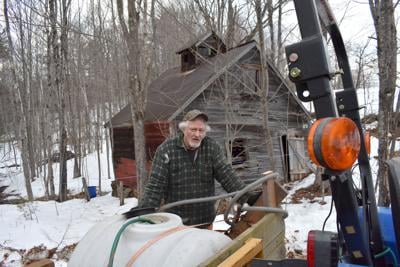
Mel Torsey, who operates Torsey’s Hillcrest Maple Farm on Upper Oxbow Road in New Hampton, comes from a long line of maple syrup producers. You could say he has the maple syrup gene. His great-grandfather, Winthrop Gilman Torsey, began the family tradition back in 1882.
As a youngster, Mel Torsey, remembers sitting in the sap house during the boiling operation and listening as his elders sat around the wood-fired boiler telling stories. As an adult, Torsey said, he has often worked well into the night, waiting for the sap to boil down to the right thickness to where it becomes syrup. As he bided his time, he sometimes would go outside the sap house and look up and stare at the stars.
Now, 52 years after he started making maple syrup on his own, Torsey produces about 50 gallons a year. Most of it he sells at the New Hampton farmers market during the summer. But some of it he sells at his sugarhouse, along with a book of poetry he has written, titled “Little Nuggets of Gold from the Heart.”
“It’s in my blood,” Torsey says of being a maple producer. “It’s a lot of work, but it’s a fun experience.”
Compared to Torsey, Roger and Barbara Proulx of Tilton are relative newcomers to the maple sugaring business.
“It started out as a 4-H project 27 years ago,” said Barbara Proulx.
Today, Just Maple Green Acres Farm on School Street, in Tilton, produces between 125 and 150 gallons of syrup. They also make maple candy.
The Proulxes have between 400 and 500 taps. About 40 percent of those are on trees on other properties, including the Tilton School. Those landowners get paid in maple syrup, Proulx explained.
While maple sugaring has been taking place since time immemorial, the method of production has changed with the times.
This year the Proulxes bagan putting the sap through a reverse osmosis process before boiling the liquid. Maple sap is typically 2 percent sugar. But reverse osmosis makes the sap between 6 to 7 percent sugar, so that once it is put to the boil it takes less time — and hence less fuel — for it to become syrup.
Some large producers use propane to boil the sap, but both Torsey and Proulx say that, because their operations are smaller, it is still more economical for them to burn wood.
Torsey said his son-in-law told him how he could improve his operation by adopting some of the newer technology, but he’s not about to change anything, he said. He even continues to collect some of his sap the old-fashion way – by hanging buckets on trees, although many of his taps are connected to plastic tubing which carries the sap to large tanks which can hold hundreds of gallons of sap.
“I’m too old to get too fancy,” said Torsey, who is 77. “Think of the money,” he added, referring to the cost of upgrading. “And besides, it takes all the fun out of it.”
Because it is the thaw-freeze cycle that causes the sap to flow in the maple trees, producers are at the mercy of the weather.
“It’s anyone’s guess,” Sue Folsom, treasurer of the New Hampshire Maple Producers Association, said when asked what the outlook was for this year’s maple crop.
While it is the warming temperatures that spurs the sap to flow, some spring weather actually limits the sap flow, and hence the production of syrup.
“Rain can warm the trees up too much to where the sap has less sugar,” Folsom explained.
Torsey said what he ideally likes to see is nighttime temperatures between 26 and 28 degrees, and daytime temperatures in the mid-40s.
This year Torsey has 420 taps. Each tree typically has one or two taps, depending on the size of the tree.
Folsom said the open houses that mark March as Maple Sugar Month are a great way to bring people out to watch how maple syrup is produced.
“It’s interesting the misconceptions people have,” Folsom said. “They don’t understand what sap looks like. It looks like water. They think it should be darker and thicker,”
Proulx said she has even met people who thought that maple syrup comes right out of the tree.
“I tell them that if that was the case everybody would be doing it (making maple syrup),” she said with a chuckle.
Folsom also said most people do not realize just how large is the area of the country where maple syrup is produced.
“It’s as far west as Minnesota and as far south as West Virginia,” she said.
Open houses at sugar houses begin this weekend. Torsey will hold an open house at his place every weekend this month. The Proulxes will have the full-fledged open house on the weekend of March 21-22, although the public is welcome to stop by the other weekends as well.


(0) comments
Welcome to the discussion.
Log In
Keep it Clean. Please avoid obscene, vulgar, lewd, racist or sexually-oriented language.
PLEASE TURN OFF YOUR CAPS LOCK.
Don't Threaten. Threats of harming another person will not be tolerated.
Be Truthful. Don't knowingly lie about anyone or anything.
Be Nice. No racism, sexism or any sort of -ism that is degrading to another person.
Be Proactive. Use the 'Report' link on each comment to let us know of abusive posts.
Share with Us. We'd love to hear eyewitness accounts, the history behind an article.