


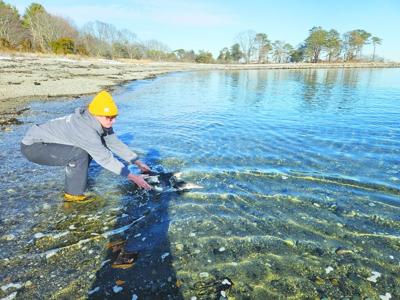
MOULTONBOROUGH — As temperatures cooled in early December, many of New Hampshire’s smaller lakes froze over, some with common loons still lingering on the water. The Loon Preservation Committee responded to multiple reports of loons at risk of becoming trapped on frozen lakes, ultimately rescuing two.
“We received calls from several lakes where loons were in danger of becoming iced-in,” said Harry Vogel, senior biologist and executive director of LPC. “Fortunately, most of the loons reported to us were able to make it off of the lakes on their own, at the last minute. But intervention was needed in two cases.”
The rescued loons included a juvenile from Big Diamond Pond in Stewartstown and an adult from Deering Reservoir in Deering.
Loons are heavy-bodied birds that need to run across a long stretch of open water, up to a quarter of a mile on a calm day, to build up enough speed to generate lift and take flight. If loons remain on lakes as they start to freeze, they can become confined to small patches of open water. Without enough runway space to take off, iced-in loons will eventually be forced up on top of the ice, where they are vulnerable to starvation, the elements, and predators such as bald eagles.
Most loons migrate to their ocean wintering grounds during the fall, well before ice forms. But each year, at least a few linger into the winter. LPC has rescued over 70 loons from the ice since 2005. In some cases, underlying issues such as lead poisoning, injury, or sickness explain why a loon failed to migrate on time. However, many rescued birds show no obvious physical impairment.
Biologists are not yet certain why otherwise healthy loons sometimes stay long enough to risk becoming iced-in. Climate change may play a role, Vogel notes, as LPC tends to see an uptick in the number of ice rescues in years with warmer fall and early winter temperatures. If a warm fall causes loons to remain on lakes longer than they normally would and is then followed by a quick cold snap that rapidly freezes lakes, or if ice in is delayed and coincides with the molt of adult loons’ flight feathers, loons can become trapped. Vogel said each winter rescue allows LPC to learn more about why loons get iced-in.
Both loons rescued in December were evaluated by veterinarians. The juvenile rescued on Big Diamond Pond had no signs of physical impairment. The adult from Deering Reservoir had damage to several feathers on her left wing, preventing her from being able to fly. After veterinary evaluation, both loons were deemed fit for release and were banded and released on the New Hampshire coast.
“Loons winter all along the Atlantic Coast, so these loons have been brought directly to appropriate winter habitat,” said Vogel. He noted the Deering loon’s missing flight feathers are not a concern on the ocean, where she will have no need to fly.
“The Deering loon will molt and regrow all of her flight feathers in January or February, so come spring, she should be in good shape to migrate back to her breeding lake,” Vogel said.
Although the early December cold snap froze most of New Hampshire’s smaller lakes, larger lakes remain open and are likely to freeze over in the coming weeks. LPC asks members of the public who spend time on or around lakes that are still open to keep an eye out for loons in danger of icing in. Anyone who sees a loon confined to a small patch of open water is asked to contact the Loon Preservation Committee at 603-476-5666.


(0) comments
Welcome to the discussion.
Log In
Keep it Clean. Please avoid obscene, vulgar, lewd, racist or sexually-oriented language.
PLEASE TURN OFF YOUR CAPS LOCK.
Don't Threaten. Threats of harming another person will not be tolerated.
Be Truthful. Don't knowingly lie about anyone or anything.
Be Nice. No racism, sexism or any sort of -ism that is degrading to another person.
Be Proactive. Use the 'Report' link on each comment to let us know of abusive posts.
Share with Us. We'd love to hear eyewitness accounts, the history behind an article.