


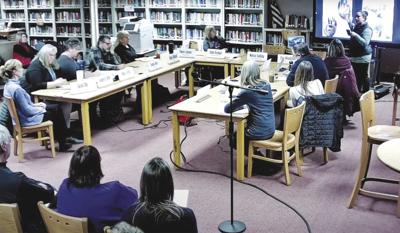
BRISTOL — In establishing a curriculum committee whose initial focus will be on the Amplify Core Knowledge Language Arts program, the Newfound Area School Board has appointed parents with conflicting views of the elementary school reading curriculum, which has been the focus of public discussion since its implementation at the beginning of this school year.
After appointing Dominic Halle of Bridgewater, Heidi Milbrand of Bristol and Thomas Edwards of Hebron to serve as the board’s committee members, School Board Chair Melissa Suckling of Danbury named Katlin Simula and Ariel Maloney as community members. High school Principal Paul Hoiriis, middle school Principal Chris Ulrich, and Bristol Elementary School Principal Linda Green also will serve on the committee.
Simula has led the opposition to the CKLA program, establishing a private Facebook group for parents sharing her concerns about the curriculum. She gave a presentation at the start of the school board’s Dec. 12 meeting to highlight what she interpreted as “grooming” of students for sexual abuse and exposing them to content that is inappropriate for students in kindergarten through fifth grade.
Maloney, who is a teacher as well as a parent, has defended the program for exposing students to new ideas and classical literature, and she maintains that the content is appropriate for students of that age.
“Although I do believe that parents have a right to make decisions about the way our children are raised, such as deciding what movies or books we watch or read at home,” Maloney wrote in an email to the school board, “I also believe that the purpose of public school is to raise literate, empathetic, curious citizens who are capable of critical thinking. From what I have seen in my child's take-home work, and in the materials, samples, and evidence-based statistics provided online, Amplify CKLA accomplishes that purpose.”
With parents arguing both sides of the matter during the public comment periods this fall, the school board asked Superintendent Pierre Couture to develop a proposal for a curriculum committee that could review the curricula used in the schools. Couture presented his proposal for the eight-member committee at the board’s Dec. 12 meeting.
In describing how the process will work, Couture wrote, “The District has a curriculum review and adoption cycle, which the Curriculum Administrator manages; when it is time to begin a new curriculum adoption, our teachers and administrator’s advisory committee will research and review programs.
“The Curriculum Administrator will inform the curriculum committee of the advisory committee’s progress and share information and research with them. A member of the school board may join the advisory committee. When the group completes their work, they will make a recommendation to the curriculum committee. The curriculum committee will review all relevant curriculum materials and research relating to the curriculum. When the curriculum committee completes its review, it will make a recommendation to the school board. The school board will make the final decision.”
Identifying the problem
In her presentation to the school board, Simula showed examples of the stories and illustrations she found objectionable.
In the CKLA version of the Grimm fairy tale “The Frog Prince,” after the princess climbs into bed, Simula read, “She wished the frog would go away, but he sat on the floor looking up at her. ‘I want to sleep on your pillow,’ the frog said.
“The princess shook her head. ‘No, please, you can sleep anywhere you want, just not on my bed. Please. You are just too disgusting and you will leave slime on my pillow.’
“‘I want the pillow,’ the frog insisted. ‘You promised you would share everything with me.’
“The princess pleaded and cried but nothing could change the frog’s mind. ‘You promised,’ he said, ‘and promises are more than air.’ Finally, she had to give in.”
Simula said, “So this is kind of like ‘No doesn’t mean no.’ ... The lens I’m looking at is that of a child who is being sexually assaulted or molested. ... ‘Oh, this is OK. I promise this is supposed to happen.’”
A science lesson in second grade contains an illustration of a uterus. “I mean, second grade: I think of head, shoulders, knees and toes,” Simula said, “and then this picture. You see the uterus, but then there’s a picture inside a picture.”
Someone viewing the slide muttered, “Oh, my God!”
Simula continued with other examples: “He was touching and searching the elephant with his hands” and “it’s talking about ‘I took care of my mistress’s baby.'”
“In this case, from the context, I think mistress is meaning the slave owner, the person in charge,” Simula said, “but I mean, ‘mistress,’ if you look it up, the definition of mistress is a woman having an extramarital affair or a sexual relationship, especially when married. Again: age appropriate.”
The final example she offered was “Swamp Angel,” in which “The first hunter was found wearing an empty molasses bucket, a silly grin on his face. ‘Seems you tried the sweet approach and got licked in more ways than one.’” Simula pointed out that the illustration shows the man with his pants down.
“This is really upsetting to me,” she said.
Counter arguments
Green had a chance to respond to the complaints as she presented the New Hampshire state testing results for Bristol Elementary.
“I learned all these stories when I was little,” Green said. “When we talk about those stories, we give context for that. ['Swamp Angel' is] an Appalachian folk tale and, down south, my dad would even say, ‘If you don’t behave yourself, you’re gonna get a licking,’ meaning, ‘You’re gonna get a spanking, girl, so shape up.’ So keep that in mind: We provide context for these stories, and we do it with pride and we do it with fidelity.”
She told of a kindergarten student who had explained to his grandmother about the lessons in Greek mythology, and the parent sent a message to the teacher: “I was really impressed with all the facts he learned and how excited he was about the stories. Thank you for giving the kids an appreciation of our diverse world.”
“These are the kinds of things I’m hearing,” Green said.
Maloney gave Simula credit for caring about children and wanting school to be a safe place for them, but said stories such as “The Frog Prince” can provide “this thing called a teachable moment.”
“I heard the opportunity to open a conversation in a classroom for a teacher to say, like, ‘Hey, that’s not right, is it? She shouldn’t have to do that if she’s uncomfortable. She should have gotten help from a grownup.’ ... I think there’s an opportunity to open the conversation for a child to talk to an adult instead of internalizing that sort of thing.”
Maloney also worried about where to draw the line when censoring content at school. Simula has spoken of the need to screen violence and exploitation from young students, but Maloney pointed out that families such as hers, celebrating Passover each year, focus on Jewish persecution and slavery. The celebration of Easter is the story of Jesus’ death and resurrection.
“Are those things too scary?” she asked. “Who is deciding at what age certain children’s books or stories can be read and discussed in schools, if not teachers?”
The prospect of censorship, Maloney said, “concerns me greatly as an educator and a parent. ... I hear a lack of faith that teachers are going to contextualize content, recognize and engage students in teachable moments, and recognize and support our students.”
Elementary test scores above average
Curriculum Administrator Jeannette Shedd presented an overview of the statewide testing results, which showed that Newfound schools scored well above the state average in most areas.
Math proficiency among third graders was 66%, compared with 51% statewide. Fourth graders were slightly above the state average in math, 49% versus 48%; and fifth graders were 45% versus 38%.
In English Language Arts, 68% of Newfound third graders were proficient, compared with 45% statewide. Among fourth graders, it was 58% versus 48%; and fifth graders scored 62% versus 54% statewide.
The picture was not as good in the middle and high schools, but the principals emphasized the work the educational teams have been doing to identify gaps in the curriculum and in making sure that middle schoolers were prepared for high school.
Hoiriis noted that the high school has a math team of 26 students — twice the size of the girls’ basketball team — which came in second in one meet and first in another. The school offers 15 advanced placement classes and has switched from Plymouth’s career and technical education center to the Huot Center in Laconia, which offers “a wider and more modern variety of career choices” — including a new program for emergency medical technicians that will have three Newfound sophomores taking part in the spring.





(0) comments
Welcome to the discussion.
Log In
Keep it Clean. Please avoid obscene, vulgar, lewd, racist or sexually-oriented language.
PLEASE TURN OFF YOUR CAPS LOCK.
Don't Threaten. Threats of harming another person will not be tolerated.
Be Truthful. Don't knowingly lie about anyone or anything.
Be Nice. No racism, sexism or any sort of -ism that is degrading to another person.
Be Proactive. Use the 'Report' link on each comment to let us know of abusive posts.
Share with Us. We'd love to hear eyewitness accounts, the history behind an article.