



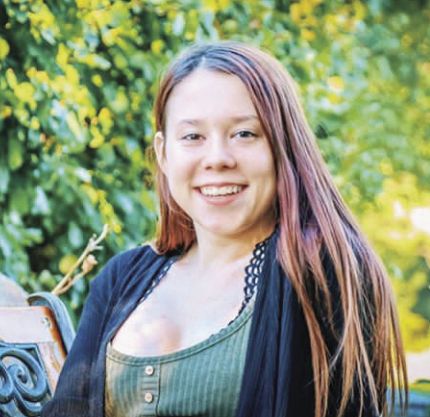

Last year, no one would have considered Brooklynn Benwell a star student – least of all herself.
But the 18-year-old from Franklin is an alternative high school hero – not just for her success, but for the circumstances over which she triumphed. This week, Benwell sets a new kind of record at Franklin High School, completing nearly 70 percent of her four-year curriculum in just over seven months, and finishing junior and senior English in less than four weeks. She started her senior year with only seven of the 21.5 credits needed to graduate, and completed two and a half years of schoolwork in one year.
"I had that talk at the beginning of the year about coming up with a plan," said her guidance counselor, Desiree Smith. "She had this fire when she came into my office. She said, 'I'm going to do it.' Sure enough, she did. The staff is so proud of her journey and the hard work and dedication she has shown. She has really risen to the occasion and shown her strength and resiliency to achieve her goals."
She is also the last happy ending anyone expected.
School “wasn’t hard. I just didn’t focus on it,” Benwell said of her first three years in high school. “I was disruptive. I didn’t care. I didn’t listen. When they asked me to stop, I just kept talking. I guess you could call me a class clown, but I wasn’t very funny. I just had an ‘I don’t care’ attitude.”
Remarkable is not just Benwell’s turnaround, her extreme motivation or first-ever achievement, but the personal difficulties she surmounted. Benwell started high school as a disruptive and failing student. Her family had just lost their home. Benwell lived for 18 months with her godmother, while her own mother lived with Benwell’s older sister, and the infant her sister gave birth to at age 18.
“All I could think about was getting back with my mom,” Benwell said. “She’s my best friend.”
During high school, Benwell visited her father’s house, where she helped care for her little brother until he was three. While completing the marathon of schoolwork required to graduate with her peers, a combination of online and virtual classroom courses, she worked roughly 30 hours a week as a dietary aide at The Peabody Home.
“I was sick of everybody looking at me and saying I couldn’t do it,” Benwell said. “Getting my work done made me happy. Just showing myself I could do it. Every time I had free time I would read and take notes. A lot of my friends didn't care about school. When I started getting better at school, I didn't care about hanging out with them that much.”
Key to her success was Paul Childs, a tutor and mentor in the Community Action Program of Belknap and Merrimack counties, who helped her catch up on grade-level reading, writing and math skills in one-on-one sessions from 7:30 to 9:30 a.m. before school. “I could tell he really cared about his students, and that made me care about me,” she said. She doubled up on courses.
This fall, she starts a two-year program in business administration at Great Bay Community College in Portsmouth, with intentions of eventually starting a program for at-risk kids. “Some people don’t have everything easy for them,” she said. “Once I found I could do it there was nothing stopping me.”
Benwell is a standout whose achievements might not warrant an impressive yearbook title or photo. Apart from Benwell's confident smile, they're invisible, rooted in resilience and perseverance, which enabled her to reach a worthy, difficult goal, in spite of painful and trying family and life experiences that might have thwarted others.
Today, she's not just a role model – she’s her own evidence of her power to change and chart an independent journey – at a time when the odds were stacked against her, with insecurities that defy definitions of a stable home. "My mom is wicked proud of me,” Benwell said.
Her story is echoed in other high schools – anywhere young people confront upsetting, ongoing personal or family trials that create emotional turmoil and can derail the smallest achievement. Instead, they forge ahead with more than average strength, channeling inner mettle. Psychologist and author Angela Duckworth says this combination of passion and perseverence can be more important than aptitude, physical strength and intelligence in determining personal success.
"I think there's some resiliency factor that comes naturally for some kids," said Samantha Raticik, a guidance counselor at Winnisquam Regional High School. "The ability to push through adverse childhood experiences and become successful despite those things."
Graduating high school seniors who prevail over adverse childhood experiences have some similar personality traits, but vastly different stories to tell. All have reasons to celebrate and remain hopeful.
Reese Clark, Gilford High School
To hear her talk and laugh, openly and unabashedly, one might mistake Reese Clark for an average senior – a bubbly teen preparing to catapult to the next phase of life. But her achievement is as striking as it is private and personal – a victory over heartache and frightening incidents at home, situations that were beyond her control while growing up.
“I started high school with two parents,” she said. “Now I just have my mom. My dad struggled with alcoholism for a lot of my life, and drug addiction for the last four years. It takes people away from you. His decisions made us lose our home.”
When they were younger, Clark and her siblings frequently heard their parents fighting. “He would hit, punch and kick my mom,” she said. “I thought that was normal when I was little.”
The family lived at Gunstock campground for a month, then in Gilmanton for five months while her father struggled with addiction. “My dad started to become violent with everyone in the house,” she said. In November or December of her sophomore year, he was arrested as an illegal immigrant from Canada – where the family lived while Clark was in elementary school.
During high school, Clark's home and family life seemed impossible for others to relate to. For a long time, Clark kept it to herself, unable to explain it to anyone her age.
“Getting enough sleep and maintaining grades was an ongoing issue for me,” she said. “I missed a lot of classes sophomore year, which resulted in a lot of detention. It wasn’t easy to socialize either. There was a lot going on in my head. I couldn’t really talk about it. I was embarrassed about what was going on. I wanted to be viewed as having a good family.”
She confided in one teacher, a study hall monitor for kids who needed extra help, and was allowed to go to her class when she needed a break or felt overwhelmed. “The biggest challenge was maintaining the social aspect of high school – fitting in with the rest of my peers and adjusting to the social norms. I did not put on a brave face at school,” she said. “I cried a lot in class.”
“There were times that she was very inward, nervous and closed,” said Laurie Belanger, a student assistance counselor at Gilford High. “But you can’t keep Reese down for long. I think it’s her absolute sense of hope and joy. She’s unflappable. She’s one of the most resilient people I’ve ever seen. She refuses to be a victim of anything. She’s also one of the kindest kids I’ve ever known.”
Encouragement from adults kept her going in high school, Clark said. “A lot of my friends are in better situations than I’ve ever been in. There’s not a lot of common ground. They just listen – which is enough to make you feel like you have a real relationship.”
Today, Reese lives with her mom and a younger sibling in her grandparents’ former house in Gilford, and the family is more financially stable than they’ve ever been, she said.
In August she heads to Plymouth State University for pre-season field hockey – a sport she discovered two years ago that she believes helped her anxiety, providing team support and competition. "I love the game. I think it's fun. I love the rivalry and the fans cheering."
In fall she begins studying for a bachelor's degree in elementary education. “I just love kids. I babysit a lot. I found I could be helpful if those kids felt down or out of place,” she said.
Her advice to struggling students, especially those in crisis: “You don’t have to be literally anyone but yourself. Everyone moves at their own pace. There’s a tendency in kids to keep things to themselves because of social expectations. Before (any situation) becomes dangerous or life threatening, contact a trusted adult. The longer you let it go on, the worse it’s going to get.”
Today, she is frank about her father’s substance misuse, and how the shock and pain of it helped her choose a positive direction – one fueled by self-awareness and optimism. Her shyness has evaporated and her joy is contagious.
“I’m so excited to start Plymouth and have a little bit of my own freedom,” she said. “I’m rooming with a girl from Martha’s Vineyard, who’s originally from South Africa. Which is very cool!"
Kristyann Tardif, Winnisquam Regional High School
At age 17, Kristyann Tardif of Northfield works in the COVID-19 unit at Manchester’s Elliot Hospital as a Licensed Nurse Assistant, helping the most vulnerable population – people over 60, with underlying conditions – in the New Hampshire city with the highest number of cases and deaths due to the pandemic that has overwhelmed the globe.
“It’s definitely hard. But it’s definitely inspiring. These people don’t get to see their families,” she said. “It fills a hole in my heart, holding their hand and helping them when they really need it.”
In many ways, Tardif is paying forward the years of love and caring she received from her grandparents, who died within months of each other when Tardif was 13. She discovered her nursing mission in high school. Her goal was won by hard work.
At the beginning, Tardif struggled academically at Winnisquam Regional High School. She’d been a cheerleader for 12 years, starting at age four or five, a passion that persisted through competition. But in seventh grade, both her grandparents, key supports and cheerleaders in her own life, passed away within months of each other. Her grandmother died in her mid-50s from throat and lung cancer. Tardif visited her in a nursing home, then regularly at Concord Hospice House. Three months later her grandfather succumbed to a heart attack.
“All the nurses working so hard really inspired me to be a nurse. They were there for (my grandmother’s) family and they were there for her, too,” Tardif said.
Tardif lived with her grandparents every summer at a campground in Loudon while her parents worked long hours. And when her grandparents were no longer alive, Tardif felt an unpluggable hole. “It was definitely difficult. They were close to me. I still made efforts to go to the campground and hang out with friends I made there, but it definitely wasn’t the same.”
Tardif spent after school hours caring for her younger brother. She floundered in school, uninvested in it, and drifted without any hope or plan that had meaning.
Then junior year she went to the Huot Technical Center’s allied health nursing center in Laconia. She accelerated through schoolwork. At 16 she became a licensed nursing assistant and worked after school two days a week at Golden Crest Assisted Living in Franklin. On the other three days, from 5 to 10 p.m. for six weeks, she attended an LNA health careers program in Manchester, which enabled her to graduate halfway through her senior year.
“Nursing appeals to someone who’s strong, can take care of themselves but can also take care of others,” she said.
Since January she has worked at Elliot Hospital, where she takes care of 10 to 18 patients in the COVID unit, helping them get dressed, and watching TV or playing games with them. Most are the age her grandparents would be if they were still alive.
“It’s heartwarming,” said Tardif, who turns 18 this month. “I do anything that makes them feel they’re more at home and not stuck in a hospital. They miss their families.”
This fall, at New Hampshire Technical Institute in Concord, she begins training to become a registered nurse – a course she intends to complete in three years, while working part time and paying $400 a month for her car.
She credits her guidance counselor, Samantha Raticik, for steering her toward the Huot Center, a technical careers program available to high school students throughout the Lakes Region. Tardif continued through accelerated training at Manchester Community College.
“I really just wanted to jump into the nursing field and work at a hospital,” she said.
"Once she figured out who she wanted to be and where she wanted to go, she did whatever it took to achieve that and nothing pushed her off her path," said Samantha Raticik, her guidance counselor. "You don't see many adults doing that, committing themselves to that degree."
Tardif's advice to disillusioned high school students is simple: “Keep on moving and find something you really love. It’s definitely worth it when you get there. There were times I didn’t want to go to school. I’m glad I had my mother to tell me to get my butt to school. Find something that meshes with your personality. It’s all about the time you’re willing to put into it as well.”


(0) comments
Welcome to the discussion.
Log In
Keep it Clean. Please avoid obscene, vulgar, lewd, racist or sexually-oriented language.
PLEASE TURN OFF YOUR CAPS LOCK.
Don't Threaten. Threats of harming another person will not be tolerated.
Be Truthful. Don't knowingly lie about anyone or anything.
Be Nice. No racism, sexism or any sort of -ism that is degrading to another person.
Be Proactive. Use the 'Report' link on each comment to let us know of abusive posts.
Share with Us. We'd love to hear eyewitness accounts, the history behind an article.