



LACONIA — ”Black lives deserve more than a Twitter rant. Silence = Violence.”
“It’s not white vs. black. It’s everybody vs. racists.”
“In the age of information, ignorance is a choice.”
“White silence is violence. Your choice to be silent is louder than you think.”
“I can’t breathe.”
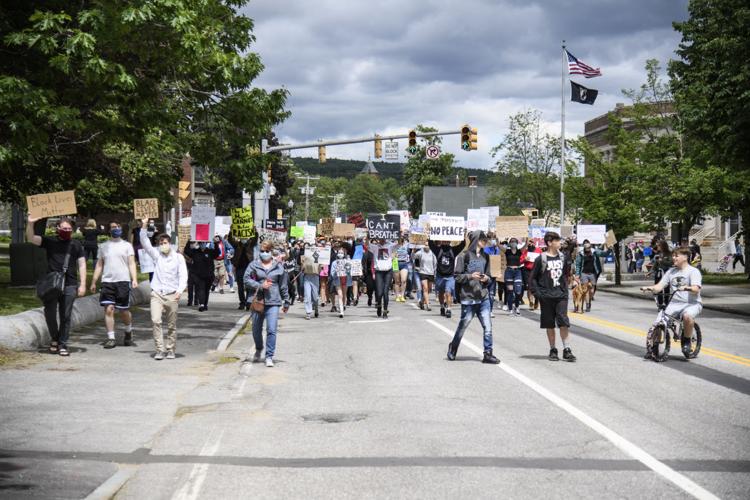
The signs at Sunday’s Black Lives Matter rally and march in Laconia were a roving billboard of emotional reactions and pleas for change in the wake of the death of George Floyd at the hands of a Minneapolis police officer – a chokehold that has been felt around the world.
During the march, which circled downtown, signs were held high in honor of Floyd. But they also gave voice to anguish and outrage, to protest ongoing and unfair treatment of blacks, particularly black males – a systemic injustice that has simmered unchecked in police departments for too long, protesters said.
“I want them to get pulled over in a traffic stop and not be worried about dying. I hope the protest will bring reforms, and psych evaluations for cops,” said Nick Blanchard, 27, a factory worker who was laid off from PCC Structurals during the COVID-19 crisis.
“It’s good to have a peacekeeping force like the police,” Blanchard said. “But you need to have oversight making sure what they’re supposed to do. It don’t think you’ll stop seeing protests until something’s done at the federal level.”
Frank Allen, 53, of Gilmanton, a buildings and grounds assistant for a nonprofit organization in Concord, said: “I respect police officers and the job they do. It’s complicated and very dangerous. Maybe they should emphasize de-escalation or have specialties within the department instead of having people who are jacks of all trades, masters of none.”
Allen blames what he considers America’s dysfunctional power structure. “It’s not just police, it’s people in power pushing around people underneath. If we’re not careful it will come to something like the French Revolution. I’d rather it be done peacefully. Getting people in power to listen is the most important thing right now.”
“My heart is breaking for this country and all of our black brothers and sisters,” said Wendy Hast, who drove from Lancaster to march. “No mother should have to worry what might happen” when her son goes to school, out to play, or out at night.
Needed for police everywhere is “not just sensitivity training, but an overall look at law enforcement and what their job is, and holding them accountable,” Hast said. “When you have an incident involving police that goes wrong, a committee from outside the department should evaluate what’s going on. It’s too ingrained inside this fraternity of law enforcement. There’s no oversight. You don’t get justice.”
Marchers waving signs formed a flank of nearly 300 that stretched from the City Hall parking lot to the post office on Church Street. The orderly rally lasted from 2 to 4 pm.
“There are so many people that see injustice on a daily basis and do nothing,” said Ash Gomez of Laconia, who moved here from Albuquerque. “If people don’t speak out, we’re just allowing violent behavior and brutality, so we need to use our voices.”
Kira Cassiani of Laconia, owner of Faithful Cleaning, a residential cleaning business, said, “I am a person of color who believes that all lives matter. As a child of God, it’s important to come together to support all those in need. Hopefully we’ll make a change – and everybody will see each other.”
Lew Henry, 74, or Gilmanton, came in support of Black Lives Matter. “Government employees sanction a lot of mistreatment of black citizens. I’d like to see black citizens treated the same as anyone else.”
Government employees need to report misconduct and abuse by their colleagues, Henry said. “It needs to be remedial, up to firing if necessary. People need to be trained to be decent. They need to be treat all citizens, regardless of color, in the same manner."
Ian Raymond, 58, who owns a photography studio in Laconia, marched on Saturday in Concord – an event organized by Concord High School students that drew over a thousand participants. “It was amazing looking at the crowd. You couldn’t see the front and back if you were in the middle.”
“There’s been injustice going on for decades,” said Raymond. “We need to do away with qualified immunity for police officers. Nobody should have a license to kill people. I’m not a thing. I’m a human. People are tired of being treated like a thing,” he said. “White people are starting to realize that black people are still being treated as an oppressed race. We’re reaching a tipping point.”
Jeff Hutchins, 20, of Belmont, a student at NHTI, spent several days researching news archives online and created a poster for Sunday entitled: “20 lives taken in 20 years since I’ve been alive. These are just some of the black men women and children killed in my lifetime.” The poster listed the name, the year they were killed, and the circumstances of police brutality which resulted in death.
“I think it’s important that we hold police accountable the way we hold citizens accountable,” Hutchins said. “If police are removing a body camera, that should be an obstruction of evidence charge. It’s important to hold them accountable by video and voice.”
When the crowd gathered at the Rotary Park gazebo, the protest’s organizer, Nezir Alic, 20, of Laconia, said: “Today we are part of history. Today we gather to stand in solidarity with black Americans across the country who have been subjected to injustices. Today we take to the streets to see a future where prejudice has no place in our government.”
During the march, protest leaders shouted and participants responded louder, their chants echoing between the walls of downton buildings: “Say his name!” “GEORGE FLOYD!” “No Justice!” “NO PEACE!” “HEY – HEY, HO – HO, THESE RACIST COPS HAVE GOT TO GO.”
Some signs quoted statements of historical figures such as the Rev. Martin Luther King Jr.: “There comes a time when silence is betrayal.” Angela Davis: “In a racist society it is not enough to be non-racist. We must be anti-racist.” And South African Archbishop Desmond Tutu: “If you are neutral in situations of injustice, you have chosen the side of the oppressor.” The signs included two unattributed messages: ”You can choose to look away, but never again can you choose to say you didn’t know”; and, “I understand that I will never understand. However, I stand.”
Martin Toe grew up in Hooksett, but came from the Ivory Coast, and is a local organizer for Black Lives Matter. He addressed the audience of marchers: “Racial issues are very serious in our country. My pastor asked me this morning, What are some things we can do in this time?” Toe said, “If you claim a faith or that you respect life, if you turn a blind eye to suffering, you’re part of the issue. I need Christian people to wake up.”
Blacks are 13 percent of the population, but they comprise more than 50 percent of the US prison population, said Toe. “If that’s not slavery, come on, wake up!” Toe said, pacing the gazebo and pleading to the crowd. “If you don’t care about your neighbor enough to do something about it, I don’t think you’re really human.”
“I’m tired of minorities being picked on in white communities. I don’t care if you’re protestant, Catholic, Baptist or whatever, said Carlos Cordana, a local activist for gay and transgender rights. “Our lives are being looted every single day by the wealthiest in our country. We can march and we can protest and we can vote and change our system.”
Chiekh Kamara, 21, moved from Senegal when he was one, and lived in Laconia for 14 years before relocating to Georgia, then recently returning. “It’s not a battle between whites and blacks. We’re talking about black lives matter. Not black lives are better or equal,” he told the crowd. “We just want to matter. I lost my sister this February, a month before my birthday. The person who did it wasn’t arrested, wasn’t detained and is still walking around.
“We are judged by our decisions and our character. We all need to be responsible as humans,” Kamara said. “We want police reform and justice so a cop can’t have the audacity to step out of line with his power. They work for us, the city and the people. It can’t be a slap on this wrist! Justice for everyone.”
Racial profiling, racism and discrimination is real, Kamara said. “It’s not, this is a black platoon. This is a Mexican platoon. We all fight together, right? We need to be strong and come together, and it starts here.”
“Color can no longer blind you,” he said, echoing a woman on the gazebo.
“Just seeing all these white faces. You are all my brothers and sisters,” said Randy Parker of Belmont, a retired postal worker who moved here from New York City.
The marchers circled downtown a second time, chanting, “What do we want?” JUSTICE!” “When do we want it?” “NOW!” “Say his name!” “GEORGE FLOYD!” “Say her name!” “BREONNA TAYLOR!” “No Trump! No KKK! No Fascist USA!” “Whose streets are these? “OUR STREETS!”
Slogans flashed on signs: “Racism is a pandemic.” “No More KKKiller cops.” “Color is not a crime.” “Who do you call when police murder?”
“No justice!” “NO PEACE!” “What do we want?” “JUSTICE!” “When do we want it?” “NOW!”
“This is an historical moment, an historical time,” Toe said from the gazebo. “In five to ten years we will look back at this moment. Don’t stand by. Be part of the change. We are all here for African American men and women who have built this country. This country has the ability to rewrite everything that was stolen or erased. It doesn’t end tomorrow. We’ve got to keep on fighting. We’ve got to show up in November and vote!”
“There are many people who could be here, but they chose to stay home,” said Toe. “We’re supposed to work together, to love each other, and make this world better. I have friends in Africa that are marching, friends in the Dominican Republic that are marching. We’re not alone.”
“The important thing to take away is when you see an African American man being pinned on the ground by police, and it’s escalating, take out your camera and speak out. Whether it’s in the school system or on the street. Don’t be quiet,” said Toe. “Stand up whenever you see injustice.”
Alic, the organizer, a sophomore at California Institute of Technology, said he plans to work with the Laconia Police Department and City Council to try to implement policies shown by data to reduce police violence, which are listed on the website 8cantwait.org.
Chief Matt Canfield said Monday the Laconia Police Department already practices most of them, including no chokeholds or strangleholds or shooting at moving vehicles, de-escalation at crime scenes, intervening or stopping and reporting excessive force by other officers. Canfield said he is happy to meet with Alic, and is considering holding community information meetings to explain police training and practices, and answer questions. The department already uses body cameras.


(0) comments
Welcome to the discussion.
Log In
Keep it Clean. Please avoid obscene, vulgar, lewd, racist or sexually-oriented language.
PLEASE TURN OFF YOUR CAPS LOCK.
Don't Threaten. Threats of harming another person will not be tolerated.
Be Truthful. Don't knowingly lie about anyone or anything.
Be Nice. No racism, sexism or any sort of -ism that is degrading to another person.
Be Proactive. Use the 'Report' link on each comment to let us know of abusive posts.
Share with Us. We'd love to hear eyewitness accounts, the history behind an article.