



Security, AI, and employee choice and productivity reshape workplace tech
For years, workplace technology followed a predictable formula: Employees were issued standard PCs, IT managed them, and most people didn’t think twice about the setup. But that routine is shifting. As cyber risks rise, AI moves into everyday workflows, and employees expect consumer-level tech at work, organizations are rethinking which devices truly meet modern demands.
A new survey of enterprise IT leaders commissioned by Compucom, an Apple Premium Business Partner, finds that many organizations are now reconsidering the traditional PC-only workplace. Their responses reveal a workplace in transition, where device strategy has become a core part of both security and employee-experience planning.
Security concerns are driving major changes
Cybersecurity pressures are shaping nearly every technology decision companies make, and leaders say not all devices perform equally under that stress.
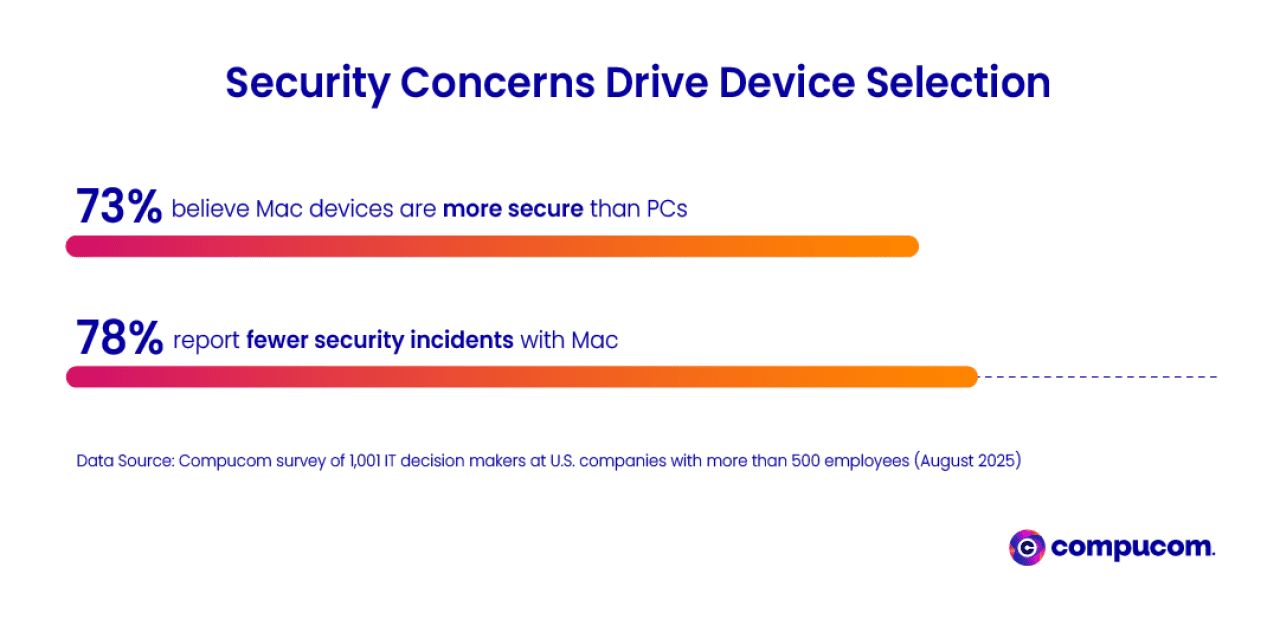
In the survey, 73% of IT leaders say Mac devices are more secure than PCs, and 83% believe the Mac offers clear security advantages overall. Their confidence seems to be rooted in firsthand results: 78% report fewer security incidents on the Macs in their fleet.
This trend marks a meaningful shift. Security was once viewed as an IT-layer issue, something handled through software and monitoring tools. Today, leaders say the hardware itself plays a central role in strengthening (or weakening) protection.
Reliability matters more as IT teams stretch thin
Security isn’t the only factor reshaping device strategy. IT teams managing distributed workforces say they’re also looking for platforms that minimize disruptions and reduce support demands.
According to the survey, 72% of IT leaders rate Mac devices as more reliable, and more than half (53%) say they’re easier to support. When devices consistently work as expected, help desk tickets drop, outages shrink, and employees stay productive. These benefits matter even more now that hybrid work has made in-person troubleshooting harder.
Employee choice is becoming the norm
One of the clearest cultural changes inside the modern workplace is the expectation of choice. What once felt like an optional perk has quickly become standard: 90% of enterprises now give employees the option to choose between Mac or PC or have enabled a Bring Your Own Device (BYOD) option.
Leaders say this shift is primarily driven by employee experience. Workers often want the same devices they use personally, and employers increasingly recognize that comfort and familiarity contribute to productivity.
With these changing workforce expectations, enterprises new to Mac may need assistance with key services like network setup and identity management.
Real-time visibility is becoming essential
To support more varied device environments, companies are adopting analytics-driven tools that give IT teams visibility into performance, security posture, and end-user experience across fleets.


Leaders using a variety of analytical tools and integrated platforms say they allow IT departments to shift from reacting to issues to preventing them. IT teams are catching performance dips, compliance gaps, and security risks before they disrupt employees.
The rise of these tools reflects a broader shift in workplace technology: Companies aren’t just managing devices anymore; they’re managing the digital experience around those devices.
AI is accelerating the move toward new hardware
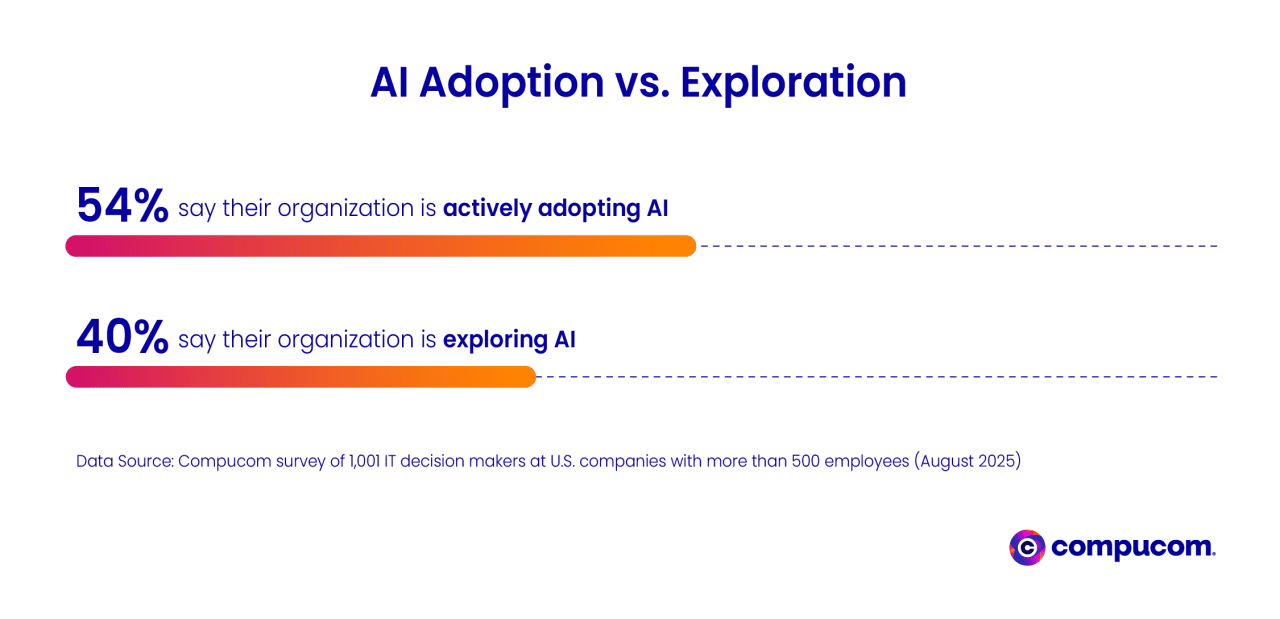
Across the workplace, AI adoption is rapidly increasing. According to the survey, 54% of IT leaders say their organizations already use AI tools, and another 40% are exploring them.
Many leaders view this moment as a turning point and say hardware capability matters more than ever. With growing demands for processing power, efficiency, and security architecture, many IT leaders believe Mac devices, especially those powered by Apple silicon, are well-positioned to support AI-driven workflows.
This doesn’t necessarily mean an immediate shift away from PCs, but it does suggest that device strategy is no longer static. Companies are making choices based on where they expect workplace technology to be three years from now — not where it was three years ago.
A more mature approach to lifecycle management
Another pattern emerging from the survey is a more structured, sustainability-focused approach to device lifecycle management. Two-thirds (67%) of enterprises now run formal lifecycle programs, and 43% actively recover end-of-life value. For many organizations, responsible device management ties directly to cost savings and environmental goals.
A future where device strategy is strategic — not standardized
Taken together, the survey findings point to a workplace where device decisions are no longer an afterthought. They’re part of broader strategies around security, productivity, employee experience, and AI readiness.
As expectations evolve, IT leaders say their strategies are evolving, too. Some are expanding choice. Others are adopting tools that help them monitor and manage more diverse device ecosystems. Many are reassessing which platforms best support emerging technologies.
The result is a workplace that looks very different from the one companies were planning for just a few years ago. And for many leaders, the move away from a one-size-fits-all PC model isn’t just a trend — it’s a response to the realities of a rapidly changing digital workplace.
Methodology
Compucom commissioned Atomik Research to conduct an online survey of 1,001 full-time U.S. enterprise IT decision makers. The survey was conducted between August 19-26, 2025. Results have a margin of error of ±3 percentage points at a 95% confidence level.
This story was produced by Compucom and reviewed and distributed by Stacker.


(0) comments
Welcome to the discussion.
Log In
Keep it Clean. Please avoid obscene, vulgar, lewd, racist or sexually-oriented language.
PLEASE TURN OFF YOUR CAPS LOCK.
Don't Threaten. Threats of harming another person will not be tolerated.
Be Truthful. Don't knowingly lie about anyone or anything.
Be Nice. No racism, sexism or any sort of -ism that is degrading to another person.
Be Proactive. Use the 'Report' link on each comment to let us know of abusive posts.
Share with Us. We'd love to hear eyewitness accounts, the history behind an article.