


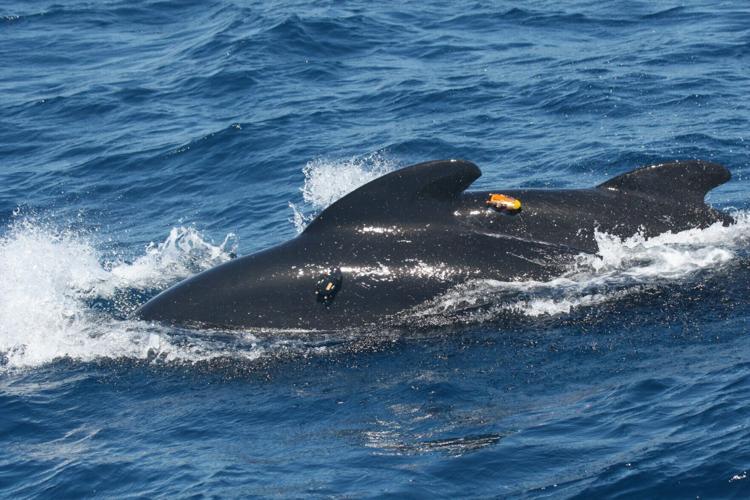

Two long-finned pilot whales with recorders. (CIRCE via SWNS)
By Stephen Beech
Pilot whales are having to shout louder to be heard over deafening noise from shipping, reveals new research.
The underwater sound from ships' engines in the Strait of Gibraltar is the equivalent to standing next to a vacuum cleaner, according to the findings.
Scientists say the noise pollution poses a potentially deadly threat to the second-largest dolphin species.
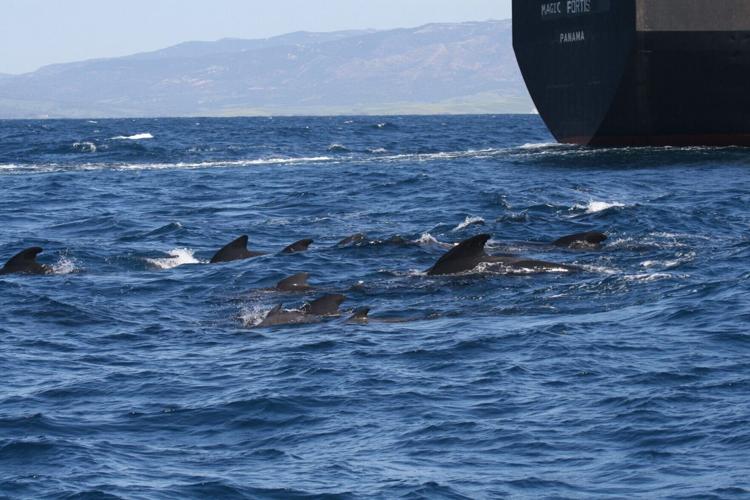
With more than 60,000 vessels passing through the Strait each year, the stretch between the Atlantic and Mediterranean is one of the world's busiest shipping lanes.
The narrow waterway is also home to a critically endangered population of long-finned pilot whales.
Living in such congested waters means whales must thread their way between ships while attempting to catch food, find mates and raise their young.
An international research team discovered that the endangered pilot whales are having to shout louder to be heard above shipping noise.

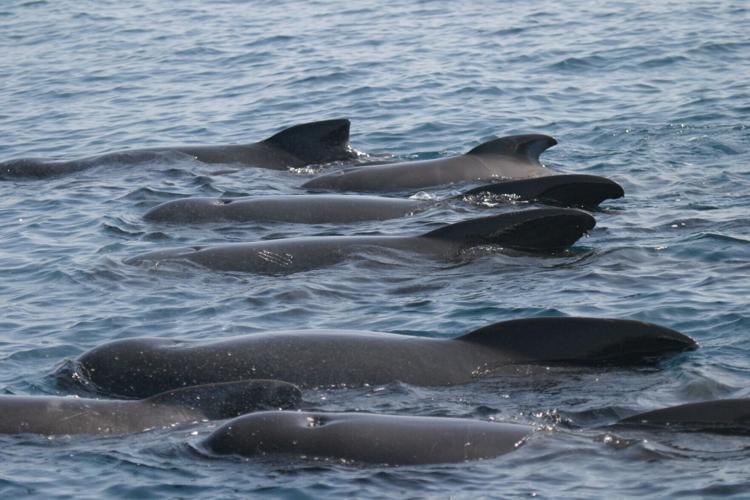
A pod of long-finned pilot whales swimming at the water's surface. (CIRCE via SWNS)
And the mammals may struggle to call loud enough when trying to relocate their pod after deep dives, according to the findings published in the Journal of Experimental Biology.
From 2012 to 2015, Frants Jensen and colleagues headed out into the Strait aboard the research vessel Elsa.
They used a six-meter-long pole to attach recorders to the backs of 23 pilot whales with suction cups.
The recorders measured the movement and depth of the whales and recorded the noise under the water before popping off and floating to the surface 24 hours later.
Back in the lab, the team began the task of discovering what the whales were hearing underwater, which whales were making each call and whether they could identify what the whales were doing based on their calls.
After listening to 1,432 whale calls, the team divided them up into four categories: low-frequency calls, short, pulsed calls, high-frequency calls and two-component calls.


A pod of long-finned pilot whales near a cargo ship. (CIRCE via SWNS)
Study co-author Jensen, from Aarhus University, said: "The low-frequency and two-component calls can be heard from further away and are thought to be important for finding and reuniting with members of their pod.
"But the whale's calls weren't the only noise in the water.
"The levels of background noise ranged from 79 to 144 decibels, which is similar to the sound range found in a noisy restaurant up to standing next to a vacuum cleaner.
"So how do the whales make sure that their calls are heard over the noisy seas?
"It turns out that the pilot whales make their calls a bit louder as the background noise increases.
"But the whales can't always crank up the volume of their calls enough to be heard over the din."
Co-author Milou Hegeman, also of Aarhus University, said: "For some of their quieter calls - like the high-frequency and short pulsed calls - they only have to shout a little louder to be heard over the noise.

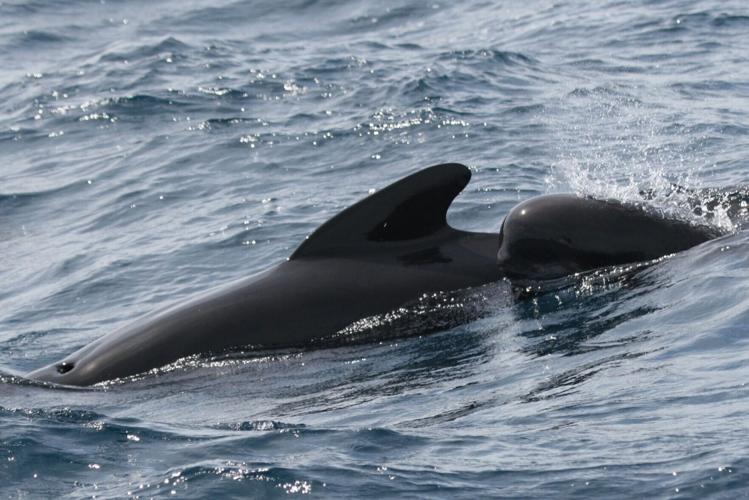
A mother and calf long-finned pilot whale. (CIRCE via SWNS)
"However, the pilot whales are already shouting as loud as possible when making their low-frequency and two-component calls, so they can't make these any louder than they already are.
"Unfortunately for the pilot whales, their loudest calls are the ones they use to find their pod again when they resurface after diving deep in search of food.
"This combined with the fact that these marine mammals cannot necessarily make their other calls loud enough to be heard over the din of the ships' engines means that they may struggle to communicate amidst busy vessel traffic."
Jensen said: "Increasing noise essentially decreases the effective communication range, making it harder for distant animals to find each other."
He added: "Given that the pilot whale population in the Straits of Gibraltar is only 250, this critically endangered pilot whale population will likely struggle to find members of their own pod again after diving for food or mates from other pods when it's time to breed in the noisy shipping lane.
"So maybe it's time we tried to keep the noise down so that the pilot whales don't need to shout to be heard."


(0) comments
Welcome to the discussion.
Log In
Keep it Clean. Please avoid obscene, vulgar, lewd, racist or sexually-oriented language.
PLEASE TURN OFF YOUR CAPS LOCK.
Don't Threaten. Threats of harming another person will not be tolerated.
Be Truthful. Don't knowingly lie about anyone or anything.
Be Nice. No racism, sexism or any sort of -ism that is degrading to another person.
Be Proactive. Use the 'Report' link on each comment to let us know of abusive posts.
Share with Us. We'd love to hear eyewitness accounts, the history behind an article.