


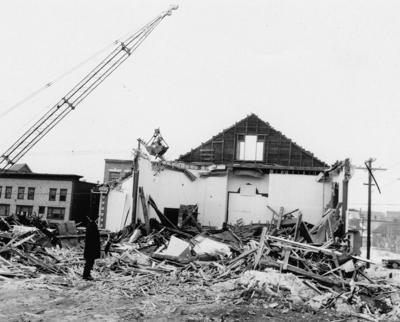
LACONIA — Today, urban renewal has a bad reputation in some circles, but in the mid to late 1960s it was seen as a way to reinvigorate downtowns – including Laconia – that faced competition from the growth of strip malls and other businesses that took people away from the city centers.
Rod Dyer, who served as mayor of Laconia toward the end of the city’s urban renewal program, said his opinion of the initiative is colored by what happened afterward, but that it did have “some pluses, and some significant losses.”
“There were some improvements,” Dyer said. “Some dilapidated buildings came down, two mills were restored, and City Hall was built. It opened up some portions of downtown Laconia that really needed it, so it was a mixed bag.”
That mixed bag included the demise of several businesses.
“The First National went out of business, A&P went out of business; O’Shea’s is gone; Chertok’s is gone. I can’t think of a major downtown business that survived in the long term,” Dyer said.
“The bottom line,” he said, “is if you asked a majority of the people in Laconia, including me, was it successful, the answer is no. Would you support it, looking back? The answer, generally, is no.”
The federal Downtown Development and Urban Renewal Program, with the local Winnipesaukee River Urban Renewal Project, began with planning in 1962. The City Council voted to go forward with the plan in 1965.
“By the time I became mayor in March of 1968, the program was essentially locked in to the point where major changes would not have been possible,” Dyer said.
The first demolition of the old downtown structures took place in late 1968.
Laconia historian Warren Huse said, “The folks who promoted it, back in the 1960s and early 1970s, had the purest of motives. Fighting a fire in the old downtown would have been a hopeless cause.”
There were a number of “horrible old rotten wooden buildings; terrible sanitary arrangements; extreme overcrowding,” he said.
Prior to urban renewal, the city no building code, Huse said, and the plumbing and electrical codes were “on the order of 40 to 60 years out of date.”
“Bringing these codes up to date was the focus of the first several years (1962-1965) for Robert Kitchel, the first UR executive director, along with learning how to navigate the federal bureaucracy,” Huse said.
Part of the plan for downtown Laconia was to create a covered pedestrian mall. The mall was created, but without a roof.
“It was deemed to be not a reasonable thing to do,” Dyer said.
Federal money covered much of the cost of urban renewal, and decisions were driven by federal agencies. The Laconia Redevelopment Authority, a separate entity unaffiliated with the original Laconia redevelopment group, oversaw the demolitions and reconstruction, Dyer recalled.
“There were very few decisions made on a local basis,” he said.
Changing the landscape
The demolition of existing buildings made way for new structures, including a new Ramada Inn in 1974 that went through several name changes over the years. Today, it is the newly renovated Best Western.
The Sundial Shoppe, which operated for several decades in downtown Laconia, came in after urban renewal.
Some businesses survived by moving elsewhere, notably Melcher & Prescott insurance. Also relocating were Peoples National Bank & Trust, now Citizens Bank; Sawyer’s Jewelry; and Melnick’s Shoe (now Bootlegger’s). Laflamme’s Bakery moved to the corner of Fair and Water streets and today is the Water Street Cafe. Laconia Electric Supply moved to Union Avenue in Lakeport.
The Soda Shop on the mall in Laconia formerly operated as Keller’s — originally a confectionary, bakery, catering, candy-maker, and luncheon restaurant.
“A number of businesses relocated and did fine until they reached the end of their natural lives,” said Huse, listing O’Shea’s, Laconia Hardware, Story Drug, Rosen’s, and Junior Deb. Palmer Plumbing Supply moved to Belmont but eventually went out of business; and Hayward’s Country Store on Union Avenue changed its name and moved to the top of Prescott Hill before eventually going out of business.
“There were a number of successor stores that did fine for a while,” Huse said: Lynch’s, Cherry Webb & Touraine, Gail’s Gentle Persuasion, and a couple of toy stores.
One near-casualty was the Belknap Mill. It was slated to be torn down until a group of local residents formed the Save the Mill Society.
Built in 1823 and in operation by 1828, the Belknap Mill features a bell in the tower cast by George Holbrook, an apprentice to Paul Revere. During the Civil War, the Belknap Mill was one of the first mills to convert from weaving to knitting, and was still making socks in 1969, when urban renewal threatened its demise.
The effort to save the mill, which included support from Bob Montana of Archie Comics fame, led to its conversion into a cultural center.
Problems
Dyer said that, as time went by, the downtown area did not live up to the expectations touted by proponents of urban renewal.
“It came to general attention that type of redevelopment really didn’t work for Laconia,” Dyer said.
Part of the reason was that one of the tenets of urban renewal was that there be no mixed use — no apartments could be built in retail locations.
“Obviously, that was a huge mistake,” Huse said, “leading to a wasteland at night in the downtown, with all its potential problems.”
He said, “I once asked Dave Lafond, who had been executive director of the urban renewal program, what he would have done differently … and he replied unhesitatingly, ‘mixed use’ for that very reason.”


(0) comments
Welcome to the discussion.
Log In
Keep it Clean. Please avoid obscene, vulgar, lewd, racist or sexually-oriented language.
PLEASE TURN OFF YOUR CAPS LOCK.
Don't Threaten. Threats of harming another person will not be tolerated.
Be Truthful. Don't knowingly lie about anyone or anything.
Be Nice. No racism, sexism or any sort of -ism that is degrading to another person.
Be Proactive. Use the 'Report' link on each comment to let us know of abusive posts.
Share with Us. We'd love to hear eyewitness accounts, the history behind an article.