


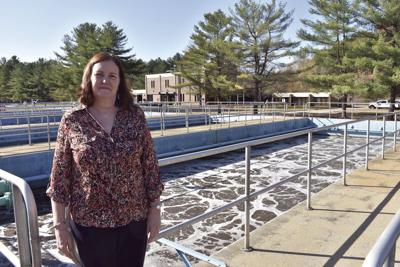
Member communities of the Winnipesaukee River Basin Program are unanimous in their view that the wastewater treatment system has been a worthwhile project, but now that they are decades in and are having to pay for repairs and upgrades to the system, many are looking to change the way maintenance is performed and costs are assessed.
The Winnipesaukee River Basin Program provides sewage treatment services to Belmont, Center Harbor, Franklin, Gilford, Laconia, Meredith, Moultonborough, Northfield, Sanbornton, and Tilton.
“There has been zero preventative maintenance performed on the collection system,” said Meredith Town Manager Phil Warren. “It appears that the strategy is ‘run to failure.’”
Warren said the program was ill-equipped to act when there was a force main break in Meredith several years ago. “It was the town’s sewer department that initially had to take the lead in the repair and stop the spillage of sewage into the lake,” he said. “Furthermore, the initial fix should have been to divert to another line and to use valves initially installed for this purpose — this was not possible, since the program did not maintain the valves.”
A 2007 brochure produced by the New Hampshire Department of Environmental Services acknowledged the problem: “The 10 municipal members of the WRBP Advisory Board and DES staff are working closely together to ensure that future investments occur in a timely, appropriate and affordable fashion to make sure that this operation remains effective and efficient.”
Belmont Town Administrator Jeanne Beaudin said there have been ongoing discussions by the advisory board about the future of the program’s administration and ownership structure. The advisory board meets monthly on the third Thursday, usually at the Corner Meeting House in Belmont. All meetings are open to the public.
“The program is run by the State of New Hampshire,” Beaudin said; “distribution of costs is based on a formula originally developed when the program began, so through the process of discussion regarding ownership and administration, it is possible that these formulas will change or be based on newer technology. It is a work in progress.”
Program Administrator Sharon McMillin said the current fee structure is a “statutory creation of the system.”
“The original facilities were paid largely with federal money,” she said. “Since then, the member communities pay the operational costs. We’re not in a money-making situation.”
Laconia Public Works Director Wes Anderson said the advisory board has been holding discussions about creating an independent sewer authority to take over the operations. The member communities will be taking a vote — perhaps as early as November — on whether to proceed with such a change.
Purpose
The Winnipesaukee River Basin project grew out of a recognition that sewage discharges into the lakes and rivers were causing water quality problems. Tilton, Northfield, and Franklin did not have treatment facilities and discharged sewage directly into the Winnipesaukee River, which leads to the Merrimack. Laconia and the Laconia State School’s primary treatment plants discharged into Lake Winnisquam, while Meredith discharged into Meredith Bay, and Center Harbor discharged into Center Harbor Bay, without secondary treatment to remove nutrients.
“The areas of Lake Winnipesaukee receiving inadequately treated sewage treatment plant effluent were precisely the areas with algae problems in the summer requiring the applications of copper sulfate, although these problems were much less severe than in Lake Winnisquam,” according to the Department of Environmental Services. “In addition to these problems, it appeared that the dense development on the shoreline of Lake Winnipesaukee in Laconia, Gilford, and Meredith and on Lake Winnisquam in Sanbornton, Belmont, and Tilton, had outpaced the ability of on-site subsurface systems to accommodate the waste. Similarly, Belmont, which lacked a sewage collection system, was adversely affecting water quality in the Tioga River, a tributary of the Winnipesaukee River."
According to Environmental Services, “In 1972, the governor and General Court determined that a regional solution was necessary and that the best way would be to give this responsibility to the Water Supply and Pollution Control Commission (the forerunner of the Department of Environmental Services).”
The Winnipesaukee River Basin Program built a system that collected the effluent and, using 14 pumping stations over 60 miles of sewer lines, carried it to a new wastewater treatment plant in Franklin. The project cost more than $75 million, culminating in 1993 with the connection of the Gunstock Recreation Area to the system. Federal grants provided 75 percent of the money, the state provided 20 percent, and the communities contributed the remaining 5 percent.
The 10 member communities share the operational costs, and contribute to a capital fund for repairs. McMillin said the fund was established to set aside 0.5 percent of the total value of the system, including the treatment plant, pump stations, and subsurface piping. That ensures that there is money available to cover a significant leak or repair, though large capital expenditures involve borrowing.
General repairs to the system are covered by the program, with costs distributed to the member communities on a formula based on their percentage of usage; but infrastructure repairs within each community are the responsibility of that town or city.
What has changed from the original formula, McMillin said, is that the project now offers 10-year interest-free loans from its capital fund for communities making repairs.
McMillin said they are studying the “sludge-handling piece” but do not have a final design, and that the next big project for the system is three to five years out.
Local improvements
Gilford Town Administrator Scott Dunn said his town recently upgraded its pump stations at a cost of about $900,000. The construction costs were financed through the project’s 10-year loan program, with annual payments of $58,120 being covered by sewer users.
Dunn said all of the towns share in the improvements to facilities owned by the Winnipesaukee River Basin Program using the formula established by state law, with each town’s share being apportioned in three categories. For Gilford, that amounts to administrative expenses of $69,112, operating expenses of $384,845, and capital charges of $118,000 for the 2020 fiscal year.
“Since inception of the program, the cost allocation was always on proportional use,” McMillin said. “It’s part of the system, but the cost also is based on the amount of flow. The largest flow contributor is Laconia, while Northfield has a small portion of use.”
Anderson said Laconia is responsible for getting its effluent to the Winni Basin’s sewer interceptor. The city’s system, separate from the Winni Basin’s lines, has been undergoing some major upgrades, including on Union Avenue from Elm to Stark Street, and on Court Street, from Keezer through the Main Street intersection. More work will be taking place in Lakeport, on the school side, Anderson said.
“Part of it is buildings needing to upsize some pipes, and some are clay pipes dating back to the 1940s,” he said.
Anderson noted that those on the sewer system pay for all the upgrades, although if done in conjunction with planned road upgrades, taxpayers cover the highway costs.
Sanbornton has not had to make any recent improvements to its system, and the town’s portion of the operation, maintenance, and capital expenditures amount to approximately 1.5% of total operating cost of the program.
“At this time, it appears that the costs to Sanbornton are reasonable, but concerns linger about the long-term viability of the program and all necessary improvements and maintenance of capital assets,” said Sanbornton Town Administrator Trish Stafford.
Belmont invested $1.5 million in new pump stations about five years ago, Beaudin said. That cost, as with all sewer department expenses, is borne by the sewer users, she said.
Warren said the Winnipesaukee River Basin Project’s cost formula is based on the original estimates of usage.
“That has changed here in Meredith,” Warren said, explaining that Meredith’s usage is lower, in part, because fewer areas are connected to sewer than originally planned. “At the time, they were correct, but much has changed,” he said.
“The advisory board has worked on a flow-based proposal for rates,” he continued. “That project was begun in 2010 and is still not completed — the data has not been collected fully and analyzed.”
Operational changes
Warren said his office has been working with the other members on a plan to consider taking over the operation of the program.
“It is a collective system, so any upgrades are made collectively and should be funded collectively, not apportioned as they are today,” Warren maintained. “Any upgrades to the collection and treatment system would be planned and made by the operators of the program.”
“About this time last year, we developed a road map for creating a separate municipal wastewater facility authority,” Anderson said. “There are multiple decision points to make on that road map so, for instance, if the costs escalate more than anticipated, the member towns can change direction or proceed to the next step.”
The board has to look at how a new authority would be configured: “If we vote to go to the next step,” Anderson said, “we’d spend the money to draft a cooperative agreement that would spell out how we want to manage the system, how to vote and collect money. If all agree to that, we’d go to due diligence, determining all the costs, who owns the land, and the easements — part of that is already done, and we may have enough to bring into due diligence, but it could take years.”
“The program and its staff do an exceptional job,” Beaudin said, adding that the project has been good for the region, and McMillin said the Winni Basin project has won numerous awards for its management of the wastewater system. That includes a recent recognition of its efforts at reducing electrical costs — savings that have lessened the impact of capital improvements.
A strategy forward
Warren agreed that the Winnipesaukee River Basin Program has been a benefit to the region, but he emphasized: “The system should be operated and maintained as a ‘collective’ system as it was designed. Individual members should not be charged directly for repairs due to (in many cases) lack of preventative maintenance work and planning. While it is acceptable for members to be allocated ‘replacement fund’ contributions … the repairs and continued maintenance of these facilities should not be ‘charged’ to member contributions just because of geographic location — the system was designed as a collective and should be operated as such, and individual members should not be responsible for the failure of the program to perform preventative maintenance or identify necessary capital improvements.”
Anderson provided a moderating tone: “There are issues, and there will always be issues. Realistically, unless you’re going to replace everything at a certain time, you will have certain failures, but you have to expect that. We will want to make sure that, as communities are growing and demands are placed on the system, we are modifying the system in sequence with what’s happening to make sure there is the capacity that can handle and support that piece. Everything has to be synchronized.”
McMillin said that, whatever the communities decide, there has to be a strategy to maintain the operation.
“We go the extra mile to look ahead with a capital improvement program,” she said. “It allows us to forecast any significant upgrades.”
Looking ahead also means anticipating changes as new water quality standards are developed. The New Hampshire Legislature will be taking up proposed new standards in December in a process that will provide “robust public comment,” according to McMillin.


(1) comment
This article barely touches on the ongoing problems the WRBP is experiencing in general an in particular regards to the maintenance section. Craig is the head of the maintenance section. For years Craig has done a terrible job perhaps because of practices such as him routinely returns home throughout the work day to "hang out" with his spouse (using a state vehicle) for sometimes more than an hour at a time. The WRBP relatively recently had a CMOM audit by EPA Region 1 (audit for the maintenance and collection system). During this audit Craig was unable to even sign in the maintenance tracking software (MP2). It got so bad people left the room it was so uncomfortable. An EPA representative had to show Craig how to sign in on his own system and computer. Once they were in , it was discovered there were no electronic records in existence. i.e. Craig has not been keeping, filing, or storing maintenance records for years!. I wish this was an exaggeration or fabrication.
Other routine practices of the maintenance and electrical departments include performing side jobs throughout the day while both being paid by the state and their private customers.
All of the above is allowed and managed by Sharon Mcmillin. Sharon is not very popular among her co workers (with the exception of Craig Shippee). Over the past couple weeks the Chief operator had to threaten "to go to Concord" (i.e. meet with Sharons supervisors Tom O'Donvoan and Rene Pelletier) to get an issue addressed that Sharon refused to acknowledge and deal with.After that statement was made Sharon addressed the issue.
People that have been hired by Sharon have nearly a 100% turnover rate. Names of people that have left/quit/been fired due to the horrific work environmental and the "know it all" condescending and micro managing and consistent lying of Sharon: Kelly Potter, Andrew Moore, Henry Anderson, Jeff Winchell, Steve, Amanda Bridge, Colin Cardin, Kevin Whalen, Megan Martinez, Arielle, Katheen McDermott. Most of these turnovers occured within a few years or less some at 6 months into employment even. Nearly all of these people reported problems to Pam Sopczyk in Concord. Often times a meeting was held but nothing was documented by Pam and then nothing happened after except the person who made the complaint was bullied and scrutinized by Sharon for speaking up and not allowing her to treat them that way.
Sharon routinely lies both to her subordinates at the WRBP and supervisors in Concord. Meetings have been held where Sharon was caught lying multiple times in the meeting in front of Rene Pelletier and Pam Sopczyk. An example of one her bigger lies would be the new Cartegraph system. The collection system and maintenance monitoring system is supposed to be online and being utilized by all the staff nearly a year ago. Ask the staff how it is going with the Cartegraph system. Not one person is using the system or even knows how to. This software and project cost hundreds of thousands of dollars and has been a complete failure according to the staff.
Rene Pelletier and Tom O'Donovan have been invited up to Franklin by Sharon so she can show them the progress that will be made. During this presentation she will lie and misconstrue things so they appear very good for her and Craig. This is something she is quite good at and routinely does. The staff all know the real story.
This is scratching the surface as to what goes on at the WRBP.
Tell Rene Pelletier, Tom O'Donovan, and Pam Sopczyk to do their job. The ones will suffer the most in the end are the towns served by the WRBP.
Welcome to the discussion.
Log In
Keep it Clean. Please avoid obscene, vulgar, lewd, racist or sexually-oriented language.
PLEASE TURN OFF YOUR CAPS LOCK.
Don't Threaten. Threats of harming another person will not be tolerated.
Be Truthful. Don't knowingly lie about anyone or anything.
Be Nice. No racism, sexism or any sort of -ism that is degrading to another person.
Be Proactive. Use the 'Report' link on each comment to let us know of abusive posts.
Share with Us. We'd love to hear eyewitness accounts, the history behind an article.