


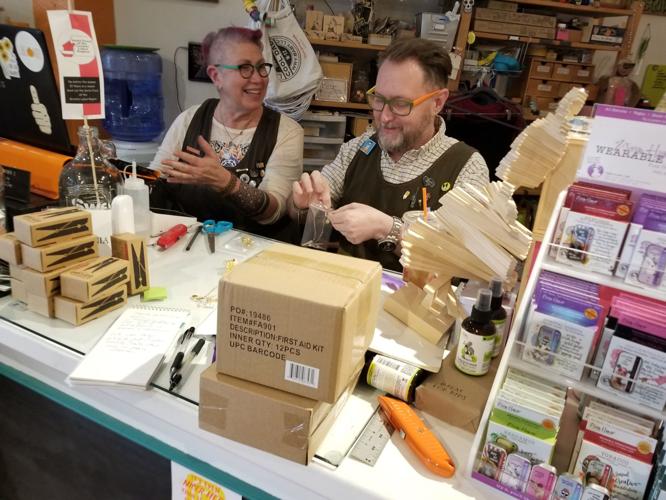
LACONIA — The store’s merchandise is fetching: Gold foil-wrapped pea shooters with multi-colored balls. A pocket-size coloring book called “32 Ways To Dress Wild Animals.” A “Portable Gratitude Kit” containing miniature cards and envelopes for leaving thank-you notes where you meander. A black baby onesie printed, “I’m a baby. What’s Your Excuse?” Tiny rubber chickens that launch like rubber bands off your fingers.
The Studio gift shop and boutique and its spirited collection is a shrine to joy and quirky humor — as well as a novel experience and a mecca for shoppers hunting for something small and unusual.
“Especially this time of year with Secret Santa, we can help people put together something that’s really nice, or really snarky,” co-owner Melissa McCarthy said.
She encourages customers to ask questions. “I tell them either I’ll know the answer — or I’ll make up something that sounds super-convincing.”
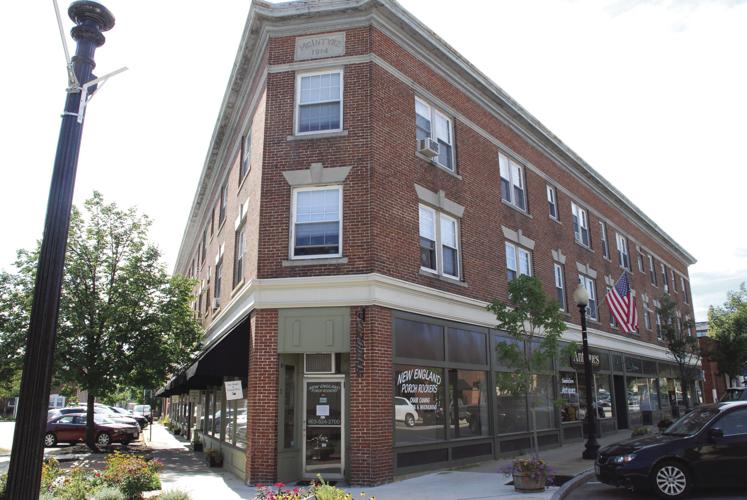
Located at a welcoming intersection, where Pleasant Street curves into Main Street, The Studio is one of the most eye-catching diplomats for downtown retail, after driving through a narrow corridor from the south. The storefront is also an invitation to travel and linger — in a city center that local leaders, residents, and business owners would like to see revived as a destination for shopping, food, and entertainment. But help is still needed to reach that goal, according to business leaders.
Betting on the Colonial
The restoration of the Colonial Theater and its rebirth as a music and theater venue and civic auditorium — a construction project estimated to end a year from now, before the 2020 holiday season — is expected to be a day- and nighttime magnet, pulling out-of-town and out-of-state visitors who will stay locally and sample what downtown offers.
“I look at the performing arts as a driver of community development,” said Laconia City Manager Scott Myers. “It’s going to be a large incubator that will drive other improvements and business. This is the engine that’s going to spur other development in the area.”
Recently revised zoning regulations will allow the city to waive existing codes for density, setbacks, lot size, and building size and height, as long as the proposed development is in synch with the character and uses in the immediate area. Sign ordinances have been simplified and streamlined to be more consistent and slightly less restrictive in certain parts, especially along Court Street and Union Avenue between the Belmont and Gilford town lines.
Businesses coming downtown and to the city’s industrial parts can earn state tax credits to help reduce the costs of construction and equipment. RSA 79E enables commercial property owners to renovate their buildings, with city taxes frozen at pre-improvement levels for up to five years, as long as their business has a public benefit, Myers said.
On Monday, Lakes Region Community College, and The Laconia Daily Sun held a panel discussion on “Growing Downtown Laconia,” convening small business owners and others for a discussion of what is working now and may help in the future. It drew roughly 35 attendees. A second forum is planned for the spring.
With many variables in its favor, the Lake City is poised to make a comeback, business owners say. Its success will depend on gauging and sustaining visitor interest, improving convenient parking by policing business and residential tenants taking up customer parking spaces in front of local businesses, and creating experiences that shoppers remember and cannot get online.
“The savior of downtown is not going to be a building,” said Jim Daubenspeck, owner of Daub’s Cobbler Shop on Canal Street. “It’s you making a choice to come downtown.”
“A destination is not just one thing,” said Karmen Gifford, executive director of the Lakes Region Chamber of Commerce, representing member business owners in 24 area towns and cities, including Laconia. “We have to tie it all together.” Portsmouth is a destination, not just a brewery, she said.
A walkable mix, including more evening restaurants, specialty shops and services, and small-scale entertainment in cafes or bars might help expand and knit together the visitor experience, Gifford said.
Businesses considering locating downtown need to make use of economic development tools, including those that show what goods and services area consumers are buying and where they’re currently shopping for them. They need to learn how to compete with e-commerce, and what is going to make their product and brick-and-mortar experience more attractive and valuable to customers who are increasingly drawn to online discounts, Gifford said.
The chamber offers marketing, networking, and grand-opening services to businesses that join, but few younger downtown business owners are members, although they participate in local events such as Pumpkin Fest, she said.
To make downtown a destination, “I would like to see better diverse retail occupancy,” including body care, personal care, kitchen and cooking supplies, and a bookshop with a café — more amenities that engage visitors and inspire them to return, said Melissa McCarthy of The Studio.
“It’s certainly a walkable downtown” — a 20-minute walk at a reasonable pace. “For a while, Laconia had a reputation for just being antiques,” McCarthy said. “The perception is it’s not easy to get to, and it’s not easy to find, but if you were to draw a one-mile radius circle around downtown, it’s amazing what’s available here,” including the WOW Trail, River Walk and lake beaches, health food stores and grocery stores. “People don’t think of that.”
Critically important is catering to up-and-coming generations of shoppers weaned on online shopping and social networks.
Gifford said millennials tend to be philanthropic and support-focused. “They recognize that, if you want something to stay in your town, you have to support it, but they’re not going to spend money just to spend money. They’re going to spend it on what they want.”
Also critical to the long-term is addressing storefront parking spaces taken by tenants who occupy two-hour slots that are supposed to be reserved for customers. City police patrol for violations during the summer, but not other times of the year, business owners say.
The traffic pattern through downtown can also be a detriment to noticing what’s here.
Lakes Region residents who drive through downtown to shop or head north still see reminders of a has-been commercial center: dark empty storefronts occupy swaths along Main Street and Canal Street. Funneling into downtown from South Main Street and Union Avenue, concentrating on parking and merging traffic and trying to time a series of lights, they can miss alluring small businesses with regional appeal, Daubenspeck said. Spotting them requires craning your neck, or slowing down while cars in front and in back are angling to get ahead. Knowing and enjoying what’s there requires parking and walking, business owners and customers say.
The newest generation of downtown merchants is energetic and dedicated to realizing and capitalizing on the city’s potential. They hope a series of sparks, including the Colonial Theater, will create lasting magic in a walkable urban center that is close to recreation and beaches, in an economic region dependent on tourism, but with homegrown, year-round employers.
McCarthy stresses the power of customer service. “Helping a customer is helping a customer, whether they’ve bought something or not. Up the street there’s this and that. I walk a customer out and give them directions.”
“We’re constantly getting new people just being here and having the lights on, and having a nice atmosphere,” said The Studio’s co-owner, Jayson Twombly.
McCarthy, who describes herself as an “accidental business owner” who wished “someone would open a cool store downtown,” says boosting the shopping experience is critical. “Location is essential, but you have to do the work.”
Customers say, “I knew I’d find something here. I’d never find this anywhere else. We make sure we don’t have run-of-the mill stuff.” She and Twombly fill the role of personal shopping consultants for those who come in.
A sticker on the back of The Studio’s cash register states: Be nice or go away.
“You should not feel entitled to customers. On a cranky day (like this, with rain) we have people who walk in and say, ‘I don’t really need anything. I just want to walk around and see something that makes me smile,”she said.
Wayfarer, a popular and trendy downtown coffee shop, appeals to a broad clientele, including downtown and home-based business owners who use it as a meeting place with internet access, Gifford said.
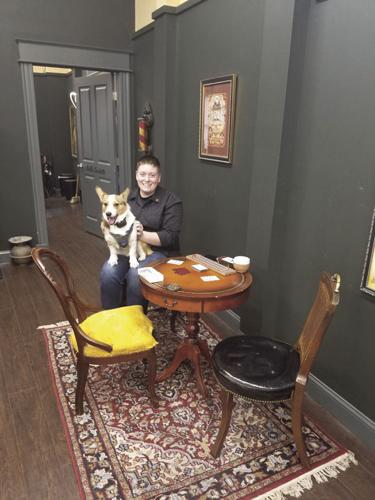
“We offer an experience that is different” from other barbershops in the city, said Breanna Neal, owner of Polished & Proper, which is next to Wayfarer. “You know you’re going to get quality and friendly conversation, and you’re going to walk out happier than when you walked in.”
An important emissary of goodwill, and a co-worker who combats stress, is Neal’s dog, Harvey, an 11-month-old Pembroke Welsh Corgi, who relishes his job of greeting customers. “For me and others who are introverts, if there’s a party, you’re going to make friends first with the dog.”
Neal, an Air Force veteran who ran for city council two years ago (and lost by a dice roll when there were no precedents for deciding a tie vote), said she wishes more downtown landlords would take a long-term view of ownership and investment, and realize how maintaining a building’s appearance benefits everyone — visitors, property owners, and downtown commerce.
John Moriarty, who owns the building that houses the The Studio, New Leaf, and Re/Max Real Estate, calls his own development strategy “productive philanthropy,” which he said depends on putting in tenants who will last, without requiring immediate financial returns.
The city “has terrific bones,” Moriarty said. “All roads lead to Laconia.”
Public parking in community lots adjacent to downtown is rarely more than 60 percent full, he said.
What’s missing downtown is residential real estate, Moriarty said. “People want to live here.”
According to real estate data, more homes are bought in Laconia than in surrounding towns, but codes make it difficult to renovate and invest in property, and that doesn’t help the tumble-down look, Moriarty said.


(0) comments
Welcome to the discussion.
Log In
Keep it Clean. Please avoid obscene, vulgar, lewd, racist or sexually-oriented language.
PLEASE TURN OFF YOUR CAPS LOCK.
Don't Threaten. Threats of harming another person will not be tolerated.
Be Truthful. Don't knowingly lie about anyone or anything.
Be Nice. No racism, sexism or any sort of -ism that is degrading to another person.
Be Proactive. Use the 'Report' link on each comment to let us know of abusive posts.
Share with Us. We'd love to hear eyewitness accounts, the history behind an article.