



GILFORD — When he was four months old, Chris Remick came to the United States from South Korea. Adopted by white parents and raised in Gilford, he became the only Asian student in his classes at school. He also became accustomed to jabs about his skin color. All his friends were white, and more than anything “I just wanted to fit in,” he said, “like a normal kid.”
During middle school, one student made a joke about Remick not being able to read notes on the "white board." At age 12, when he made the all-star basketball team at Gilford Rec, his friends who weren’t selected were jealous. One said, “My parents told me the only reason you’re any good is because your skin is brown.” Another said, “But that’s OK, because (my parents) said that’s all it’s good for.”
When Remick was 16 and in his first driver’s ed class, he said he’d been warned about the teacher. While Remick was driving, the instructor pelted insults about how “people like me don’t belong in New Hampshire. People like me were born to fail classes like this.”
“It’s already a little overwhelming for a 16-year-old kid to be behind the wheel while keeping everyone safe,” Remick said. “Stuff like that is not acceptable anywhere.”
After another student, who went to a different high school, told his mother what had happened, she informed school officials, and that district banned its students from using that driving school, which eventually went out of business.
“That just speaks to how we can be allies to everybody. It just took one person to speak up,” Remick said. “I couldn’t be more proud of those people for standing up for me. I don’t even know them.”
Wednesday night’s rally at Gilford’s town field brought a compendium of testimonies by students who experience or spoke out against discrimination, including Jaylin Tully, a Gilford High senior from Gilmanton, whose biological parents are of different races: “My first time being called a ni***r by an adult white male was when I was seven, and looking at Oreos in Vista Foods...As someone who has seen racism rear its ugly head, my heart breaks for every single black man, woman and child who is unable to exist in their own country free of fear or pain. Everyone here needs to care about all black lives, not the just ones that are dead.”
Talk about it
It’s important to have conversations in your town and with family members, Tully said. “I think the one thing I can do more than anything is educate. I’m black when go out, when I’m home and when I go to school. It's being the only person of your race in a room, almost all the time. It's “being called ‘smart’ or ‘pretty’ for a black girl, as if that’s even a compliment,” said Tully, who plans to go to Lakes Region Community College next year and become a gynecologist after medical school.
Samm Johnson, who co-organized the rally in honor of her friend, Chloe Bourgeois, researched ways to be an ally to people of color. More than standing in solidarity with her friend from their freshman year at Gilford High, Johnson wanted to give the audience a takeaway message on how to stand up, speak out and change, she said – one that might resonate with sympathetic and critical residents in Gilford.
Just before Johnson’s African-American grandfather, a Vietnam veteran, flew to combat in Asia, she said he tasted racism at a New Jersey diner. When he and members of his regiment stopped for breakfast, the waiter served everyone except the single black soldier in the group.
“Aren’t you going to take his order?” his commanding sergeant asked. The waiter said the diner didn’t serve blacks. So the sergeant ordered all soldiers back on their buses, and they went to eat at McDonald’s, she said.
It’s an example of taking an active stand against racism, Johnson said – one that burned a sense of honor and fairness into her memory – and one she hopes others may remember and follow.
“I knew quite a few people who thought it was OK to throw the N-word around, and to make jokes about people’s skin color” during high school, said Johnson, who graduated from Gilford High in 2018 and now lives in Canterbury. “It’s not enough not to be racist,” she said. “I’m telling people to make sure their activism doesn’t end with this rally.”
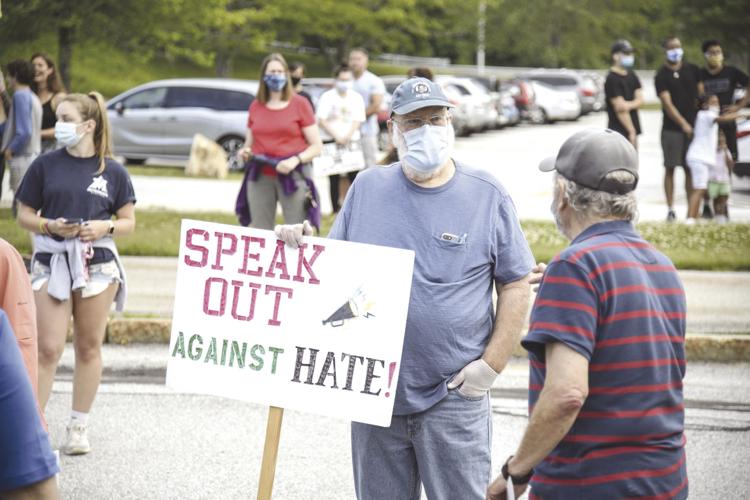
On Wednesday, Johnson’s message to over 200 people gathered at the town gazebo was about ways white people can become better allies to those who experience hate or discrimination because of their skin color or ethnicity, or because they are members of a minority group.
This requires taking an active stand, Johnson told the crowd.
First, listen without speaking over anyone to their thoughts, feelings, ideas and experiences, she said.
Get educated about history and current issues facing marginalized communities through books, articles and films, and seek out anti-oppression training, she said. “Make sure you know what you’re talking about before you start talking about it,” Johnson also advised in a post on Facebook. “Educate, not humiliate.”
Join local groups working for social justice, and intervene when you when you witness injustice, she said. When you see someone being physically or verbally attacked, ask if they would like your help, Johnson said. Focus on supporting them, rather than engaging the aggressor.
Actively call people out – friends, relatives, co-workers or strangers – for racist remarks, including those statements they may not intend to be hurtful. “Silence allows oppression to continue,” she said. “Don’t comment on every situation with your own perspective, or go out of your way to prove how aware or educated you are. Uplift others without speaking for them.”
“When you encounter something that makes you uncomfortable…ask yourself, ‘why do I feel this way?’ We as white people can never truly know how people of color feel, but we can work through our own feelings and recognize that it’s their time to be heard, whether you like what they have to say or not.”
Johnson said people can learn from their mistakes and change their behavior. “We all have roles to play in ending racism and ending white supremacy.”
Signs in front of homes on Belknap Mountain Road echoed the themes of the speakers, and included quotes from Dr. Martin Luther King: “Darkness cannot drive out darkness. Only light can do that. Hate cannot drive out hate. Only love can do that.”
“In the end, we will remember not the words of our enemies, but the silence of our friends.”
Rosemary Uicker, 82, a retired art teacher, stood in her front yard, holding a homemade Black Lives Matter poster.
“I think this a new America,” she said. “I grew up in an Irish family in Boston. They told me about their lives when they were the underdog. It’s time to stand up with your brothers and sisters to make America peaceful and good. I think this is a new day and I’m very proud.”
•••
The Sunshine Project is underwritten by grants from the Endowment for Health, New Hampshire’s largest health foundation, and the New Hampshire Charitable Foundation.
Roberta Baker can be reached by email at Roberta@laconiadailysun.com.


(0) comments
Welcome to the discussion.
Log In
Keep it Clean. Please avoid obscene, vulgar, lewd, racist or sexually-oriented language.
PLEASE TURN OFF YOUR CAPS LOCK.
Don't Threaten. Threats of harming another person will not be tolerated.
Be Truthful. Don't knowingly lie about anyone or anything.
Be Nice. No racism, sexism or any sort of -ism that is degrading to another person.
Be Proactive. Use the 'Report' link on each comment to let us know of abusive posts.
Share with Us. We'd love to hear eyewitness accounts, the history behind an article.