


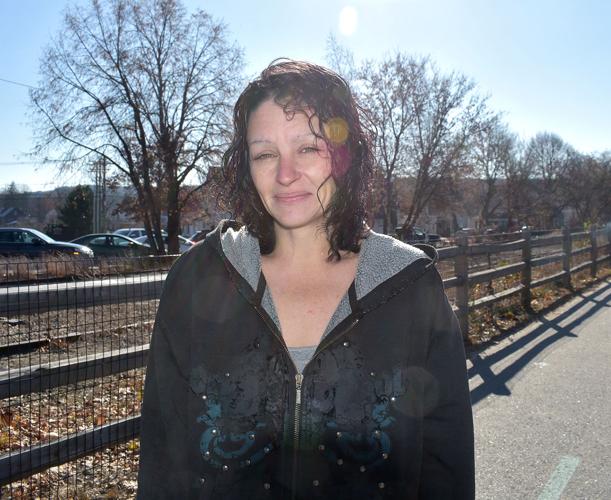

LACONIA – Stephanie, who is 42, wants to be identified by her first name only – so she doesn’t embarrass her sister who lives here. She came north from Massachusetts, she said, “to get away from drugs and alcohol” which helped her tolerate life on the streets. She’s been homeless and on her own for six years.
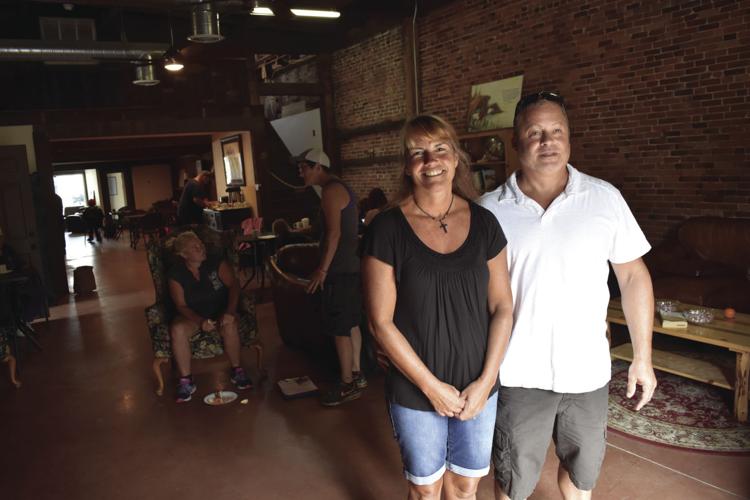
As winter settles in the woods outside the city, “We’re building shelters and making sure our tents are equipped,” she said recently at Isaiah 61 Café on New Salem Street – a soup kitchen with showers, laundry facilities and lockers, where area homeless people come weekdays for a mid-day meal. Stephanie finds warm clothes she can layer and items she can use by dumpster-diving in strategic locations. “I make sure I find clothes for everyone,” she said.
Laconia Police Chief Matt Canfield said it’s difficult to gauge the size of the local homeless population because of the number of transients who come through the area.
The reasons for homelessness range from job loss to substance addiction, family breakups, and rents which exceed the ability of lower-income working people to pay – and an ongoing shortage of housing that is truly affordable for most. Housing First, a national movement and strategy for helping people out of homelessness, is based on providing a dependable place to live before addressing the life and mental health factors that lead to chronic homelessness; it’s nearly impossible to tackle substance addiction and perennial unemployment when someone doesn’t have a place to live, experts say.
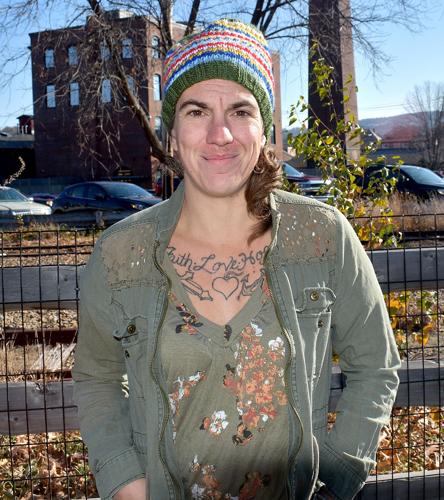
Rebecca Hanson said she has been without a secure place to live for a year and a half. She stayed briefly at the Carey House on Spring Street, but said she was told to leave by a staff member who said she wasn't competent enough to follow the shelter’s rules. Since then, Hanson’s been sleeping in a tent, keeping herself warm with blankets – which provide heat, but not security. "Some scary nights, I don't even go to my tent," she said.
Hanson said Isaiah 61 Cafe has been a welcome addition for local homeless people because it opens its doors to everyone – regardless of whether they’re struggling with drug or alcohol addiction. Laconia needs shelter space that does the same, she said, shaping services for the people it helps – not assisting only those who fit a certain profile.
"Something for everyone," Hanson said, "It's supposed to be individualized."
Amy Beaudoin works in homeless outreach – she is not affiliated with Isaiah 61 Cafe – and was recently living in Plymouth, where she opened her door to people who, because of substance misuse, had no other shelter options. She said she lost her apartment when one of the people she took in died while she was at work. Afterward, Beaudoin lived for a week in the woods, before finding a shelter bed in Laconia.
She said the community needs to be more inclusive of all homeless people if it wants to help them out of homelessness.
Shelters demand sobriety and enforce curfews, which excludes people who are substance-dependent.
"You can't stop overnight," Beaudoin said. "How do you expect them to change overnight?"
For the size and needs of its homeless population, Laconia can and should do more, according to local homeless people and service providers.
Coming together around a pressing issue that looms as a humanitarian crisis – as well as an embarrassment in an area with pockets of conspicuous wealth - is essential to addressing the problem and its roots, they say.
Carmen Lorentz, executive director of Lakes Region Community Developers, which has created new affordable housing developments for residents in a variety of circumstances – including seniors whose finances have been exhausted by medical bills – has said affordable housing remains a community’s most enduring weapon against homelessness.
Over the last 10 years, homelessness in New Hampshire has far outpaced the state's population growth, she said, reflecting a disconnect between real estate prices and the pocketbooks of a bulk of the people who live here.
"Housing is only being created for people with a lot of money," Lorentz said, "but there are more people who need housing on the lower end of the income spectrum. If you've got a bad landlord history or a substance abuse problem or a criminal background, it's making it very much harder for the people at the bottom to find a place to live."
“Poverty is not just a financial issue," she said. "It’s lacking a network to help you in time. We need a crisis shelter for people to live for a short time to get connected to treatment, specifically designed for people in the throes of drug addiction” – as well as affordable housing for homeless people to move into.
“It’s a matter of priorities. What is the city’s priority?” said Dave Longval, co-founder of Isaiah 61 Café. Families should be first in line for shelter, he said, “But we have no (low barrier) facility at all. When it comes to the addiction crisis no one wants to deal with them.” Longval, who owns apartment houses in Laconia, said his long-term goal is to open a low-barrier homeless shelter that serves those with addictions.
“Families are camping out in the woods, or in their cars, and bringing their children for meals,” he said. “People with addictions are camping in the woods or couch-hopping, and if they still have a car they’ll be in their car.”
The Laconia Salvation Army is considering adding an annex to its Carey House shelter on Spring Street that will include a cold-weather-only shelter with 10 to 12 beds, and six “safe beds” for people referred from The Doorway at Lakes Region General Hospital who need short-term housing while their addiction medications are balanced. The expansion is currently in the planning stage.
Right now the state’s low-barrier shelters that serve homeless people with addictions are concentrated on the Seacoast or the southern part of the state, with the exception of Tyler Blain House, a 13-bed facility in Coos County, said Cath Kuhn, director of the NH Coalition to End Homelessness. Because of rising local demand, “wet” shelters such as New Horizons in Manchester are limiting service to people in their areas – and that can leave homeless people who live well north of Concord without a bed.
Beaudoin said she can name about 30 people who currently live on the streets or in the woods, and another 200 who squat in places they don't have a legal right to occupy, or who live at a friend's place.
“Our state is still feeling the impact of the very serious opioid epidemic,” Kuhn said. “There are a lot of families that need support through that. Emergency shelters need to be as low-barrier as possible so we’re not keeping people out. Just because they’re using is not a reason to turn someone away.”
“There needs to be more focus on a local level so people can stay where they live,” said Kuhn. Right now homeless people are “shifting around the state,” traveling considerable distances to find emergency shelter and services in communities they have no connection to.
Beaudoin said she learned a lot from living among people on the streets, who treat others in their situation as members of the same loose tribe – albeit one that is rootless and fluctuating. “They will give the last shirt off their back for anybody,” Beaudoin said. “It takes a village.”
She said she’d like to see the city treat its homeless the same way. More shelter space, transitional housing for people coming out of substance abuse treatment programs, help with employment. As it is now, "it seems like a setup for failure," Beaudoin said.
“A lot of people have drug and alcohol problems and have nowhere to go in the cold,” said Stephanie, who has ties to Laconia. “There’s no help for single people without kids.”
Daily life can be tenuous, she said, even without the challenges of plunging temperatures.
“Every store has the homeless population banned because they’re afraid people are going to steal,” she said – every store except Cumberland Farms on Court Street, which is “the hub activity in town” for people who are homeless.
“Last week when I got poked in the eye with a stick, Tanya at Cumby’s gave me first aid and let me stay inside. But you can’t stand in front of The Spa without them wanting to slap a restraining order on you.”
“It’s a lonely life living on the street,” she said. "I wasn’t addicted to drugs until I was on the street. Just because some people go to AA and are “clean” doesn’t mean life is going to fall in place for you. There’s a lot of pressure put on society to do things the right way,” she said. “What is the right way?”
Longval, of Isaiah 61 Café, wishes more faith-based groups would take an interest in serving or supporting the homeless need. The bustling soup kitchen, as much a weekday gathering place as a way station, is staffed mainly by an army of individual volunteers. Volunteers from Good Shepherd Evangelical Lutheran Church in Laconia and Gilford Community Church prepare and serve food on the second Tuesday of each month and every other Friday. Evangelical Baptist Church and Real Life Church in Laconia provide financial support.
“It’s great to want to go overseas and do missions. But there’s a huge mission field right here,” Longval said.
“This is one of the things we’ve decided is in our purpose, to share and feed,” said Beverly Nelson of Moultonborough, a volunteer from Good Shepherd, wearing a mustard yellow t-shirt printed, “God’s Work. Our Hands.” She spooned a rice dish onto plates. “We feel driven to do this as Christians,”she said. “Here in Laconia there are needs that are obvious.” At the café, “There is no judgment here.”
•••
Staff writer Adam Drapcho contributed to this story.
The Sunshine Project is underwritten by grants from the Endowment for Health, New Hampshire’s largest health foundation, and the New Hampshire Charitable Foundation. Roberta Baker can be reached by email at Roberta@laconiadailysun.com


(0) comments
Welcome to the discussion.
Log In
Keep it Clean. Please avoid obscene, vulgar, lewd, racist or sexually-oriented language.
PLEASE TURN OFF YOUR CAPS LOCK.
Don't Threaten. Threats of harming another person will not be tolerated.
Be Truthful. Don't knowingly lie about anyone or anything.
Be Nice. No racism, sexism or any sort of -ism that is degrading to another person.
Be Proactive. Use the 'Report' link on each comment to let us know of abusive posts.
Share with Us. We'd love to hear eyewitness accounts, the history behind an article.