


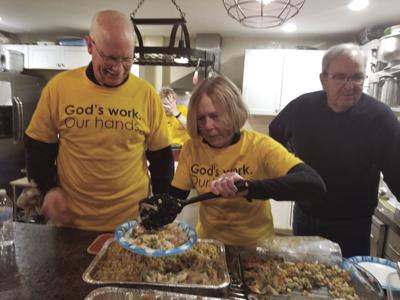
LACONIA — The Laconia Salvation Army is requesting architectural drawings for an annex to its Carey House homeless shelter on Spring Street. It would contain a first-floor cold-weather shelter with 10 to 12 beds. The addition would also include six “safe beds” upstairs for homeless patients referred by The Doorway program at Lakes Region General Hospital who need short-term housing while their addiction medications are balanced.
Salvation Army Capt. Scott Neal said Friday the proposal is still in the planning phase, and will ultimately depend on community support and fundraising success.
If built, it could prove a critical addition to local homeless shelters that are operating year-round at or near capacity, regardless of the weather, and regularly must turn people away, experts say.
“Over the past five years, we’ve seen a significant increase in the homeless population in Laconia,” said Laconia Police Chief Matt Canfield. “It’s one of the more significant community concerns that we deal with, and it has an impact on all community services. Certainly the addition of any resources – shelters or short-term housing or resources for drug and alcohol addiction – would be helpful.”
Isaiah 61 Café, a soup kitchen and homeless resource center on New Salem Street, currently serves about 70 meals each week to people who are homeless or struggling. That's up from the 40 weekly meals it served when it opened 16 months ago, according to co-founder and manager, Dave Longval.
Belknap House on Court Street opened in February 2017 as a cold-weather-only shelter with 19 beds for families and pregnant women who live in Belknap County, subsidized by revenues from operating as a summer hostel. When it reopened last month as a year-round shelter, rooms were filled the first week, and three families came in opening day, said Colleen Garrity, board president of Belknap House.
Pamela Clark, general assistance coordinator for the town of Gilford, said two homeless families in Gilford waited for over two months for Belknap House to reopen. They alternated between sleeping on couches or in cars, and using vouchers for rooms at local hotels.
Currently, when Belknap House and Carey House are full, homeless people who come to Laconia’s welfare office are given vouchers to stay at a motel in West Franklin. The Landmark Hotel on Court Street used to accept vouchers, but stopped that practice after it was renovated. That leaves the DK Motel, a 32-minute drive from downtown Laconia, as the only motel in the Lakes Region accepting the city’s vouchers for emergency housing in cold weather, said Glen Smith, the city’s finance and welfare director.
“The resources are very limited in Laconia for the homeless,” said Longval, a Sanbornton resident who owns five apartment buildings in Laconia and started Isaiah 61 Café with his wife Dawn to serve a growing need.
“Demand is bigger than capacity,” said Clark in Gilford. “If there’s nothing available, you can’t place them. You’re trying to make the impossible happen. Some people sleep in cars and tents.”
“Based on phone calls and requests that we get, there’s an increasing need for families and individuals, and those who have addictions and can’t go in other shelters,” said Leonard Campbell, local director of outreach for Catholic Charities.
At a time when ranks of the homeless are increasing statewide – including families, out-of-work people and those whose lives are upended by substance abuse – New Hampshire towns and cities are grappling with ways to accommodate their own, even as the need is growing faster than local solutions can be conceived or built. More affordable house locally is a pressing and universal goal, experts say.
“If you look at Laconia, it’s at an interesting nexus. We have an aging population, a drug problem, a widening wealth gap and unemployment higher than the state average,” said Campbell, who also convenes a monthly gathering of service providers who assist the homeless. “Local agencies are doing great work, but it’s not touching all the people.” Affordable housing stock needs to increase, he said, and “local welfare departments can look more at ways to prevent homelessness.”
The reasons for homelessness are multi-faceted, and can be tied to a perfect storm of opioid addiction, job loss, family dissolution, and wages that are out-of-synch with local rental rates.
“A tire blows out and someone’s homeless” because they can’t get to work, Campbell said. “Someone gets sick and loses a couple of days of work and becomes homeless” after they’re fired and can no longer pay rent, or have to choose between food for the family and paying rent. “It’s not one-size fits all,” The result, he said, is “people are sleeping in hallways and the woods when it starts to get cold.”
Canfield said Laconia police respond to complaints from property owners about homeless people camping on their land, and reports of homeless people sleeping in municipal parks and beaches after hours. Police clear out homeless encampments that are reported violations, but “if we clear out one, they just go to another area. We just kind of displace the problem.”
Cathy Kuhn, director of the New Hampshire Coalition to End Homelessness, said what appears to be a statewide uptick in homelessness has been evident in a recent increase in people living outside in Manchester, which has the largest homeless population of any municipality in the state. City police and fire officials recently reported “never seeing anything like it,” Kuhn said.
“If you ask around the state, it tends to get more intense every year,” said Kuhn. The state’s next snapshot report on homelessness in New Hampshire, reflecting data from January 2019, will be released December 18.
“It seems like we’re having to turn more people away,” at shelters across the state, Kuhn said, adding that it can be difficult to get people out of emergency shelters because of the shortage of affordable housing. People are staying in shelters for longer periods of time” and that means more homeless people can’t find a space when they need one.
“I hear from communities all the time, particularly small, rural communities, ‘We’re seeing more homeless people on the street and more homeless families asking for support and we don’t know what to do.’" Faith-based groups are also reporting more people asking for financial help, she said.
The homeless coalition’s director said municipalities across the state must focus on creating local resources and a safety net so people can stay where they live instead of moving around the state to find space in an emergency. “Do you have a place in your community that can be available so you don’t have to ship a family or an individual 100 miles away to a shelter?’
Effective stop-gap measures in small and rural communities include converting a community resource center or church basement – or even empty space in a nonprofit agency office – to a temporary shelter on the coldest nights, said Kuhn. Smaller, far-flung communities don’t always have a local hotel, or one that is willing to accommodate homeless people, or accept municipal vouchers. It's important to have an overflow station or shelter that can be activated on nights when people are at risk, and find volunteers to staff it for one or two days during a cold snap, she said.
The solutions to the homeless problem lie upstream of the crisis, experts note.
“Eviction prevention assistance is something needed across the state,” Kuhn said. “That can be hugely helpful in slowing down the flow of people becoming homeless.”
Increasing the amount of affordable housing across the state is essential, but not instantaneous. In the interim, people need emergency housing. Helping homeless people get housing quickly also frees up time to allow them to look for work, Kuhn said.
“Towns need to make sure they’re doing something in their own area and that people who come in are tied back to their towns," said Campbell of Catholic Charities. "Towns are afraid that if they keep someone (from outside), it’s going to cost them a lot of money” down the road.


(0) comments
Welcome to the discussion.
Log In
Keep it Clean. Please avoid obscene, vulgar, lewd, racist or sexually-oriented language.
PLEASE TURN OFF YOUR CAPS LOCK.
Don't Threaten. Threats of harming another person will not be tolerated.
Be Truthful. Don't knowingly lie about anyone or anything.
Be Nice. No racism, sexism or any sort of -ism that is degrading to another person.
Be Proactive. Use the 'Report' link on each comment to let us know of abusive posts.
Share with Us. We'd love to hear eyewitness accounts, the history behind an article.