


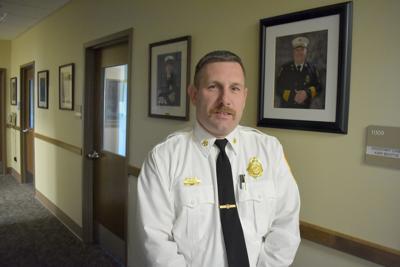
TILTON — Tilton-Northfield Fire & EMS advertised for six weeks for someone to replace a firefighter who left in January for an opening at a department in Keene. But none of the six applicants who replied were also paramedics – a designation highly prized by fire departments – who double as first responders to all sorts of medical emergencies, from heart attacks to childbirth and interrupted breathing.
To attract and retain applicants, Tilton-Northfield Fire & EMS requires a five-year contract and pays for paramedic training after one year of service, which could cost applicants roughly $12,000 if they had to pay personally. But competition for firefighter-first responders is steep, especially in the Lakes Region. There's a greater demand for paramedics than there are paramedics available statewide.
Tilton-Northfield Fire & EMS pays $17.93 and hour for starting employees, who must come with firefighter certification, emergency medical training and a commercial driver’s license – which can be expensive and time-consuming to achieve. Downstate, the same entry-level job pays $20 to $22 an hour, Fire Chief Michael Sitar said. In southern New Hampshire, firefighters who are paramedics make $24 an hour.
The problem isn’t confined to Tilton. Before and during the coronavirus pandemic, it has created a paramedic crunch for fire departments in the northern two-thirds of the state.
Compounding the problem over the last four years has been New Hampshire’s robust economy – a godsend for business activity, jobs, earnings and savings and retirement accounts, which are now imperiled by coronavirus fallout. People who may have considered firefighting careers were lured by more lucrative jobs in private industry, as well as higher wages at fire departments in Hillsborough and Rockingham counties, and in Massachusetts, Sitar said. “The economy just kept growing and growing. In bad times, fire departments are good and steady jobs,” said Sitar, who has been a firefighter for 40 years.
To face the coronavirus, the Tilton-Northfield department is staffed with EMTs, whose training is sufficient in almost all medical emergencies, including those related to the current pandemic. But attracting and keeping more highly-trained paramedics – the fire industry’s standard of care – is increasingly challenging, he said. Paramedics have specialized skills in treating children, can administer many more types of medications, and are trained in advanced tools to alleviate respiratory distress, including intubation, which enables oxygen to get through clogged airways to lungs.
The New Hampshire Fire Chiefs Association is looking at ways to solve the paramedic shortage, including greater advertising, training incentives and recruitment efforts, said Laconia Fire Chief Kirk Beattie, a member of the association's board. The efforts may not pay off soon enough.
“We’re seeing an overall decrease in applicants with any EMT training,” said Beattie. “It’s been trending for a couple of years. Finding paramedics who are also firefighters has been increasingly difficult.”
Gilford Fire and Rescue currently has openings for three firefighters, and only one of 14 applicants was a paramedic, Chief Stephen Carrier said. "They're trained to a much higher level" than advanced or basic EMTs, he said. "Their patient assessment skills are at a different level. They can give a lot more more drugs and can perform more skilled and invasive procedures."
Economists say national and international crises such as this pandemic can pinpoint fundamental deficiencies in health care and other systems, including shortages of physicians, nurses and specialized workers including paramedics, who are essential to long-term community wellbeing and safety.
“I think all health care workers across the board are vulnerable, and we’re very fortunate that the shortages that are beginning up pop up are not more intense than they have been,” said Russ Thibeault, an economist at Applied Economic Research in Laconia. “Maintaining our stock of health care workers should be a number one priority, along with giving them the protection they need.”
Over the last decade, healthcare has been a growth generator for New Hampshire, Thibeault said. In September 2019, there were roughly 79,000 health care professionals employed statewide, including those at hospitals, clinics, nursing facilities, and in ambulatory care, compared to about 55,000 in 2000, according the New Hampshire Department of Employment Security.
The challenge now is to ramp up quickly when needs surge during emergencies. As of March 30, 450 volunteers had signed up with NH Responds, a statewide network of volunteers with or without medical training, to help meeting surging health care needs during the coronavirus crisis. It is unknown how many are trained in emergency medical services.
“Right now, there’s a high level of paramedic recruitment in the southern part of the state,” said Franklin Fire Department Chief Michael Foss. Currently three of the Franklin department’s 14 full-time firefighters are paramedics.
“Advanced EMTs are a great resource,” Foss said, “but they cannot provide all the same medical interventions,” such as advanced airway maneuvers and administering the full range of cardiac medications.
So far it, that hasn’t been a problem during the coronavirus, Foss said. Roughly a third of emergency calls to Franklin FD are coming from people who report symptoms similar to coronavirus.
At times, Lakes Region fire departments have had to request assistance from paramedics from outside the Lakes Region mutual fire aid agreement, at a cost of $550 per ambulance trip – a rate that may increase, Foss said. Franklin has had three such cases since July.
“If the trending goes the way it has been and we see a decline in paramedics in the Lakes Region in the months and years to come, ambulance service in the Lakes Region will be affected,” said Foss.
“People think firefighters just go to fires,” he said. “Keeping up on their craft is where most of their time is spent.” In additional to emergency medical training, firefighters must stay proficient in different types of technical rescues, including from trenches, confined spaces, high water, swift water and at high angles, Foss said.


(0) comments
Welcome to the discussion.
Log In
Keep it Clean. Please avoid obscene, vulgar, lewd, racist or sexually-oriented language.
PLEASE TURN OFF YOUR CAPS LOCK.
Don't Threaten. Threats of harming another person will not be tolerated.
Be Truthful. Don't knowingly lie about anyone or anything.
Be Nice. No racism, sexism or any sort of -ism that is degrading to another person.
Be Proactive. Use the 'Report' link on each comment to let us know of abusive posts.
Share with Us. We'd love to hear eyewitness accounts, the history behind an article.