


Franklin was working on its opioid problem.
The Three Rivers City was among those hit hardest by the crisis in New Hampshire, and as federal money began to flow into the state, first responders and substance abuse clinics worked toward prevention, treatment and recovery efforts.
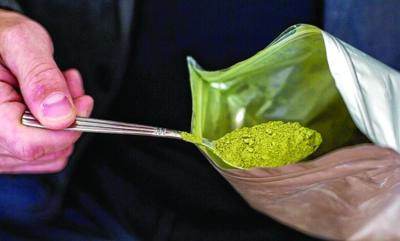
Around the same time, however, a new drug came on the scene. Kratom, made from a tropical plant in southeastern Asia, contains the compound 7-hydroxymitragynine — more commonly known as 7-OH — and is often used to relieve pain or to wean off opioids. The substance, sometimes called “gas station heroin,” is federally legal, widely sold in smokeshops and gas stations and has no state-mandated age limit.
The Franklin City Council took matters into its own hands, banning the use, possession and sale of the products within city borders in 2019.
A city ordinance isn’t law — offenders face fines rather than jail time — but Police Chief Daniel Poirier said things have improved in the years since Franklin banned kratom and other drugs, including those known as “spice” and “K2.”
“We really haven’t had as much of a problem with it since then,” Poirier said. “Obviously, it wasn’t illegal, but it was the city ordinance for the city of Franklin. It wasn’t allowed here.”
Now, state lawmakers are hoping to take the ban statewide, sending legislation to Gov. Kelly Ayotte’s desk that would prohibit the sale of all “enhanced” kratom products.
Two tales in Franklin
Some officials in Franklin say kratom use has likely declined alongside other drug use. The fire department does not track kratom-related calls but saw a reduction in overdose calls where Narcan is deployed, down from 89 in 2017 to just 10 last year. The city’s biggest problem is heroin, which accounted for 38% of drug-related emergency calls over the past decade.
At the same time, addiction counselors and experts say kratom use is on the rise.
Mark Watman, vice president and chief operating officer of the recovery center Archways, which has locations in Franklin, Concord, Tilton and Plymouth, said he’s noticed more people experiencing issues with kratom over the past two years.
“It’s a fairly consistent stream of people coming in,” he said.
Kratom use is difficult to track locally because it’s often not the main factor for an emergency call or someone seeking help for addiction. Instead, it’s often used in tandem or combined with other substances.
Nationally, kratom use is escalating. The Centers for Disease Control’s National Poison Data System tracked a 1,200% increase in kratom-related reports, with 3,434 last year.
Some people do report benefits from small doses of kratom, according to Randy Herk, director of prevention and early intervention services at Reality Check in Jaffrey. The plant acts as a stimulant in low doses, and people use it to relieve pain and as a mood and energy boost, though it is not approved or regulated by the U.S. Food and Drug Administration.
Some also use it to relieve symptoms of opioid withdrawal, but experts warn it’s a double-edged sword. Though it’s not an opioid, it can act like one and carry its own danger of addiction.
“The same with nicotine, you know, some people have that initial part where nicotine helps them, and then it develops, and then it becomes a negative,” Herk said.
To see meaningful change, Watman said it can’t just be New Hampshire’s smallest city banning the substance on its own.
“It’s not hard to go to another town to pick it up,” he said.
Rather, Watman said, it requires statewide control — and lawmakers are on board.
State steps in
The House passed legislation on Thursday to ban any licensee of the Liquor Commission from selling products with “enhanced levels” of 7-OH that are not naturally found in the kratom leaf.
The Liquor Commission already regulates any business with a liquor license, including gas stations and vape shops, where most kratom products are found.
“Kratom-infused energy drinks are sitting on convenience store shelves right now, available to anyone who comes in, including children, who today have complete, unfettered access to every form of kratom in the state,” said Jerry Stringham, a Lincoln Democrat. “There are no age restrictions, no labeling requirements, no safety standards, nothing — and every member of this body agrees this must change.”
If any shops violate the law, the punishment would be up to the Liquor Commission. Upon second offense, their license to sell alcohol would be revoked.
Deputy Majority Leader Joe Sweeney, a Salem Republican, pushed another version. On one hand, he wanted to be stricter, making it illegal for anyone to possess, distribute or manufacture certain products and classifying them as a Schedule II controlled drug. On the other hand, the bill allowed products containing up to 1,000 parts per million of 7-OH — much higher than the natural levels. That, he argued, would get “the bad kratom out of New Hampshire while keeping the market alive for the good kratom.”
Democrats said making it a criminal offense would force local police departments to get involved without giving them the funding to do so.
Gov. Kelly Ayotte hasn’t shared her thoughts on the bill, but has pushed for more drug regulation and harsher penalties for harmful drugs like fentanyl. Her office did not respond to a request for comment by deadline.
Herk, in Jaffrey, said he was keeping his expectations low, knowing how slow and “watered down” legislation can get.
“Something’s better than nothing,” he said. “We’re making steps in the right direction.”
For Watman, regulation helps, but he wants lawmakers and communities to see kratom as a symptom of larger challenges and care for their neighbors.
“We’re talking about an epidemic of addiction, and the substances are really just a symptom to the larger sense of dis-ease and not feeling a part of something meaningful in people’s lives,” he said. “That’s what we really need to attend to: better mental health counseling, more money put towards substance use and addiction treatments and, most importantly, much greater empathy for the people who are suffering.”
•••
These articles are being shared by partners in the Granite State News Collaborative. Don’t just read this. Share it with one person who doesn’t usually follow local news — that’s how we make an impact. For more information, visit collaborativenh.org.


(0) comments
Welcome to the discussion.
Log In
Keep it Clean. Please avoid obscene, vulgar, lewd, racist or sexually-oriented language.
PLEASE TURN OFF YOUR CAPS LOCK.
Don't Threaten. Threats of harming another person will not be tolerated.
Be Truthful. Don't knowingly lie about anyone or anything.
Be Nice. No racism, sexism or any sort of -ism that is degrading to another person.
Be Proactive. Use the 'Report' link on each comment to let us know of abusive posts.
Share with Us. We'd love to hear eyewitness accounts, the history behind an article.