


LACONIA — Faculty returned to Lakes Region Community College — at least in a virtual sense — on Monday.
“Normally, on the first day faculty is back, everybody is here and we have an all-college meeting,” LRCC president Larissa Baia said. “It’s our 'welcome back' to all faculty who have been away for the summer, and it sets the tone for the next two weeks leading up to the start of semester.”
On Monday, a Zoom meeting was held instead.
When they come back to teach classes, some of the instruction will also be virtual.
“We are expecting staff to be on campus a maximum of three days a week,” she said. “The rest of the time they will be working remotely. The less people we have here, the less the risks of transmitting the virus.”
When students return on Aug. 31, they will notice new protocols to guard against the transmission of COVID-19.
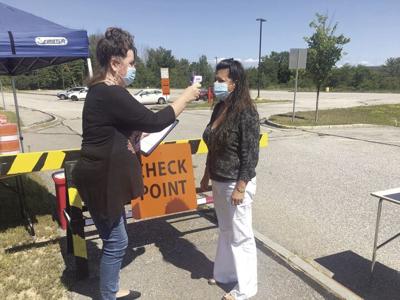
For those attending in-person classes, they will stop at a checkpoint on their way in and have their temperature taken.
Instruction will be delivered through a hybrid learning model that will include online and in-person classes.
Unlike some universities, community colleges will not require their students to take a COVID-19 test.
Enrollment is down 16 percent by credit hour and 10 percent by number of students compared to last year at this time, Baia said.
These numbers are good compared to other community colleges in the state.
Susan Huard, interim chancellor for the Community College System of New Hampshire, said Monday that the characteristics of the typical community college student mean that some are not able to return to classes at this time.
“So many of our students are in fact essential workers,” she said. “They may come back in September, October or they may wait until spring.”
The age of the average community college students skews older than those at four-year institutions.
“Mom and dad may be trying to fit in their own education and their children’s education while they work in the hospitality or restaurant industry,” Huard said.
Personal protection equipment and social distancing will be key in courses where students have to learn in person.
“The issue is maintaining safety,” Huard said. “Our welders, nurses, cyber security, they will be on campus,” she said. “We need to think in terms of how we keep people safe on campus as they come in and out of the community.”
Given the economic disruption wrought by the pandemic, the community college system has a key role to play, she said.
“We are concerned about funding for helping people retrain,” Huard said in an online conference with Sen. Jeanne Shaheen and other educational leaders. “We want to be well positioned so we can help with short-term training that then can be molded into certificates and degrees.”
Baia, the college president whose doctorate is in political science, said she never thought she would be so immersed in public health planning.
“I don't think any of us could have predicted this in March,” she said. “We were responding to a situation and hoping that things would be getting back to normal rather quickly. This has become the new normal.”


(0) comments
Welcome to the discussion.
Log In
Keep it Clean. Please avoid obscene, vulgar, lewd, racist or sexually-oriented language.
PLEASE TURN OFF YOUR CAPS LOCK.
Don't Threaten. Threats of harming another person will not be tolerated.
Be Truthful. Don't knowingly lie about anyone or anything.
Be Nice. No racism, sexism or any sort of -ism that is degrading to another person.
Be Proactive. Use the 'Report' link on each comment to let us know of abusive posts.
Share with Us. We'd love to hear eyewitness accounts, the history behind an article.