


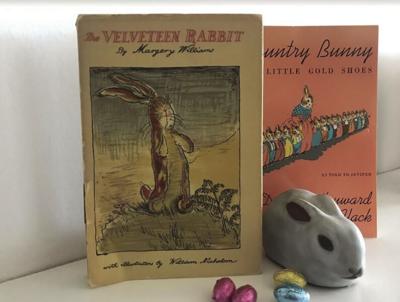
There is something about rabbits. Soft as kittens. The ability to hop, mimicking a frog seated on a lily pad, and eyes that peer at you from a narrow head and pull you in, if you can get close enough.
Just as reindeer play a role in Christmas, rabbits and bunnies are associated with Easter. Why, I wondered? Apparently, others have attempted to figure this out, as well, although it’s still somewhat of a mystery.
According to an article I found in Time magazine:
“According to some sources, the Easter bunny first arrived in America in the 1700s with German immigrants who settled in Pennsylvania and transported their tradition of an egg-laying hare called 'Osterhase' or 'Oschter Haws.' Their children made nests in which this creature could lay its colored eggs. Eventually, the custom spread across the U.S. and the fabled rabbit’s Easter morning deliveries expanded to include chocolate and other types of candy and gifts, while decorated baskets replaced nests. Additionally, children often left out carrots for the bunny in case he got hungry from all his hopping.”
Rabbits and bunnies have been on my mind because two of my favorite children’s books are The Velveteen Rabbit (or How Toys Become Real), a British children's book written by Margery Williams, illustrated by William Nicholson and first published in 1922, and The Country Bunny and the Little Gold Shoes, written by Du Bose Heyward, with illustrations by Marjorie Hack and published in 1939.
In The Country Bunny, a mother bunny, with 21 children, is chosen by the grandfather bunny to become one of the five bunnies who are invited to the Palace of the Easter Eggs to deliver Easter eggs to girls and boys across the land. A special honor. The characteristics of the five bunnies include wisdom, kindness, and swiftness in moving about. When the country bunny is selected, one of her trips is to carry the most beautifully decorated egg to an ill child who lives high on a mountain. Along the way she slips and falls. The grandfather bunny finds her and provides her with a pair of gold shoes, allowing her to fly up to the top of the mountain and deliver the beautiful egg to the sick boy. Now, the grandfather bunny calls her the “bravest” of all the bunnies.
The Country Bunny is an enchanting story that reminds us there is hope. Through perseverance, kindness, and wisdom we can succeed at whatever it is we want to achieve.
My recollections of Easter include polished patent-leather shoes, new white gloves edged in lace and wrapped in white tissue, baskets we filled with eggs found around the house, searching for nests with tiny blue robin eggs and lots of bouquets of spring flowers. There was a long morning church service with glorious music and dozens of potted Easter lilies, followed by a grand luncheon buffet. There is spring renewal found in celebrating Easter and Passover.
This Easter, for the very first time, I’m going to attempt to bake hot crossed buns.
Perseverance will prevail.
•••
Elizabeth Howard is the host of the Short Fuse Podcast, found on Apple Podcasts, Spotify or through the Arts Fuse. Her career intersects journalism, marketing, and communications. Ned O’Gorman: A Glance Back, a book she edited, was published in May 2016. She is the author of A Day with Bonefish Joe, a children’s book, published by David R. Godine. She lives in New York City and has a home in Laconia. You can send her a note at eh@elizabethhoward.com.


(0) comments
Welcome to the discussion.
Log In
Keep it Clean. Please avoid obscene, vulgar, lewd, racist or sexually-oriented language.
PLEASE TURN OFF YOUR CAPS LOCK.
Don't Threaten. Threats of harming another person will not be tolerated.
Be Truthful. Don't knowingly lie about anyone or anything.
Be Nice. No racism, sexism or any sort of -ism that is degrading to another person.
Be Proactive. Use the 'Report' link on each comment to let us know of abusive posts.
Share with Us. We'd love to hear eyewitness accounts, the history behind an article.