




Why 74% of AI customer service chatbots are pulled offline after launch
New research from more than 2,500 enterprise leaders finds the chatbot handling your support request has a better-than-even chance of having already been taken offline and restarted.
The AI-powered chatbot failed. The customer repeated themselves three times, got a confidently wrong answer, and gave up. For the company on the other end, that interaction didn’t just cost a support ticket but something harder to win back.
That scenario is playing out at scale. A new survey of 2,527 enterprise decision-makers across 10 countries conducted on May 12 finds that 74% of companies that deployed AI agents in customer communications have been forced to shut them down or roll them back, often after customers had already experienced the failure firsthand.
The research, published in May by communications infrastructure platform Sinch, examines a specific and underreported problem in the AI market: not whether companies can deploy AI in customer communications, but what happens after they do.
AI customer service has gone mainstream
There's a widely accepted story in enterprise AI that the biggest challenge is getting pilots into production. McKinsey reported in 2025 that two-thirds of organizations remained stuck in experimentation phases. BCG found that 60% had yet to show any material value from their AI investments. Gartner forecast that half of all generative AI projects would be abandoned after proof of concept.
In customer communications specifically, something different happened. A Sinch study shows 62% of organizations already have AI agents live in production across customer channels, and 88% expect to be there by the end of 2026. That's nearly 9 in 10 businesses actively deploying AI agents by the end of this year.
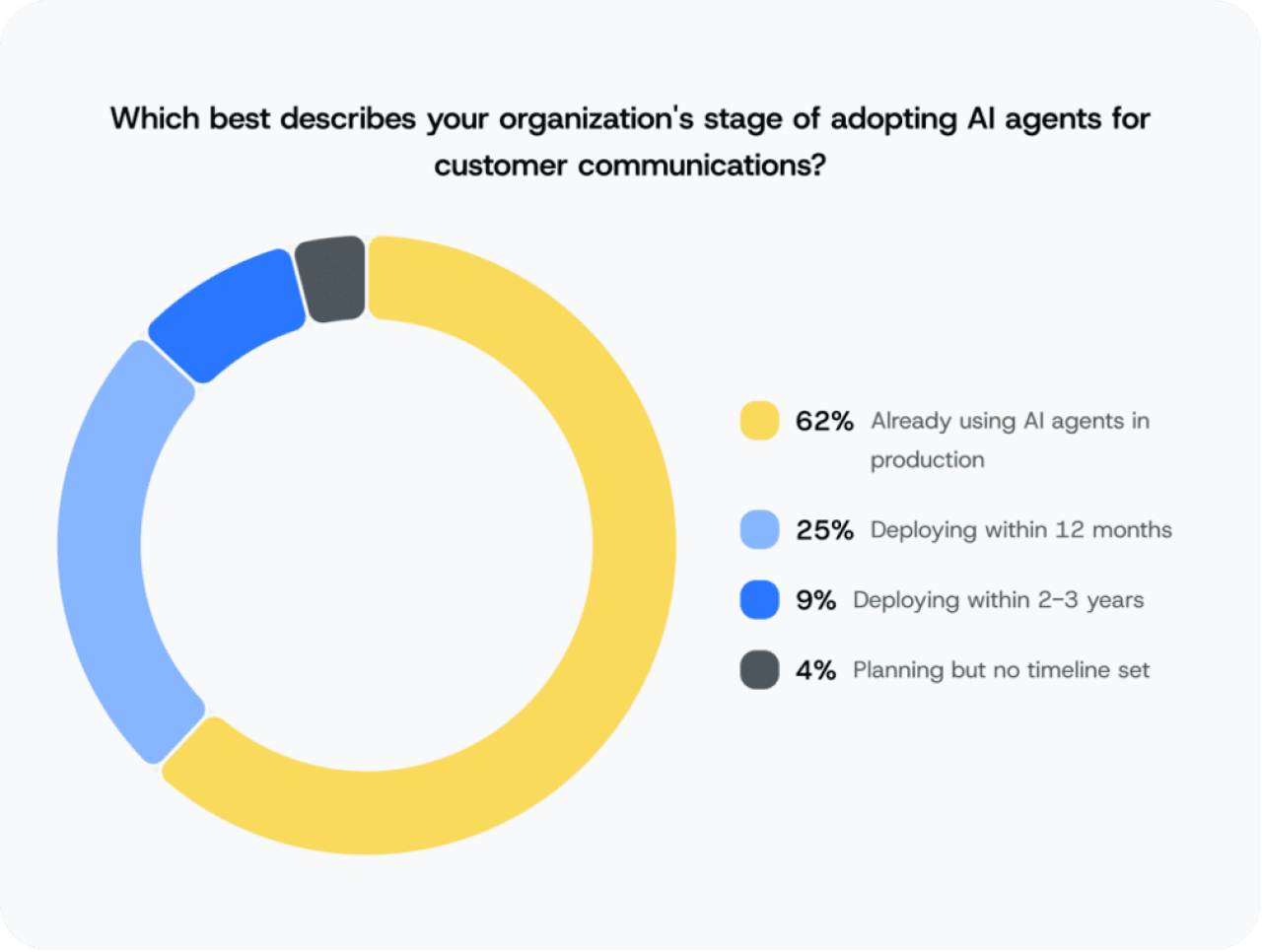
Enterprises aren't dipping a toe in either. The average deployment spans 3.3 channels simultaneously, with nearly half running AI across four or more, including web chatbots, email, social media, WhatsApp, SMS/MMS, RCS, and voice and interactive voice responses. And the goal driving most of that investment isn't cost reduction. For 36% of respondents, the primary objective is improving customer satisfaction and loyalty. They're using AI to compete on customer experience, and to earn something harder to measure than efficiency: customer trust.
By every metric the market established to measure AI progress, these organizations won. They escaped pilot purgatory. They crossed the finish line.
Except that wasn't the finish line.
Going live turned out to be the easy part
Here's the finding that should make every AI communications leader stop and read more carefully: Research by Sinch from 2026 shows that 74% of organizations have been forced to shut down or roll back a live AI customer communications agent.
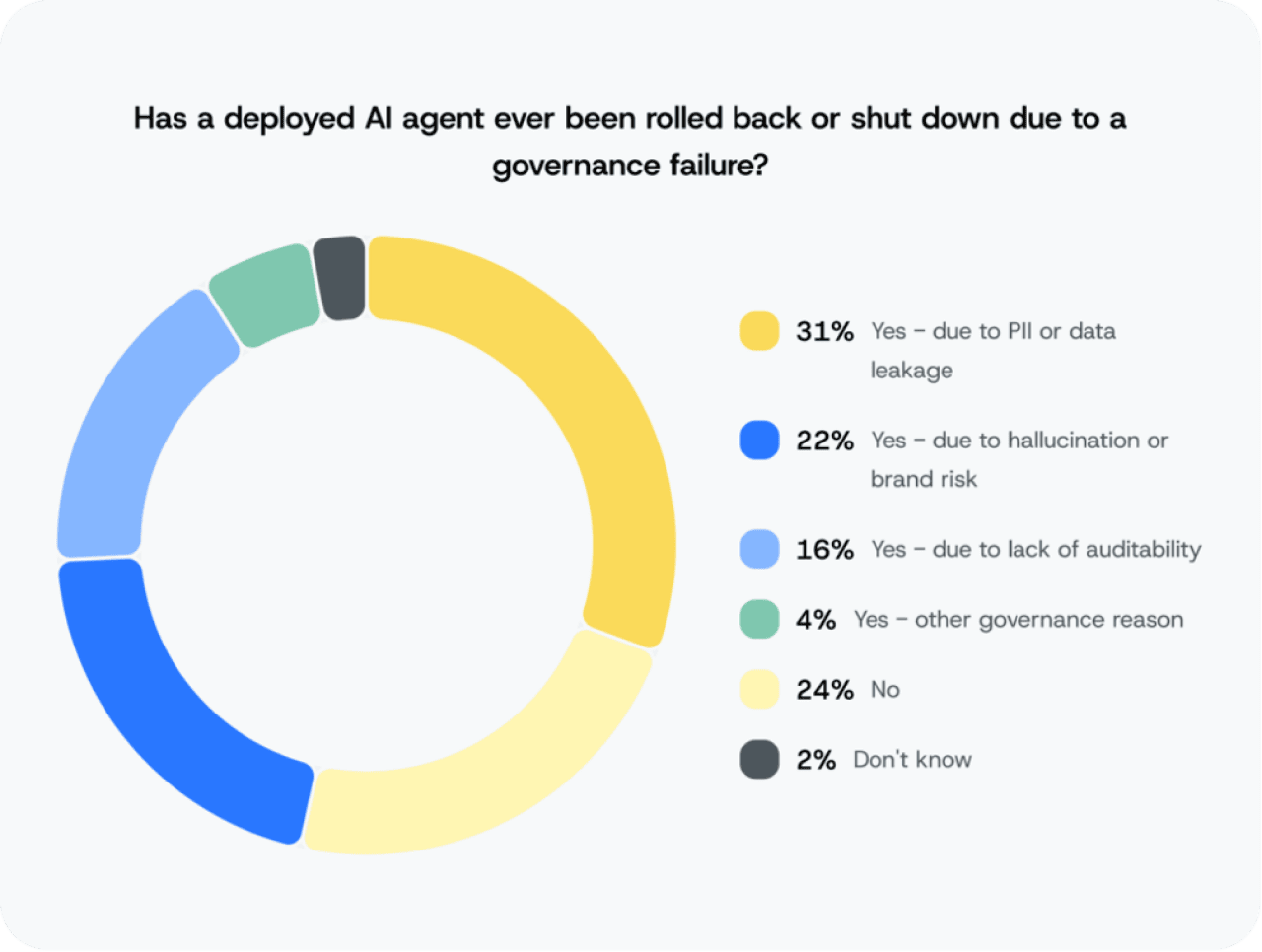
That holds across every region and every industry in the study. It doesn't decline with experience. It doesn't decline with investment. All along, the market has been drawing the wrong finish line, and what happens after enterprises successfully ship radically changes the question every AI communications leader should be asking right now.
More oversight hasn't stopped the shutdowns
Here's where it gets interesting. Among organizations that describe their guardrails as fully mature, the most governed, most monitored AI programs in the survey, the rollback rate is 81%.
More governance, more monitoring, more investment, and still 8 in 10 of the most advanced programs have had to shut something down.
The data offers a worrying explanation. Organizations with mature governance instrumentation can see failures that less mature organizations miss entirely. The programs reporting lower rollback rates aren't necessarily running cleaner AI, and in many cases, they simply lack the monitoring to know when something goes wrong. The organizations reporting no governance failures are not the benchmark. They may just be the ones with the least visibility into what's happening.
And then there's the confidence problem: 90% of enterprise decision-makers describe themselves as confident in their AI agent readiness. Of those already in production, 75% have experienced at least one governance rollback. Confidence doesn't correlate with fewer failures. In many cases, it's the precise condition under which the next failure is being prepared.
The more useful question for any leadership team is, "If something went wrong right now, would we know before our customers did?"
When the chatbot goes down, brands feel it in three ways
When an AI communications agent fails in production, customers notice. The research shows the impact splits in three directions simultaneously, and most organizations are only tracking the first.
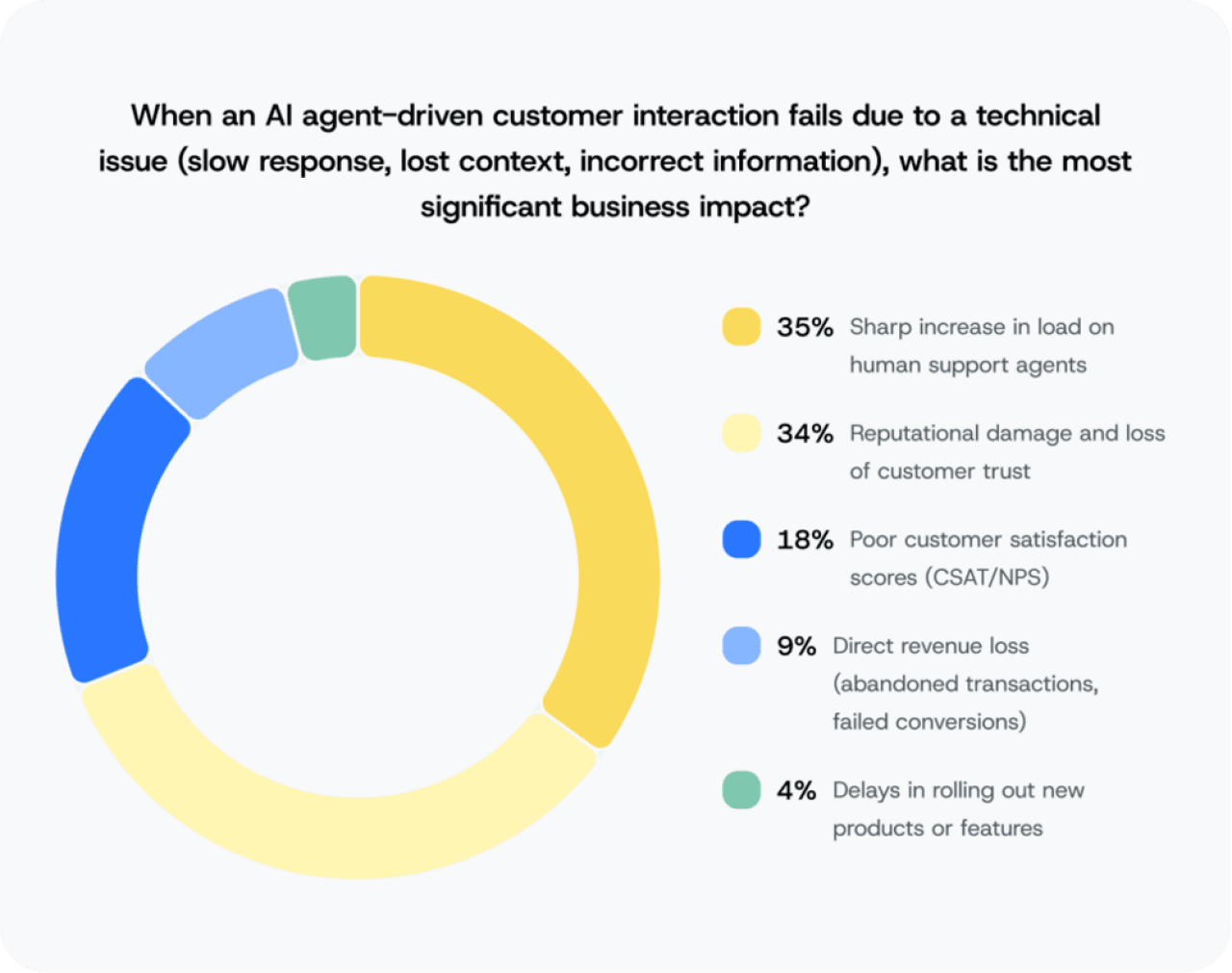
Research by Sinch from 2026 shows an increase in the support queue (35%) and reputational damage to the brand (34%) are the biggest impacts of AI agent failure.
Why support wait time spikes


Thirty-five percent of organizations cite a surge in human support agent load as the primary consequence. The agent goes down, and every interaction it was handling reverts to a human. A support team sized for a world where AI handles significant volume is suddenly managing all of it. At peak moments, a product launch, a service outage, a seasonal spike, that's not an inconvenience. It's an operational crisis.
This is the failure mode that gets reported upward. It shows up in dashboards, generates incident reviews, and resolves when the agent comes back online. It's visible, it's measurable, and it has a clear path to resolution.
Why the brand damage outlasts the outage
Thirty-four percent cite reputational damage and loss of customer trust, essentially tied with support overload. That near-tie is one of the most underreported findings in the survey, because these two failure modes don't resolve the same way. The support queue clears. Brand damage doesn't have a clear path back.
From the customer's perspective, there's no platform, no vendor, no infrastructure layer. There's only the company's brand. For 31% of organizations, the leading cause of a governance failure rollback is customer data exposure: personal information surfacing in an interaction where it shouldn't have. That attribution is permanent in a way that a queue spike is not.
What makes this harder to address is that it often isn't visible to the people who could act on it. Technical leaders report rollbacks at a higher rate than their business counterparts at the same organizations, 77% versus 69%. In retail, C-suite executives are 2.3 times more likely than their VPs and directors to say most AI communications pilots are succeeding. Same organization, very different accounts of the same events. That visibility gap is where the brand takes the hit.
The hidden engineering cost behind every AI launch
There's a third cost that appears in neither the dashboard nor the customer complaint. Sinch data shows 84% of AI communications engineering teams spend at least half their time building guardrails and safety controls, instead of building the next customer experience. Thirty-five percent spend most of their time there.
And the direction of that burden surprises people. Production-stage engineering teams are spending more time on safety infrastructure than pre-production teams, not less. Each new agent, each new channel, each new compliance requirement adds another layer. The guardrail tax doesn't amortize. It compounds.
"Every team needs to decide what controls belong at the platform layer and what their engineers should build on top, because the cost of building custom guardrails compounds over time, especially as the team moves through the product lifecycle,” says Anton Efimenko, SVP software engineering at Sinch. “Each new agent, each new channel, each new deployment adds to the pile. And eventually you lose that momentum when it comes to outperforming on the market."
The real problem runs deeper than the AI itself
Across every statistical method applied to this dataset—correlations, regression models, cross-tabulations—one variable consistently outperforms all others as a predictor of AI deployment success: communications infrastructure satisfaction.
It’s not investment level, AI maturity, how long you've been in production, or how sophisticated your safety policies are.
The correlation between infrastructure satisfaction and AI deployment confidence is 0.52, the strongest relationship across 4,656 variable pairs analyzed in the study. How an organization feels about its communications infrastructure is a better predictor of AI success than anything else measured in the study.
Yet most organizations identify at least one significant shortcoming in their current provider. The most common gaps: insufficient reliability for AI at scale (42%), limited multi-channel capability (37%), and lack of AI platform integrations (32%).
And more than half of enterprises (55%) are custom-engineering the ability to preserve customer context when someone moves from one channel to another, from chat to voice, from WhatsApp to a phone call, because their platform doesn't provide it natively. When a customer has to repeat themselves to an AI agent, they're not experiencing a model failure. They're experiencing the infrastructure gap directly. And it's the company's brand that pays the price.
The industry has voted with its budgets, trust, security, and compliance is the number one spending category globally, ahead of AI development itself. But most of that investment is going into application-layer guardrails built by engineering teams, treating symptoms while the infrastructure underneath stays the same. That's why 74% are still rolling back agents. Companies can invest heavily in safety and still fail, because the failure modes originate one layer below.
Companies are already looking for alternatives
Enterprises haven't fully articulated that diagnosis yet, but their behavior suggests they've felt it. Eighty-six percent have had active or exploratory conversations with alternative providers in the past 12 months, and only 4% have no plans to evaluate.
The strongest trigger for switching is experience. Ninety-one percent of enterprises that have had to roll back a live agent have evaluated or are actively evaluating a new communications provider. The most sophisticated buyers are the most active shoppers, not because they're unhappy with a vendor, but because their AI ambitions have outgrown what the current infrastructure was built to handle.
When companies assess alternatives, reliability ranks first with 29% of respondents placing it at the top, ahead of compliance capability, ease of integration, and, notably, pricing. Pricing ranked eighth out of nine factors in the survey.
What this means for the next time you need help
Sixty-two percent of organizations have an AI customer communications agent live, and 88% will have one by the end of 2026.
Getting to production was hard, and most enterprises have made it. But the data is clear: Escaping pilot purgatory wasn't the hardest part. Many organizations have deployed, they're scaling, and what they've found on the other side is not what the market expected.
For the consumer on the other end of these interactions, the gap is immediate. When an AI agent fails mid-conversation, it often reverts to a human support team, one that was sized for a world where the AI was handling most of the volume. The wait gets longer, the frustration grows, and the brand takes a hit that doesn't automatically resolve when the system comes back online.
The companies truly pulling ahead in this study aren't just the fastest to deploy. They're the ones whose AI stays live long enough to keep improving, backed by communications infrastructure that was actually built for the job.
This story was produced by Sinch and reviewed and distributed by Stacker.


(0) comments
Welcome to the discussion.
Log In
Keep it Clean. Please avoid obscene, vulgar, lewd, racist or sexually-oriented language.
PLEASE TURN OFF YOUR CAPS LOCK.
Don't Threaten. Threats of harming another person will not be tolerated.
Be Truthful. Don't knowingly lie about anyone or anything.
Be Nice. No racism, sexism or any sort of -ism that is degrading to another person.
Be Proactive. Use the 'Report' link on each comment to let us know of abusive posts.
Share with Us. We'd love to hear eyewitness accounts, the history behind an article.