


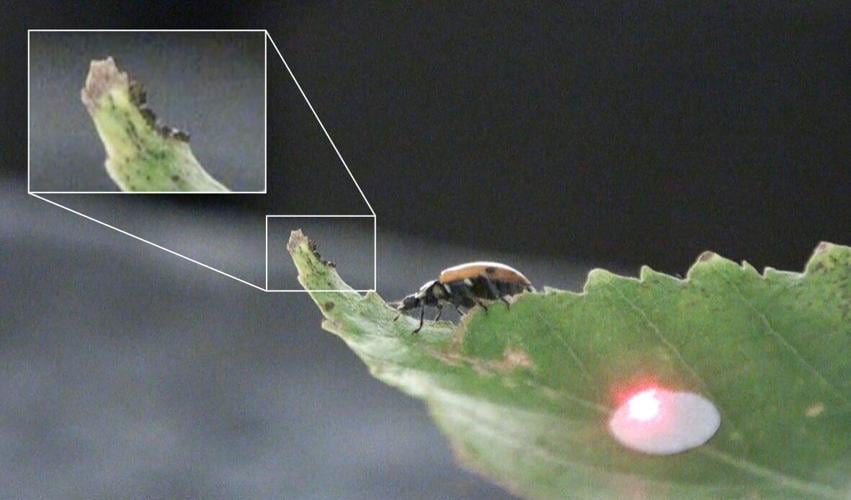



A ladybeetle (Hippodamia convergens) approaching a warty birch caterpillar (Falcaria bilineata, enlarged in the inset top left) on a birch leaf. (Emilie Maudult via SWNS)
By Stephen Beech
Day-old caterpillars one-twentieth the size of a grain of rice can recognize the footsteps of predatory ladybugs, reveals new research.
Warty birch caterpillars, less than 1.5 millimeters (0.06 inches) long, defend their leaf tip homes from invading caterpillars by scraping and pounding the leaf to warn off potential invaders.
But scientists were unsure how one-day-old caterpillars defend themselves when voracious ladybugs — also known as ladybeetles or ladybugs — are on the prowl.
They discovered in a new study that the minuscule insects can distinguish between the approaching footsteps of ladybugs and invading caterpillars.
Study leader Jayne Yack said: "The young homeowners are smart enough to keep quiet when a ladybeetle approaches and throw themselves off the leaf for safety when the attacker gets too close.

(Photo by Irene Ästhetik via Pexels)
"But when an invading caterpillar closes in, the defender makes a lot of noise to try to scare them off."
Yack and her colleagues at Carleton University in Ottawa, Canada, allowed newly hatched caterpillars to establish home on a leaf tip, filming the resident, while recording the vibrations generated by the youngster using a laser beam trained on the leaf.
The team then released an adult ladybugs onto the leaf and watched what happened.
Yack said: "The caterpillar fell almost quiet, became completely silent as the ladybeetle drew nearer and froze.
"The caterpillars weren't even trying to deter the ladybeetles.


"And some caterpillars flung themselves off the leaf within five seconds of the ladybeetle's arrival, remaining suspended on a silken thread until the adult ladybeetle departed, because the stakes were high: 43% of the caterpillars did not survive their encounters with adult ladybeetles.
"When faced with a lady beetle larva, which crawl around on six legs, the residents made some effort to warn off the intruder, beating and scraping the leaf a little more often than when alone on the leaf, before falling silent.
"They also took up to 40 seconds before deciding to evacuate."

(Photo by Manish Sharma via Pexels)
However, when research team member Sarah Matheson recorded intruding warty birch caterpillars approaching an occupied leaf tip, this time the caterpillar resident ramped up their beating and scraping to every couple of seconds to send a strong warning message.
Fellow research team member Emilie Mauduit says the caterpillars are "capable of recognizing the level of threat and responding in accordance."
She added: "The caterpillars could distinguish between different intruders, but how could they tell the difference?
"Might the vibrations produced by the thundering footsteps of a 20 milligram adult ladybeetle, the pattering of 3 milligram ladybeetle larvae and shuffling 0.8 milligram caterpillar intruders be sufficiently different for the caterpillars to distinguish them?"
The team recorded the vibrations produced by each type of intruder as they charged past the vibration-sensing laser beam, comparing various aspects of the vibrations — including the intensity, pitch and bandwidth — to find out how they differed and realized that the intruders' footsteps were all uniquely distinct.
The findings, published in the Journal of Experimental Biology, showed that ladybugs produced the loudest vibrations, which traveled through the leaf providing an early warning for the vulnerable resident caterpillars.
However, the vibrations produced by the ladybugs larva intruders were more similar to those of the shuffling caterpillars, possibly explaining why the resident caterpillars were initially confused, trying to warn off the intruder before realizing their mistake and falling silent.
Yack said: "Tiny warty birch caterpillars can distinguish the footsteps of threatening ladybeetles from interlopers that would evict them, and decide to take defensive or evasive action, which is quite extraordinary for such a minute day-old creature."
She added: "That caterpillars one-twentieth the size of a grain of rice have such sophisticated sensory capabilities is astounding."


(0) comments
Welcome to the discussion.
Log In
Keep it Clean. Please avoid obscene, vulgar, lewd, racist or sexually-oriented language.
PLEASE TURN OFF YOUR CAPS LOCK.
Don't Threaten. Threats of harming another person will not be tolerated.
Be Truthful. Don't knowingly lie about anyone or anything.
Be Nice. No racism, sexism or any sort of -ism that is degrading to another person.
Be Proactive. Use the 'Report' link on each comment to let us know of abusive posts.
Share with Us. We'd love to hear eyewitness accounts, the history behind an article.