


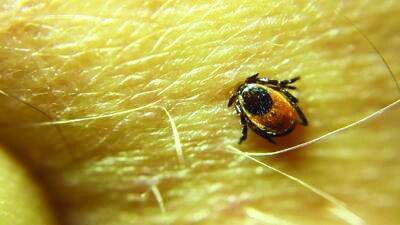
Tick activity in the Northeast — including New Hampshire — is the highest it’s been in years, and as peak summer approaches, these numbers are expected to increase, the Centers for Disease Control and Prevention says.
The season, which begins in April, had seen 104 emergency room visits for tick bites per 100,000 people in the Northeast as of June 1, compared with 89 visits per 100,000 throughout last year’s tick season, which runs until November, per the agency’s tick tracker. The last time the region saw numbers in the triple digits was in 2019, with 106 visits per 100,000, according to the data.
Some species of ticks carry bacteria, parasites and viruses that can infect humans during a bite. Lyme disease is the most well-known but there are other infections, and most of them are on the rise, according to the agency.
But by taking basic precautions, you can continue to enjoy the outdoors safely.
Here’s what you need to know:
What can I do to prevent tick bites?
The NH Department of Health and Human Services recommends people wear protective clothing. Socks, long-sleeved shirts and pants can offer some protection. Light-colored clothing can also make it easier to spot and remove ticks before they attach.
For an extra layer of safety, treat your clothes with permethrin and apply bug spray to exposed skin. The CDC has an insect repellent guide to help people narrow down their options that can be found at www.cdc.gov/ticks/prevention/index.html
What if I find a tick on me?
The state health department recommends people do a tick check after being in the woods. The check should also include clothing, gear and pets. Washing and drying clothes on high heat can kill stray ticks that may have been missed.
Ticks must be removed as soon as possible to lower the risk of illness, the health department said.
What’s the best way to remove ticks?

The CDC recommends people use clean, fine-tipped tweezers to remove attached ticks, though regular tweezers can do in a pinch.
The goal is to grasp the tick as close as possible to the skin and pull it away with an even pressure, according to the agency, which also says people should avoid a twisting motion that could cause the mouth to break, leaving a part of in the skin.
If the mouth part breaks, the agency says people can remove those with tweezers, but only if it’s easy to do so. It advises against digging in the bite site for attached mouth pieces as the body’s immune system will eliminate those.
The agency also recommends against using nail polish, petroleum jelly or other substances to remove ticks, as this can force infected fluid from the tick into the skin.
How do I dispose of a tick safely?
Ticks can be flushed down the toilet, thrown out in a sealed container or killed by immersing them in rubbing alcohol, per the CDC. The agency advises against squashing ticks with your fingers.
I have a tick bite. What should I do?
People should monitor the bite site for a few weeks and contact their doctor if they develop a rash, fever or other symptoms.
Lyme disease can sometimes, but not always, cause a bulls-eye rash at the bite site. Some people can experience symptoms even after the infection is treated. The condition, post-treatment Lyme disease, is poorly understood, but people who have it can experience long-term fatigue, dizziness, sleep problems, pain and body aches.
•••
Breaking News and Trending Editor Liora Engel can be reached at 603-355-8543 or lengel@keenesentinel.com.
These articles are being shared by partners in the Granite State News Collaborative. Don’t just read this. Share it with one person who doesn’t usually follow local news — that’s how we make an impact. For more information, visit collaborativenh.org.


(0) comments
Welcome to the discussion.
Log In
Keep it Clean. Please avoid obscene, vulgar, lewd, racist or sexually-oriented language.
PLEASE TURN OFF YOUR CAPS LOCK.
Don't Threaten. Threats of harming another person will not be tolerated.
Be Truthful. Don't knowingly lie about anyone or anything.
Be Nice. No racism, sexism or any sort of -ism that is degrading to another person.
Be Proactive. Use the 'Report' link on each comment to let us know of abusive posts.
Share with Us. We'd love to hear eyewitness accounts, the history behind an article.