


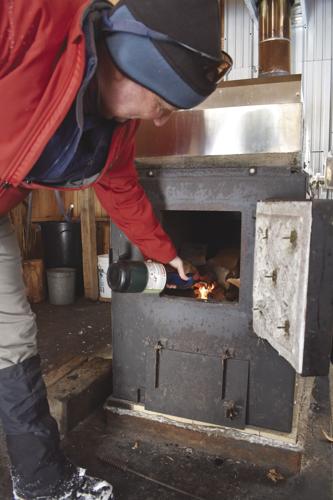
Every late winter into spring, on hundreds of small operations across the state, a story of transformation is told. Simple sap, made mostly of water, is collected through tubes and troughs, or carried in buckets, then boiled for hours until the result is a syrup that ranges in color from gold to dark amber. It’s the state’s first agricultural crop of the calendar year, and its appeal is as sweet as ever.
This year’s maple run began early, much earlier than most local producers can recall. And though an early season doesn’t equate to a bountiful season, this year’s crop could represent a high-water mark for the local industry.
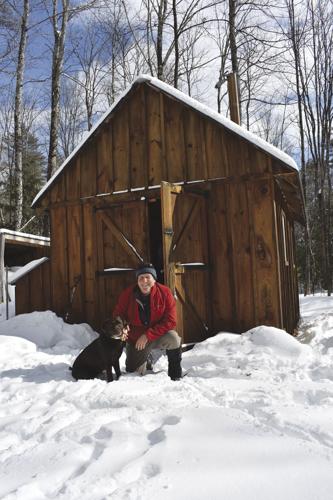
In Meredith, near the Center Harbor town line, the Crosby family is part of the disparate effort to capture the flow of maple sap so that it can be converted into a valuable commodity.
Pete Crosby said his family has been tapping maple trees on a 200-acre parcel of land that’s been in the family since his father-in-law bought it. The Crosbys aren’t in it for commercial reasons; they do it just because they can.
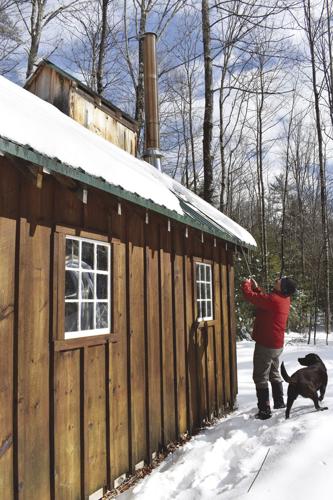
“For us, it’s a social thing,” Pete said. He and his son built a sap house, and friends and relations who have learned the rhythm of the process tend to drop by to lend a hand, on the hope that they’ll be rewarded with a jug to take home.
“It’s something you’re doing with the land. It’s kind of like farming — you’re putting a little something into the land and getting something back from nature,” Pete said. His son, Ben, grew up as part of the tradition, then chose to study maple syrup production as part of an ecological agriculture degree he earned from the University of Vermont.
“I would definitely call us a hobby operation,” Ben said, noting that they only tap about 200 trees. He works for a construction firm currently, but said he has dreams of starting his own maple business someday.
“I think it’s always cool when you can make something out of a natural product,” Ben said, adding that it’s also a “good time. We have fun doing it.”
The Crosbys might see themselves as small and hobbyists, but, said Andrew Chisholm, president of the NH Maple Producers Association, they’re fairly representative of how the state’s industry takes shape: through the collective efforts of hundreds of small operations, usually run by a single person or family.
Chisholm said the association, which has been growing in recent years, currently has 288 members and should end this year’s season with about 350 members. So far, 176 of those members have committed to opening their sugar shack for public tours on NH Maple Weekend, which will take place on March 18-19 — visit nhmapleproducers.com to find a participating producer near you.
Statistics provided by the U.S. Department of Agriculture show that the network of producers can generate $10 million in syrup and other maple-based products. New Hampshire producers brought 167,000 gallons of syrup to market last year, which was higher than in the previous two years, and this year could be greater yet, helped by a head start provided by mild February conditions.
“I know a lot of producers have made quite a bit of product already,” Chisholm said, with some association members reporting that they’ve bottled 60% as much syrup as they made in all of last year, and that the season usually doesn’t start until March.
Of course, maple trees don’t read calendars, so an early start doesn’t correlate to a strong season. The sap flows when the temperature is below freezing at night, and warmer during the day. That means maple sugar producers have to be ready to catch the flow while the conditions are right.
“Everyone, across the board, is scrambling to get caught up, the season is starting,” Chisholm said. The cold snap currently in place for this final weekend of February is only going to be a welcome time-out, he said, which will allow those behind the game to get caught up. Any snowfall will also help, to ensure the tree roots stay cold. “If there’s no snow in the woods, the ground tends to warm up too quick.”
On Rogers Road in Belmont, Todd Lemieux’s operation is increasing. He plans to tap 1,400 trees this year.
“I’m still considered a little guy,” he said. He hasn’t got all of those taps in, though, as he has been busy taking advantage of the sap that’s already flowing. “This is the earliest I’ve ever made syrup. And I could have made it a little earlier, but I wasn’t ready. ... It’s a really early year.”
Does he think it will be his best year?
“I’ll let you know in April,” he responded. “Right now we’ve got a nice little reset with the cold weather, they’ll start producing again. But if we go into March like we did last year, and go into the 60s and 70s, it will end the season quick.”
Lemieux grew up Vermont, where his relatives tapped trees from near the Massachusetts border to up near Canada.
“My uncles wouldn’t even start tapping until Town Meeting Day, and they would still be doing syrup through April," he said. "Now if you wait until Town Meeting to tap, you’ve missed half your season.”
Lemieux’s business plan includes several value-added products, such as crystallized maple sugar, used in place of cane sugar, and maple cream. But 80% of what he sells is straight syrup.
“In New England it’s an interesting market. You usually get a cult following,” said Lemieux, who was preparing to ship some syrup to Hawaii as he spoke, and noted that he has shipped to military bases around the world and sends a lot of jugs each year to customers in Florida. “I think it’s a very strong market right now.”
Charles Hunt, who sugars in Hillsborough and whose syrup was awarded among the best of last year’s batch by the NH Maple Association, agreed that maple syrup is a prized commodity in today’s food scene.
“The trend today is people want to know where their food comes from,” Hunt said. “They visit the sugar house, they look around, they talk to myself or my employee’s family, they go away happy.”
Hunt’s family has been sugaring since 1913, he said, and Hunt’s Sugar Shack became an official business in 1996. He said he’s been increasing every year — he’s up to 3,700 taps this year — because “we can sell all that we produce.”
“Some of the people are concerned about where it comes from, and some of it is just the culture itself,” he said about the enduring demand. “There’s plenty of market out there for maple syrup, not just liquid syrup, but dry sugar, maple cream, maple candies, and a lot of chefs today are using the darker, deeper flavored syrups for cooking.”
Boutique industry
In the same way that wine aficionados enjoy exploring the nuances of products from small wineries, and that micro- or even nano-breweries can succeed precisely because they are small and produce limited offerings, Chisholm said the hundreds of small syrup producers, each making their own similar but distinct product, give New Hampshire producers a marketable brand.
“I would say that most of our producers are on the smaller side,” Chisholm said. “We have a lot of micro-producers that have between 200 and 1,000 taps.”
The association, which has opened up a new category of membership for those who wish to join as “supporting members” and may not actually produce syrup, is looking to expand the market for local syrup beyond the region where it’s traditionally made.
“The association is really trying to promote New Hampshire maple outside of New Hampshire, promote the nutritional benefits of New Hampshire maple, using New Hampshire maple as a natural sweetener,” Chisholm said. “The consumer needs to be educated as to how unique and special New Hampshire maple is.”
The state’s product is a drop in the proverbial bucket compared with how much is produced in Quebec, for example, but Chisholm said there’s a homogenization that goes along with the larger production regions. Much of Canada’s product is blended, so a single bottle could have syrup from a dozen or more producers in it.
That’s not the case for New Hampshire syrup, he said. Because each producer bottles their own, each jug will have its own subtleties, owing to the type of tree — red maples make darker syrup, sugar maple syrup is light gold in color — the mineral composition of the soil, and the evaporation method employed by that producer.
“New Hampshire maple, for the most part, our producers across the state produce very small batch. If you go to a sugar producer and go into their shack and buy a bottle of syrup, the chances are very good that the trees that produced that syrup are only a few yards away,” Chisholm said.
And what the jugs contain is the essence of those trees, concentrated.
Chisholm said that every boiling season, he and just about every producer gets asked the same question: What do they add to their syrup?
“We don’t add anything. We just take away the water,” he said.


(0) comments
Welcome to the discussion.
Log In
Keep it Clean. Please avoid obscene, vulgar, lewd, racist or sexually-oriented language.
PLEASE TURN OFF YOUR CAPS LOCK.
Don't Threaten. Threats of harming another person will not be tolerated.
Be Truthful. Don't knowingly lie about anyone or anything.
Be Nice. No racism, sexism or any sort of -ism that is degrading to another person.
Be Proactive. Use the 'Report' link on each comment to let us know of abusive posts.
Share with Us. We'd love to hear eyewitness accounts, the history behind an article.