


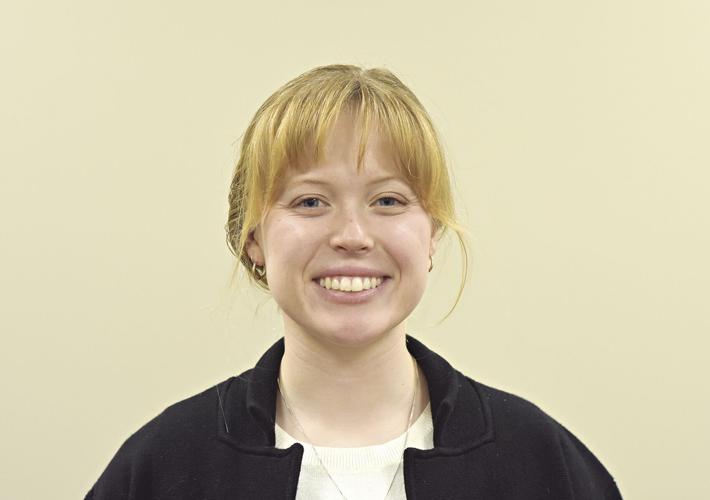

Catherine McLaughlin has just wrapped up her first year as a full-time reporter. She started at The Laconia Daily Sun immediately after graduating from college. Her first year ended with an investigation into a raft of departures from the Laconia School District. Co-host Julie Hirshan Hart was also in collaboration with Catherine in editing the story, giving Granite Beat twice the inside look.
Adam Drapcho: Could you start us off, please, by telling us when and why you decided to make journalism your profession, and how you managed to get a start in your career?
Catherine McLaughlin: Absolutely. I came into journalism because I took a class on it in college. I was a political science major and knowing that I liked politics, and I liked writing, but I didn't really know where I was going to take that and what I was going to do with it. And my junior year, so kind of late, I took a class on journalism, and it just collected and just felt really right. It felt really natural. It was fun. And so I just followed my passion there. I quickly joined the school paper and got involved with a news team there. I did a couple of summer internships, or just one summer internship in journalism. And by the time I graduated, there was an opening here and I had done some freelancing for The Daily Sun during the pandemic. And everything fell into place. I was just so excited to start my life and start earning money and working after graduating because I'd been in school during the pandemic, it was just an easy "Yes."
Adam Drapcho: Do you think that many of your peers age wise are in the habit of reading local news? And if not, do you think there's anything that we could do as a news outlet to correct that habit?
Catherine McLaughlin: That's a thinker of a question. I don't think many of them are. I think a lot of my friends if they're reading local news, it's because I send it to them. Or because I wrote it, and they're kind friends who care about my work. I think things that local news could do more is in the ways that we try to ground our reporting and broader issues, national trends is to think about, well, which national trends kind of do that in reverse? Which national trends are relevant to the young people in our area? And why are they relevant to the young people or an era in our area? And ask them how they feel? I think, because we don't have a lot of young reporters in the local news space, young people don't end up being sources. And that's kind of a waterfall in disconnect, I suppose.
Adam Drapcho: I'd like to move on to the story we referenced in the intro. The article was headlined "Exit interviews: Laconia School District didn't ask employees why they left. So we did." And it was published in May. How did the story idea come about?
Catherine McLaughlin: This story was one that we had sort of heard snippets about. It's been developing over more than a year. But we have never been able to reach a source that was willing to go on the record. And some events at a school board meeting, discussing this outflow of employees, sparked a few people to feel motivated to feel the courage to come to us and say, “I'm ready. I'm ready to talk and I need to know what's actually happening.” And that was how we first got on the tail of it. And we just heard from more and more people, we reached out to more people who agreed to speak with us and it became a story.
Adam Drapcho: Julie ... to back up, The Daily Sun, like most news outlets, has an aversion to using anonymous sources. Could you tell me why that aversion exists when that policy is broken, and why this story seemed fitting for an exemption to that policy?
Julie Hirshan Hart: Well, I want to back up by first saying to clarify what is an anonymous source. An anonymous source is not somebody who called up the newspaper and left a tip and didn't leave us their name or any way to contact them. An anonymous source is someone who is known to the reporter, or to the reporter and the editor. It is someone who they know, the identity of it is someone who they have vetted the identity and knowledge of their subject matter in the story, and an anonymous source is just what we said earlier, an unnamed source in the story. But that does not mean that we don't know who they are, and that we can't go back to them if we have more questions or to clarify things. And that's just a really important point that I want to make. Anonymous sources can be hard for readers to identify with when you're reading a story. I think having a person-centered story is one of the things that we really focus on to help a reader understand a topic through a narrative, often by a person who's experiencing the issue that we're covering. So that can be harder to do with an anonymous source but not impossible.
It also raises questions for readers who don't understand what an anonymous source is, or why, which is one of the reasons that we're talking about it today. As Catherine mentioned, it is not something that we take lightly. You know, in the past six months, I can probably not even count on both my hands the number of times that one of our team has come to me and said, “Hey, I have this person, but they only want to speak anonymously.” And then I just turn around to them and say, “Well, I think you need to find another person.” This was a very delicate story. Because of the breadth of the story. We did decide that anonymous voices, who again, as Catherine mentioned, whose accounts could parallel other things that we had heard and other source documents, that it was an appropriate way to tell the story. Because those anonymous sources were wrapped into other named sources who were lending us their credibility and their names to the story to help make sure that the narrative was clear.
Adam Drapcho: So once you were able to build an investigation incorporating a large amount of anonymous sources, what did that investigation reveal?
Catherine McLaughlin: So we spoke to a number of both named and unnamed former employees at the Laconia School District. And they outlined a series of events involving the superintendent that had led to them departing the district either because they chose to leave because they felt they just could no longer stay there, or whether they were forced out, or in some cases terminated. The account that they gave was that complaints that they had filed against the superintendent for a number of reasons, many of them involving intimidation or feelings of coercion, then those complaints were investigated by an independent investigator hired by the school board. And they participated in that investigation under a promise of anonymity. During the investigation, they felt that their identities had been exposed and compromised, and that the superintendent knew who they were, and then retaliated against them. The results, according to their accounts, was that by the end of this school year, every principal and vice principal in the district as well as nearly a dozen other administrators had departed. And that such an influx was bad for students. It was expensive for taxpayers, and it was, of course, very stressful for them. And we felt that that story, especially the latter part of it, the costs to these individuals, the cost to students, the cost to the community, made it absolutely something that we were obligated to report on.
Adam Drapcho: How do you think this story might have been different had you insisted on using named sources?
Catherine McLaughlin: I don't know that we would have had enough sources for this to be substantive enough to publish, to even have a story. Many of the people we spoke with, some of them were [for] reasons of fear or deep concern. Others were really firm barriers that people were up against in terms of their reasons for needing anonymity from us. And while the named sources we had were very powerful and very clear, in terms of the story, they told. They were on their own not enough to have told this story. We [thought] the power of the story is in the breadth of the number of people affected and the breadth of the people that spoke with us. And in this case, we may not have gotten this story if it weren't for that, that shield of anonymity. As Julie mentioned, a lot of the time when you speak with an anonymous source, or when someone requests anonymity, we ask, “Is there somewhere else we can go to get this commentary? Is there someone else who can offer us this information?” And this was a story in which there were no other routes to get this information. Providing anonymity was the only way.
Adam Drapcho: Are you working on anything that you'd like to preview?
Catherine McLaughlin: There is a developing story in Meredith with a public boat launch right beside a marina that's trying to expand. And on paper, it kind of sounds like small potatoes. But the story is so interesting to me, and why I'm so interested to see where it goes. It's still developing, because this sort of tension between the Marina is trying to expand and the local lake residence has been happening for decades. I think the first time they tried to expand was in 2003. And they still haven't been successful. And it also, I think, is a microcosm of a lot of the cultural attitudes around the lake around expansion. And people using the lake who aren't necessarily lake homeowners, and a sort of tension between full time residents and people who travel here to use the lake. All of that is wrapped up in this one story. And so I'm very excited to see where it goes.
Julie Hirshan Hart: Do you have any advice that you'd like to share with aspiring journalists?
Catherine McLaughlin: Do what you want. I had several people when I was approaching my graduation and trying to decide what to do and where to work. One big one was to stay away from local news, "Don't get into a trap, don't do it, you'll be there forever." And they couldn't be further from the truth. They don't know every paper or they don't know this paper, our team. New Hampshire is such a vibrant place for local news. I would say, go where you're called and do what you want to do. It's your job, it's your life. There's no pressure to be on the right path. Do what's going to pay your bills and make you happy and forget about the rest of it.
This article is part of The Granite Beat, a project by The Laconia Daily Sun and The Granite State News Collaborative, of which Laconia is a partner. Each week Adam Drapcho and Julie Hirshan Hart will explore with local reporters how they got some of the most impactful stories in our state and why they matter. This project is being shared with partners in The Granite State News Collaborative.


(0) comments
Welcome to the discussion.
Log In
Keep it Clean. Please avoid obscene, vulgar, lewd, racist or sexually-oriented language.
PLEASE TURN OFF YOUR CAPS LOCK.
Don't Threaten. Threats of harming another person will not be tolerated.
Be Truthful. Don't knowingly lie about anyone or anything.
Be Nice. No racism, sexism or any sort of -ism that is degrading to another person.
Be Proactive. Use the 'Report' link on each comment to let us know of abusive posts.
Share with Us. We'd love to hear eyewitness accounts, the history behind an article.