



For years, volunteers drove Claire Gagne and Gertrude Jocelyn to the Tilton Senior Center in the town’s old Grange hall, where they enjoyed coffee and donuts, witty or wistful conversation and a bluegrass jam session on Wednesday nights.
Gagne, a Belmont resident, sang while Jocelyn, who lived in Tilton, played the harmonica – borrowing the instrument from a bandmember until she bought her own when she was in her 90s.
For seniors in Tilton and neighboring towns, the center’s activities and the friendly musicians who played audience requests were highlights in a humdrum week – a respite that continued until COVID-19 lowered the curtain on social life, especially for older people.
Last week roughly 15 people from Tilton, Northfield, Sanbornton and Belmont came to the Tilton Senior Center for coffee and a break from cabin fever after the building had been closed for 12 months.
“They were actually in tears. They were blown away by being able to walk in and talk to people,” said Pat Consentino, a Tilton selectboard member who heads the senior center’s executive committee. The building – owned by the town, with services provided by the Community Action Program of Belknap and Merrimack counties – is currently limited to half occupancy and requires social distancing and masks.
“They’re really, really missing networking. They’re really, really missing a human being to talk to,” said committee member Jane Alden. “They were really touched after having to be housebound. To get in and sit down and interact with people was overwhelming to them. They had been so bored all winter.” One gentleman told Alden he came to the senior center three times a week so he could talk to people when he picked up his meals.
Senior centers are magnets for retirees and elders seeking conversation, card games, bingo, yoga and the companionship and stimulation of peers. During COVID they closed for more than a year, serving meals to go, but not hosting any in-person activities or sit-down lunches – important isolation-busters for elders living alone.
“The meal is a very important thing,” said Suzanne Demers, director of elder services for the Community Action Program of Belknap and Merrimack Counties, which operates eight senior centers and Meals on Wheels, including in Tilton, Laconia and Alton. “People really love to come together. The meal is important, but the most important thing is to be able to connect with people.”
“Just to see another face and talk with their neighbor,” the joy was overwhelming at Tilton’s recent coffee hour, said Emily LaPlante, who regularly drove Gagne to the center and to bluegrass night, until Gagne and Jocelyn moved into nursing homes this year. LaPlante continues to cook for older guests and musicians at the center’s bluegrass jam sessions.
With the arrival of spring and the approach of summer, seniors are looking forward to outdoor activities and the end of home confinement – and the drought of interaction that became a desert as COVID-19 stretched on.
Now, a question hangs in the air along with remaining uncertainties about the coronavirus: When will normal social life return for seniors – in one of the oldest counties, age-wise, in New Hampshire, itself the nation’s the second-oldest state? In Belknap County, 31 percent of the population is predicted to be 60 or older by 2030, according to census projections. In terms of average age of its residents, New Hampshire narrowly trails Maine, the oldest state, by one or two decimal points.
COVID did not put the brakes on essential services, such as home health visits and Meals on Wheels, which continues to deliver frozen meals for seniors to heat in microwave ovens at home. Exercise classes continue via Zoom and other online platforms, and a sprinkling now occur socially-distanced, in-person. Some seniors gather informally with peers and family members.
At this point, few if any senior centers and venues are open for in-person meetings, casual drop-ins or live educational programming and entertainment – leaving a population that is vulnerable to both COVID and chronic loneliness and in limbo.
“The loneliness issue is so devastating to people,” said Tom Menard, director of the Laconia Senior Center, which served 40 to 60 people before COVID. “A lot of people call and say they’re lonely and dying to come back.”
The center closed to group meals and activities after its St. Patrick’s Day celebration last year. In the months that followed, Menard and a handful of volunteers called members at home to see how they were faring. Two friends who met at the center sent cards to others sequestered at home. The center linked members who normally weren’t friends to shop or do something together, which has jump-started some companionships.
But for most, COVID has been a long bout of boredom and self-containment “They do get depressed. They’re in the same boat I’m in. I do everything alone,” said Irene Johnson, 83, who sends cards to Laconia Senior Center members who have agreed to receive them. “Even after the pandemic is over, they’re by themselves if they can’t get out. Either they’re homebound because of illness or they don’t have any transportation.”
It’s a state of suspended animation that is especially uncomfortable for elders who live alone and don’t have family members in the area.
Jeanne Agri, executive director of the Community Action Program of Belknap and Merrimack, said the decision and date to reopen the senior centers will depend on a variety of factors, including guidelines from the state and recommendations from the Centers for Disease Control, and will vary according to circumstances at each location. Community vaccination rates may be a piece of the puzzle. Masks and social distancing will be required, and the centers need to have enough space for members and staff to function safely for everyone.
“We’re champing at the bit to open them up,” Agri said. “I want to make sure we understand the risks and have everything in place to mitigate the risk. It’s really about making sure we are going to be safe” – and that the systems and infrastructure in place are sufficient. “None of us want to not provide services that are so critical for seniors. We are going to be moving to a next step.” Agri said the senior centers will hold outdoor activities in the summer where their locations permit. Returning to congregate meals is a universal goal for the centers that served them, including Laconia. ‘’We’re processing what life is after COVID 19,” Agri said.
Decisions may vary between locations, and depend on manpower and who calls the shots on reopening the buildings.
Alton Police Chief Ryan Heath, who heads the town’s emergency management team, said Alton’s senior center will remain closed while local officials continue to keep an eye on emerging cases of COVID, including a recent spike of positive tests among town employees that resulted in quarantining. Alton’s three parks and recreation workers clean town buildings, including the community and senior centers. “These diminished resources make it important to prioritize our essential services right now,” Heath said. “We need to take extra care because the elderly population is at highest risk.” No date has been set to reopen Alton’s senior center.
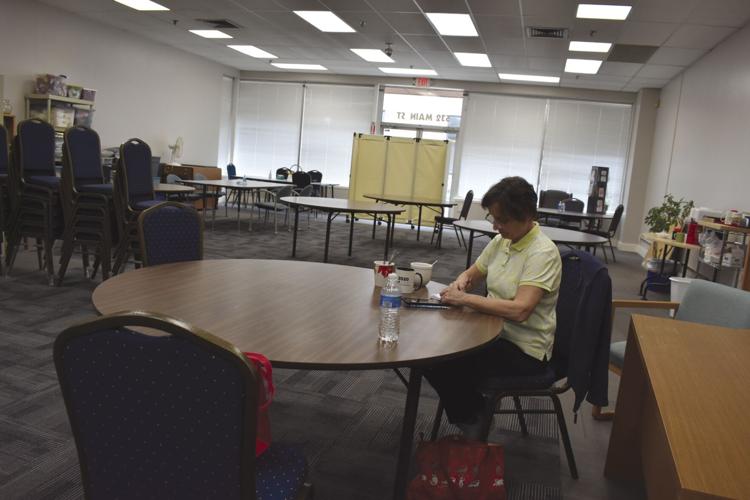
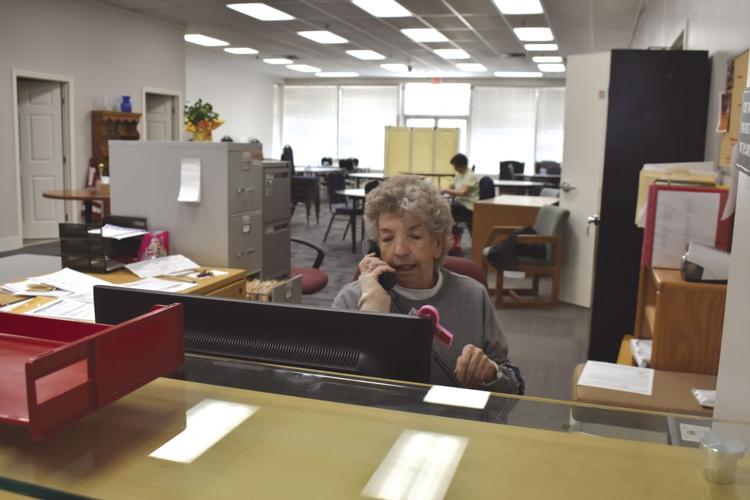
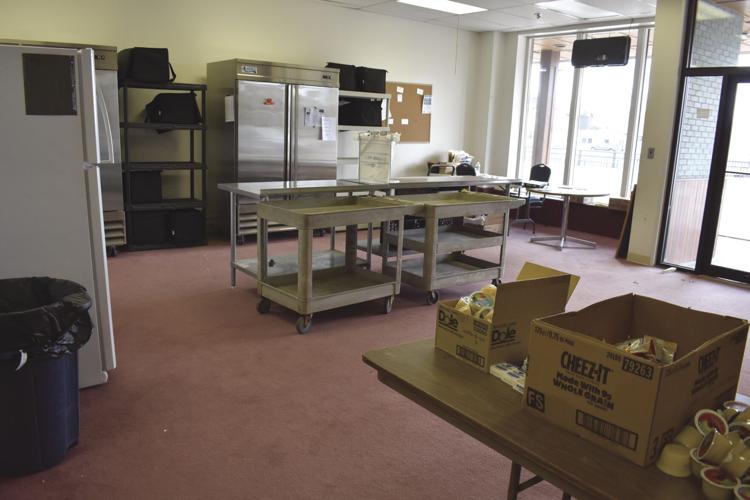
Although no date has been set in Laconia, where CAP owns the building and runs the programs, Menard hopes the center will reopen in June, perhaps for limited activities for smaller groups of fewer than 10, adding staggered lunches over time. During COVID, the center moved from its longtime location near the library, post office and senior apartments. It now occupies two connected storefronts on Main Street downtown purchased by CAP two years ago. It was a business decision that allowed the agency to direct the use of its space, Agri said. A door joins the two spaces, but there are no cooking facilities yet. Large freezers store Meals on Wheels. Construction of a full-scale commercial kitchen has been delayed by COVID, and will depend on how soon grants and fundraisers can pay for the cost, said Suzanne Demers, director of elder services at CAP.
Drop-in weekday afternoon coffee has always been a big hit at the center and members miss it. “They knew they could stop in and vent and talk,” said Menard. Before COVID, a shifting census of regulars came for activities such as arts and crafts, meditation and walking groups, and special celebrations with holiday themes and entertainment drew older residents from a wide area. Now two active members run a fledgling pen pal service and Menard calls members every week or two. Meals on Wheels drivers visit homes three times a week. Some seniors meet the pre-COVID exercise challenge by walking outdoors alone. Bone Builders classes occur over Zoom, which “hasn’t entrenched itself in this population as much as it has for younger folks,” said Menard.
A Stanford University study showed that – for some people, including older adults – meeting by visual teleconference triggers a fight-or-flight response and uncomfortable participants turn the camera off and say much less and feel put on the spot when asked to speak. For older adults, the switch to online communication “is a lot more socially complex than people thought it would be,” said Menard, not just for lack of internet and technology savvy.
Seniors crave in-person contact, which is often the highlight of a monochromatic day. One senior center member in her late 70s, who was well-known among her peer and active in groups and as a community volunteer, talked about going gambling to beat the feeling of solitary confinement. Menard said she felt she was on limited time, her life was “being lost in this COVID bubble,” and she didn’t want to spend the last years of her life this way, after years of taking care of her husband at home. Last year she died of COVID, which cast a shroud of sorrow over center members, increasing their worries and caution around the virus.
Linda Palermo and her husband moved to Weirs Beach from Massachusetts in 2006, after Palermo spent summers in the Lakes Region for almost 50 years. She dove into part-time work organizing activities at the Laconia Senior Center. For many people, the shutdown has been a question of which is worse, the disease or the isolation. “It was like they just shut us off,” said Palermo. “If I only had a lot of money, I’d buy a little house and have my seniors come and talk and sit and play cards.”
For many older people, the center furnishes a ready and available surrogate family. “Our seniors miss it. Even if it’s just to come in and sip a cup of coffee and have a conversation,” Palermo said.
Johnson moved from Tennessee to the Lakes Region in 2013. Recently she joined forces with a friend to send cards to six or seven senior center members who don’t get out. She wishes she knew more people to write to, but privacy laws prohibit the center from sharing names and addresses without getting the recipient’s permission first.
“I make up my own sayings. I write inside, ‘I am with you during this time.’ ‘God will get you through this.’ I try to stay upbeat. You’ve got to give them a little hope,” Johnson said. She would like to write to older people who belong to her church – which reopened for in-person services last week – and send encouraging messages to residents at local nursing homes, if the nursing homes will only let her inside. “I have both shots and wear a mask and shield. I asked to go once a week.” Until then, “I’m stymied,” said Johnson. “I know plenty of lonely people, but I don’t always know their names. I know so many, I can’t remember their names.”
Johnson and a companion collaborate for their social survival. “My one friend comes over. She calls me every day. One day she comes for lunch. One day we go to the Soda Shoppe for breakfast. That’s two days. There are five more days in the week. I don’t talk to anybody during the day except the cat, and he doesn’t answer. I can get in my car and drive, but some people can’t.”
For a change of pace, Johnson walks at Tanger Outlets in Tilton, “just to be out and see people. If you’re lucky you’ll meet somebody you know. You have to get yourself dressed, fix your hair and put some earrings on, just to make yourself feel good. Just talk to people, even if you don’t know them. If they’ve got smiling eyes, you can see that, even if they’re wearing a mask.”
On Wednesday afternoons, she goes to Wendy’s restaurant in Gilford for the $2.17 senior lunch, which includes a drink and a bowl of chili or a junior cheeseburger. “I see more older people there than younger people because they go out and they can afford it,” she said.
Now that the weather’s getting nicer, Johnson will head for the beach and the park.
Like so many, she misses the Laconia Senior Center, especially the congregant meals. “I hate eating alone. I absolutely hate it! You could go there and talk to somebody, like a family at a dinner table.”
At her CAP office in Concord, Demers expects to weather complaints until senior centers fully resume. “I’m getting a lot of hate mail and hate calls. But I have to follow protocol,” she said. “What’s safe? Looking at the news, one day it’s this, one day it’s that. It’s never fun being the one who has to follow protocol. When people call, it’s not ‘How have you been?’ It’s “When are you going to open up?’”
During the pandemic’s shutdown, the most difficult hurdle for older people has been the mental health challenges of grief and isolation. “You hear them talk and say how sad they are,” especially when they’ve lost someone they know, Demers said. A COVID-related death breeds fear for one’s safety, which in turn spawns more isolating at home.
Pat Gould, 80, a retired nurse, says she feels fortunate that all but one of her five children and eight grandchildren live within a 90-minute drive of Laconia – which means regular meals with at least one. An avid bridge player, she missed playing with four friends, who plan to start up again next week. “I did get a little depressed, but I’m doing a lot more now,” she said, now that she is fully vaccinated. She recently started line-dancing twice a week at the Gilford Library – in-person, socially distanced, wearing a mask.
“I’m lucky enough to wake up each morning with a smile on my face,” Gould said. “I think I’ve been fortunate to have whatever chemicals are in my system to look on the positive side. But it’s hard for a lot of people. Things change and seniors don’t like change. The pandemic I never would have predicted. But you have to go with the flow. I guess I’m glad I wasn’t 25 years younger and working in a hospital.”


(0) comments
Welcome to the discussion.
Log In
Keep it Clean. Please avoid obscene, vulgar, lewd, racist or sexually-oriented language.
PLEASE TURN OFF YOUR CAPS LOCK.
Don't Threaten. Threats of harming another person will not be tolerated.
Be Truthful. Don't knowingly lie about anyone or anything.
Be Nice. No racism, sexism or any sort of -ism that is degrading to another person.
Be Proactive. Use the 'Report' link on each comment to let us know of abusive posts.
Share with Us. We'd love to hear eyewitness accounts, the history behind an article.