


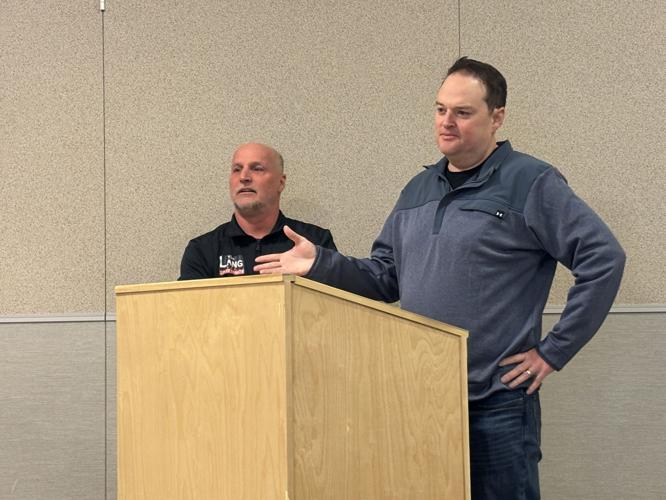
MEREDITH — Sen. Tim Lang (R-Sanbornton) and Rep. Matt Coker (R-Meredith) met with the selectboard Monday, and discussed with members, along with Town Manager Judie Milner, bills and Statehouse action that could affect the town.
Milner said funding from the state is a concern, and noted over the last few years, the town has lost quite a bit of funding. One particular area of concern was the state Meals & Rooms Tax, which she said is on the line for potentially cutting. Revenue from the tax is shared with the state. Communities get 30%, and the state keeps the remaining 70%, and the community portion is allocated based on population.
“Meredith probably contributes a lot to the rooms and meals tax, as you might imagine, and we heard there is a bill in play that may actually eliminate the portion that is coming to the communities,” Milner said. “We are very concerned about that, because that offsets our tax revenue lift that we’ve asked for.”
Lang is chair of the Senate Ways and Means Committee, and said this bill would not pass his committee.
“One of the bright spots this year in the revenues for the first six months is the rooms and meals tax,” he said.
Lang doesn’t anticipate a bill like that would get much traffic.
He said he helped change a law this year to ensure the state Department of Business and Economic Affairs received tourism dollars to advocate for out-of-staters to visit New Hampshire.
Milner noted tourism is big for Meredith, which is a “hospitality municipality,” and an issue they face is housing those who work in the industry. The town recently earned the Housing Champion state designation, but learned there is no funding this year for that project. She asked for Lang to keep the program in mind during the next budget, as it helps with infrastructure to provide affordable housing to help employers hire.
Lang said it was a tight funding year, and there was a big difference between what the House and Gov. Kelly Ayotte wanted, and what the Senate settled on. Many programs were pushed off, because of the uncertainty of revenues.
“My prediction was the first six months would be a struggle, and the last 18 months would be much more free, based on what’s going on at the federal level, relative to tariffs,” Lang said. “Interest rates is the big one. The Fed interest rates, as they start topping those rates, loans for businesses become more available.”
Lang said his prediction was on point, and noted the state went from being down $62 million down in October, to the latest revenue projection showing the state is short just $162,000.
“So, we tightened that number up, just as I expected,” Lang said.
Lang expects December revenues will end up in the positive for the state, and hopes that trend will continue, so they can look more at supplemental appropriations.
“We’ve just got to see what the numbers look like,” Lang said.
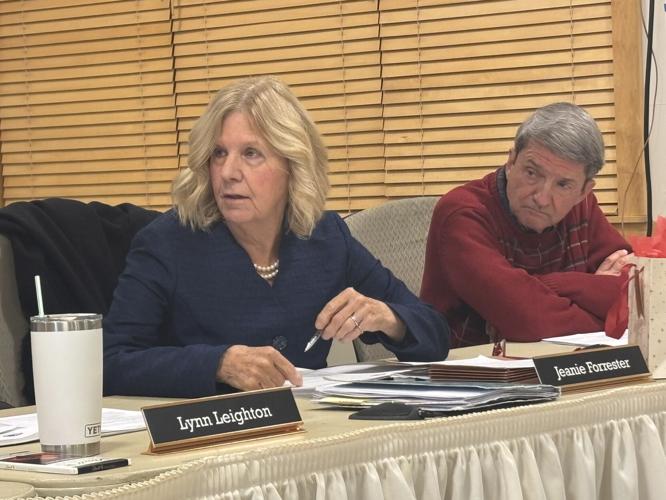
Selectboard member Jeanie Forrester asked Lang to clarify if the revenues come in better than expected whether there could be a supplemental appropriation for housing. Lang said it is “possible,” and will be on the list of priorities when there are sufficient funds to do so.
He added he thinks it is “more likely than not” that the state will have money to spend, but will look at the priorities.
“There will be a list of programs, I’m sure, that will be asking for revenue, if the revenue comes in the way anticipated,” Lang said.
Milner said the town is making an effort by applying for the Housing Champion designation, while some communities are saying “not in my backyard.” Some of the legislation, she said, is geared toward forcing communities into compliance, such as lot sizes and requiring only one parking space. She wants to protect the control they have as a municipality.
“Having that local control, so we can keep the flavor of the community, but also provide the programs and housing we want to provide, which we do, but in a way that protects our natural resources and keeps our local flavor,” Milner said. “People come here because we are who we are.”
She asked Lang for his support in defeating bills to take away local control, and Lang said “absolutely.” Lang was a zoning board chair a decade in Sanbornton, and while he did vote in favor of the parking stipulation mentioned by Milner, he was against all others.
“I actually spoke on the floor against those bills,” Lang said. “I think that as a town, you get to decide what your character is of your community. The state shouldn’t be stepping in and telling you, ‘No you have to do quarter acre lots, or 1-acre lots,’ or whatever the number is.”
Lang said with affordable housing, the barrier is the price of interest, rather than the price of the home. He said interest rates are what has caused houses to be unaffordable.
“The problem is really the interest rates that have risen, and our salaries haven’t kept pace with it,” Lang said. “So yes, you’ll have my support of blocking some of that.”
Coker said House leadership has a view that zoning restrictions are keeping housing prices so high, but he believes it is the cost of building, and agreed with Lang's comments about interest rates. He also said he fully supports local control, and helped organize a caucus of legislators pushing back on these bills.
“The internal dialogue that I have with my group is, 'We are going to keep on fighting a lot of these,'” Coker said.
“I would rather keep the power localized at the towns, than the state, level, when at all possible.”
The conversation shifted to education funding, which Milner said clearly won’t be solved overnight. Meredith is a donor town, meaning they pay a significant amount of money into state education. The town is part of the Coalition Communities 2.0 movement, which is concerned about a funding system which requires Statewide Education Property Tax, or SWEPT, to be redistributed to “receiver” towns, according to the coalition website.
Lang rewrote the education funding formula last term — still active this term — and donor communities became part of a conversation. However, he said there is not a consensus on how to deal with it. The discussion, he said, is ongoing.
Forrester asked Lang and Coker to keep them informed about any bills of concern.
“We can’t watch everything like you can, and sometimes, things happen that we don’t know about. And it would be helpful, if you see items you think are going to impact the community in a negative way,” Forrester said.
Lang and Coker agreed to keep the town apprised.
“I’ll keep you aware of the Senate bills, if Matt can keep an eye on the House bills,” Lang said.


(0) comments
Welcome to the discussion.
Log In
Keep it Clean. Please avoid obscene, vulgar, lewd, racist or sexually-oriented language.
PLEASE TURN OFF YOUR CAPS LOCK.
Don't Threaten. Threats of harming another person will not be tolerated.
Be Truthful. Don't knowingly lie about anyone or anything.
Be Nice. No racism, sexism or any sort of -ism that is degrading to another person.
Be Proactive. Use the 'Report' link on each comment to let us know of abusive posts.
Share with Us. We'd love to hear eyewitness accounts, the history behind an article.