




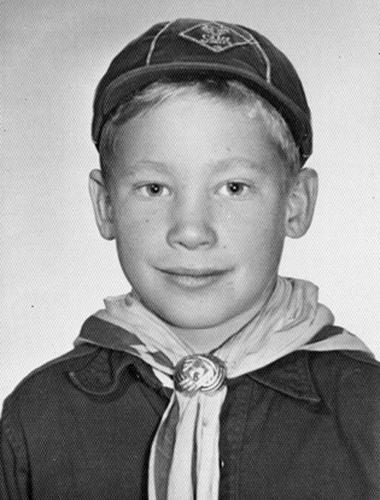
Editor's Note: This is the first of a three-part, first-person account of David Stamps' coming to terms with Asperger's Syndrome.
I was informally diagnosed with Asperger’s Syndrome (AS) at the age of 69. Most of my life was a quest to understand why I didn’t fit in, a struggle to fit in, a period of self-medication and, finally, a period of just learning and coping.
At one level, this probably sounds a lot like everyone’s life. Childhood in rural New Hampshire in the 1950s was a pressure-cooker to conform.
I had a lot going for me. I came from a successful, well-off family and this meant that my quirks were often overlooked. At least in my younger years, it was “David needs a little more time or help.” “He should just try harder, but he will do well because he comes from a good family.”
Is it better for people to expect more or less from you? My brother, two years older, seemed to be the smart, successful one, and he was constantly held up to me as “why can’t you be as good as your brother?” Even without AS, I am sure many younger siblings hear this growing up. Reading my school reports, I seemed very puzzling to most of my teachers. I was inconsistent in work, in attention, in testing and in recess. I was obviously bright but just as obviously “different.”
My preadolescent period was almost entirely un-self-aware. I was often hyperactive, other times moody and withdrawn.
Gilford in the fifties was a nurturing community — built around the Gilford Outing Club — children always had many adult-supervised activities. They also had a lot of free time for play. We often started out in one house and hours later surfaced somewhere else, having been fed by someone’s mother. We rode our bikes everywhere.
What I lacked was any real sense of connection with kids my age. Most of my relationships existed at one-on-one play. I always felt left out of groups of people but never understood why. I had poor eye-hand coordination and was usually the last chosen on the playing field.
Bullying was common, as I had trouble with communication. I tended to not “get” what conversations were about. I didn’t understand irony or how to socialize. I remember one day I walked into the Gilford Store when I was 10 or so, and Mr. Whitney asked how the weather was. As always, I was still trying to figure out the answer when he just shrugged and turned back to the customer he was waiting on. Looking back, I realized that he was just looking for something like “fine” or “looks like rain” or whatever, but not an exhaustive meteorological analysis. So I started a lifetime habit of saving up stock phrases when I perceived people where just wanting simple answers — though I still didn’t get why. What is as natural as breathing is a constant struggle for people with AS.
As I advanced into adolescence, life became a greater and greater challenge. Adolescence is all about learning how to function in society — although I don’t really know what that meant. I slowly fell further and further behind because I could not cope with spontaneous interactions. By the time I figured something out, people and conversations had moved on. Since there was no one who understood where I was coming from, I slowly withdrew more and more. I became both isolated from my peers and from my family.
My family was having its own issues, since my father and brother had undiagnosed Asperger’s as well. Family life was volatile and fraught with tension. Alcoholism and anger issues swirled around me. Though I liked and could interact with adults, teachers often found me trying. One of my Aspie superpowers has been an insatiable curiosity; however, I was usually unrestrained in how I went about satisfying it.
I grew up with my own set of World Book Encyclopedias for friends. I read for hours, zigzagging from one subject to another to another. Then they might sit for weeks, flipped open, while I was off on another tangent — stamp collecting, geology, model building, chemistry — and then back to World Book to read about atomic fission.
Instead of the usual sports heroes, my room was decorated with maps of everything from the solar system world maps, and National Geographic maps of countries. I even had maps on the ceiling and turned sideways – the better to look at in bed. I had privileges in the adult section of the local library and read constantly. I read electronics books, built radios and other gadgets and listened to classical, folk and Broadway music. Not an average fifties kid.
Hoping to “shape me up,” my parents sent me away to the Holderness School in Plymouth for high school. Reading the faculty comments now, they sounded just like the comments from earlier grades. Classes were a constant struggle for both myself and my teachers. Looking back through my current lens, I can see the pattern: starting a new class, everything was chaos for me. To teachers it looked like I was struggling with homework but the reality was much deeper: I was struggling to “put things in their place.” In fact, I cannot cope easily with large-scale complexity — but given time, I can adapt.
For me, the world burns bright. When I walk into a room, I notice everything: I see the layers of history on a wall; the bright lights and shadows; the way furniture is arranged; and of course, the people are like giant crossword puzzles. All this takes time to figure out even as my effervescent mind goes careening off into space. And then the bell rings and it starts all over again.
This process was not conscious then, but I can see now how my days were an endless cycle of stress, moving from class to class. Slowly, I could “master” my near space, but interruptions would often freak me out and I would react with anger or withdrawal. Schools always insist that students — especially freshmen and sophomores — have roommates to better learn to get along. Unfortunately, for an Aspie, this is the wrong prescription. The only chance I had to get along was to have a safe place to withdraw to. If I can’t withdraw in space, then I withdrew in mind through anger and sullenness. I had no words for why I needed to withdraw; I was just angry and stressed. And no one else knew why, either.
This cycle of moving, arriving, trying to “grok” my surroundings even as I struggled to succeed, went on and on. Six colleges and dozens and dozens of jobs and all kinds of self-medications, all interweaved with moving from coast to coast, and city to mountains and back again.


(0) comments
Welcome to the discussion.
Log In
Keep it Clean. Please avoid obscene, vulgar, lewd, racist or sexually-oriented language.
PLEASE TURN OFF YOUR CAPS LOCK.
Don't Threaten. Threats of harming another person will not be tolerated.
Be Truthful. Don't knowingly lie about anyone or anything.
Be Nice. No racism, sexism or any sort of -ism that is degrading to another person.
Be Proactive. Use the 'Report' link on each comment to let us know of abusive posts.
Share with Us. We'd love to hear eyewitness accounts, the history behind an article.