


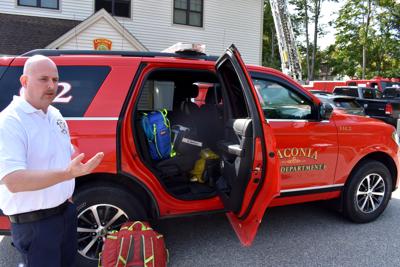
LACONIA — A new pilot program for community paramedicine will be implemented following the receipt of a major grant to fund a trial period.
City councilors heard from Fire Chief Tim Joubert that the fire department and the Partnership for Public Health were likely to receive a three-year grant to fund a pilot program in mobile integrated health care and community paramedicine at their meeting on Sept. 9. Joubert said the idea takes a page from a prior era in community health care.
“The rural town doctors, they played a huge role in local communities, getting to the people that needed the help where they were located,” Joubert said. “This program is very similar to that, utilizing a paramedic that works for the Laconia Fire Department.”
The program could greatly reduce costs for patients in need of medical attention, but not necessarily medical transport, and ease the burden on the city’s EMS and regional hospitals alike. If successful, it could divert the volume of emergency room usage, which stresses hospitals in municipalities across the country.
Last week, PPH Executive Director Tammy Carmichael confirmed the organization had received the grant and the program, now in its infancy, would begin to move forward in 2025. The allocation comes from the federal Health Resources and Services Administration and the Rural Northern Border Region Outreach Program.
The grant comes in at $250,000 per year for three years, and will renew each September, Carmichael explained. The goal of the pilot is to develop data on the efficacy of the program and work out if EMS will be able to bill insurance companies. They’ll look to develop a plan beyond the first three years, and evaluate if expanding the program would be beneficial.
“There’s a potential to work with other communities,” Carmichael said in an interview. “That’s the dream.”
Likened to the relationship between an old-time town doctor and local residents, a community paramedic would be capable of bringing medical care into individual’s homes. In the city, a large portion of medical transports are provided to repeat users who may be able to avoid an expensive ambulance ride with proper care and prevention, while also reducing the burden upon city EMS and freeing ambulances up to transport critically ill or injured patients.
Two key metrics organizers will be reviewing throughout the pilot are the number of preventive health care visits conducted by the community paramedic and community health workers, which they hope will increase, and a reduction of the 30-day readmission rate for patients with chronic disease.
Carmichael described a situation, which sometimes occurs, whereby a patient is released from the hospital and has no transportation available to see a doctor for follow-on visits. That patient may call EMS and ride in an ambulance back to the emergency room. In such a case, the hospital would refer that patient to the paramedicine program.
“Our goal is, over the next few months, to develop the processes,” she said. The program is meant to launch in early spring after the first round of funding begins on Sept. 30.
“It reduces barriers to medical care,” Carmichael said. “Transportation barriers, primary care provider barriers and basically is proactive in dealing with people’s medical care.”
In the period between 2021 and 2023, 51% of medical incidents occurred at properties operated by Laconia Housing, 16% at Taylor Community and 14% at Genesis Laconia Rehabilitation Center, along with visits to St. Francis Rehabilitation and Nursing Center and other locations.
The largest users of EMS transport combined for 1,169 or 25% of total incidents over that two-year period.
Noting the entire health care system is over capacity, Joubert told councilors that first responders must often “stack calls” and ambulances have, at times, been forced to wait around half an hour at the hospital for beds to open up for their transported patients.
“The health care system is overwhelmed and EMS is no different,” Joubert said. “At Concord Hospital and other large hospitals, there is a process called ‘stacking calls.' There are no beds in the emergency rooms, there is no access, which means that ambulance crews are kind of stuck on their aprons with their patients in the back, waiting to get in. We’re very fortunate that this does not happen very often in Laconia, but it does happen.”
Ambulance transport and visits to the hospital emergency room are exceedingly expensive. Basic life support transport costs, on average, $1,313 per trip, and advanced life support transport can range between $1,894 and $2,787 per trip. The average visit to an emergency room for treatment will cost a patient $2,400.
“There’s nothing more expensive than an ambulance transport and a trip to the emergency room,” Joubert said.
Joubert described the community paramedicine approach as providing the right care to the right place at the right time, preventing patients from falling through the cracks in the system and eliminating duplication of efforts. He described a sort of “life cycle” of continuity of care, beginning with early and comprehensive assessment with a preventive approach, facilitated by collaboration to provide individualized and patient-centered care, capped off with coordinated and proactive follow-up.
The target population for the program includes those patients diagnosed with chronic conditions, frequent or high-volume users of ambulance transportation or the hospital emergency room, patients who’ve been recently discharged from a hospital, people experiencing homelessness and frail patients who have difficulty leaving their homes.
A community paramedic could provide a wide-range of diagnostics and treatment including: performing an expanded physical assessment, checking vital signs or blood glucose levels, interpreting heart rhythm scans, basic airway management, oxygen therapy, burn care, medical equipment adjustment, wound care and hemorrhage control, catheter placement and removal, pain management, medication administration and in-home assistance.
The community paramedic would realistically fill many gaps within the health care field. They’d be able to provide emergency care, education, work to reduce rates of readmission, provide social services and primary care, help coordinate disease management and promote public health.
If the program were successful, more patients would avoid being admitted to a hospital or emergency room, the number of missed medical appointments would be reduced, patient adherence to medication regimens would increase, the overall rate of ambulance transports would be reduced and more patients would be able to manage their own health care needs following an intervention.
While the fire department will focus on medical intervention, PPH is dedicated to address “social determinants of health,” meaning environmental and societal factors which affect quality of life and health outcomes. They’re ready to serve those requiring assistance with navigating complicated systems such as Medicaid, Medicare, social services and utilities.
The community health worker, another major aspect of the program, will coordinate with the community paramedic to address social determinants of health, provide patient education and connect patients to required resources. They’ll seek to establish partnerships with local hospitals, primary care providers and social service organizations to coordinate their continuum of care.
The first steps in the pipeline include developing the system for a referral process, working out the hiring of a paramedic and developing a strategic plan. The right person for the job would have a paramedic license and could make a major impact on the public in the Lakes Region by reducing costs and improving long-term health outcomes.
“We really want to work with the other organizations that are in our community to make sure that the people that we’re caring for don’t fall through the cracks,” Joubert said. “There’s nothing more expensive than an ambulance transport and a trip to the emergency room."


(0) comments
Welcome to the discussion.
Log In
Keep it Clean. Please avoid obscene, vulgar, lewd, racist or sexually-oriented language.
PLEASE TURN OFF YOUR CAPS LOCK.
Don't Threaten. Threats of harming another person will not be tolerated.
Be Truthful. Don't knowingly lie about anyone or anything.
Be Nice. No racism, sexism or any sort of -ism that is degrading to another person.
Be Proactive. Use the 'Report' link on each comment to let us know of abusive posts.
Share with Us. We'd love to hear eyewitness accounts, the history behind an article.