


LACONIA — It is better to give than to receive, so the Scriptures tell us.
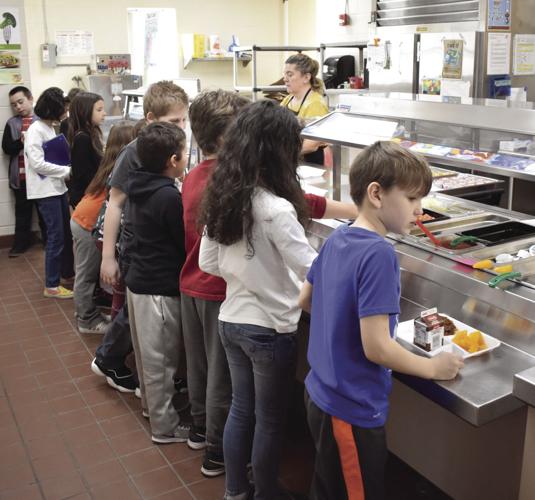
A group of current and former Laconia residents have been putting that saying into practice by giving money to the Laconia school’s lunch program to help offset its growing deficit.
Lynn Brody Keltz was inspired to make the first donation in early November when she saw a posting on Facebook which read, “Wanna give back? Call your local school and ask to pay overdue lunch accounts for kids. Kids have bigger worries than whether or not they’re able to eat or not that day.”
She shared the post with her Facebook friends — many of them other members of the Laconia High School class of 1983 — and was stunned by the response. Donations started coming in almost immediately.
“I felt I had to put my money where my mouth is,” said Keltz, who moved back to Laconia this past March. “Parents should not have to worry how (their) kid is eating today.”
The Laconia School District’s food service program currently has a deficit of $12,600 and rising, according to Food Service Director Tim Goossens.
Between 55 and 57 percent of Laconia public school children qualify for free or reduced-priced meals because they come from families whose income is 130 percent or 185 percent, respectively, of the U.S. poverty level. The highest percentage is at Woodland Heights Elementary School — 70 percent; the lowest, Laconia High School — 45 percent, according to Goossens. Those who qualify for reduced-price lunches pay $1.75, compared to the full price of $2.90.
But Keltz said there are families who do not meet the income guidelines for meal assistance, but that are nevertheless struggling, and so their children’s lunch accounts have an unpaid balance.
The federal poverty guideline for a household of five people in New Hampshire is $25,100. To qualify for reduced-price meals at school, a household cannot have a total income exceeding $54,427. For free meals, the income cutoff is $38,246.
“It’s particularly hard for families with multiple children who are very likely to be struggling to pay all their expenses, including school lunches,” Keltz said. “We are trying to help those families who are trying their best to pay for their child’s school lunch, but just can’t afford to pay for all of it.”
So far the response from Keltz’s Facebook friends has yielded $1,300 in donations. Now she wants to spread the word about the initiative in hopes of increasing participation in the effort.
The money has been turned over to the food service directors at the city’s three public elementary schools, who then disburse the funds to the appropriate student accounts.
“A $10 donation can buy three or more (reduced-price) lunches. The money goes a long way,” Keltz stressed.
School food-service programs are akin to enterprise funds. They are meant to cover their expenses by the revenue they receive from student meal charges. They are not supposed to make a profit, and they are not allowed to carry a deficit over from one fiscal year to the next.
While school districts often receive donations, the money is usually for the purchase of a piece of classroom equipment or something similar, according to Laconia School Superintendent Brendan Minnihan. “What unusual (about this fundraising effort) is it is to offset costs that families are experiencing,” he said. “It’s an interesting situation.”
Up until two years ago the Laconia school food services deficit fluctuated between $1,500 and $2,500, Goossens said.
But in 2016 the state enacted a law which meant that school districts could no longer have an upper limit on how high a student’s school lunch balance could climb.
The law states,”... all students (must) have access to a healthy school lunch … and that no student will be subject to different treatment from the standard school lunch meal or school cafeteria procedures.”
“That,” Minnihan said, “means we can’t subject (those students who can’t afford the cost) to different treatment, like giving (needy students) a cheese sandwich and a carton of milk while the other kids get a full lunch.”
Laconia is not alone in having this problem. According to a 2016 survey by the School Nutrition Association of 1,000 school-meal operators, about three-quarters of districts had unpaid student meal debt at the end of the last school year, an increase from just under 71 percent in 2014.
Some school districts, like one in Rhode Island, have resorted to hiring a collection agency to collect the overdue money.
The Laconia district has no plans to resort to that measure, Goossens said. “I want every kid to be able to eat. But at the same time we have revenue and we have expenses.”
“It’s fantastic,” Goossens said of the Laconia fundraising effort.
Keltz said that if there is greater response to the fundraising they hope to be able to expand the effort to include the middle and high school.
She said those who wish to make a contribution should make checks payable to “Laconia Schools Food Service” with “Lunch Support” in the memo line. The donations can be mailed to the Laconia School District, 39 Harvard Street, Laconia, NH, 03246.


(0) comments
Welcome to the discussion.
Log In
Keep it Clean. Please avoid obscene, vulgar, lewd, racist or sexually-oriented language.
PLEASE TURN OFF YOUR CAPS LOCK.
Don't Threaten. Threats of harming another person will not be tolerated.
Be Truthful. Don't knowingly lie about anyone or anything.
Be Nice. No racism, sexism or any sort of -ism that is degrading to another person.
Be Proactive. Use the 'Report' link on each comment to let us know of abusive posts.
Share with Us. We'd love to hear eyewitness accounts, the history behind an article.