


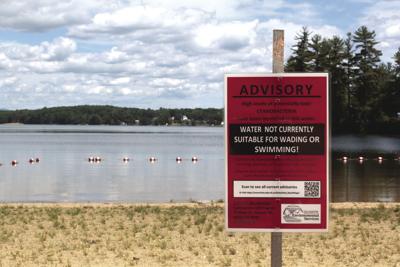
LACONIA — The Laconia Parks and Recreation Department and the New Hampshire Department of Environmental Services has issued a cyanobacteria advisory for Lake Opechee. Residents are advised not to swim, wade, fish, or boat in the waters.
“DES came up and tested Monday, came back and said 'yup, its officially cyanobacteria,” said Laconia Parks and Recreation Director Amy Lovesik. “The entire lake is under advisory. They are testing again on Friday, and will have the results Friday as well.”
In a bulletin sent out to the Parks and Recreation department from the DES advised residents to “Be cautious of lake water that has a surface scum, changes colors, or appears to have green streaks or blue-green flecks aggregating along the shore.”
The bacteria is the result of an algae bloom, and can cause serious symptoms in humans and animals. Exposure can result in diarrhea, vomiting and respiratory illness. The bacteria can also damage the kidneys, liver and nervous system, potentially resulting in seizures. Be alert for signs including abdominal pain, headache, and ear, nose, throat and skin irritation.
Symptoms in pets include tremors, excessive drooling, loss of balance, loss of energy, vomiting and not eating. The bacteria can enter the body via skin contact, ingestion, or inhalation.
For lake goers, bacteria issues are nothing new. Explosions of bacteria like E. coli occur annually at crowded bodies of water like Opechee Park as a result of excessive fecal matter. Cyanobacteria is a different breed, and blooms could become more common.
“We are seeing increasing cyanobacteria reports across the state since this program was started in 2003,” said Kate Hastings, the DES's cyanobacteria harmful algal bloom program coordinator. Hastings explained that the blooms are controlled by many factors, including increasing temperatures, changing weather patterns due to climate change, and an increased access to nutrients like nitrogen and phosphorous.
When it rains, many of these nutrients enter bodies of water via runoff from sewer systems, septic tanks, and even lawn fertilizer.
“With changing rain patterns, the pulses of nutrients into a body of water are effected,” Hastings explained. “It's typical to see more dramatic events with climate change. You get a huge pulse of nutrients into a water body all at once instead of spreading into the body over a longer period of time.” When the cyanobacteria have enough nutrients from one of these “pulses”, a bloom can occur, making the water hazardous.
“People are becoming more aware. That could be part of the phenomena of seeing increasing reports,” Hastings said. “People are also really interested in protecting their water bodies so I hope there will be a lot of action in reducing nutrient input into water bodies.”
Until testing reveals a decrease in cyanobacteria levels, it is recommended that people and pets stay away from the lake.
If you spot any of these signs on a body of water, report it to the DES by calling 603-848-8094, or emailing hab@des.nh.gov.


(0) comments
Welcome to the discussion.
Log In
Keep it Clean. Please avoid obscene, vulgar, lewd, racist or sexually-oriented language.
PLEASE TURN OFF YOUR CAPS LOCK.
Don't Threaten. Threats of harming another person will not be tolerated.
Be Truthful. Don't knowingly lie about anyone or anything.
Be Nice. No racism, sexism or any sort of -ism that is degrading to another person.
Be Proactive. Use the 'Report' link on each comment to let us know of abusive posts.
Share with Us. We'd love to hear eyewitness accounts, the history behind an article.