


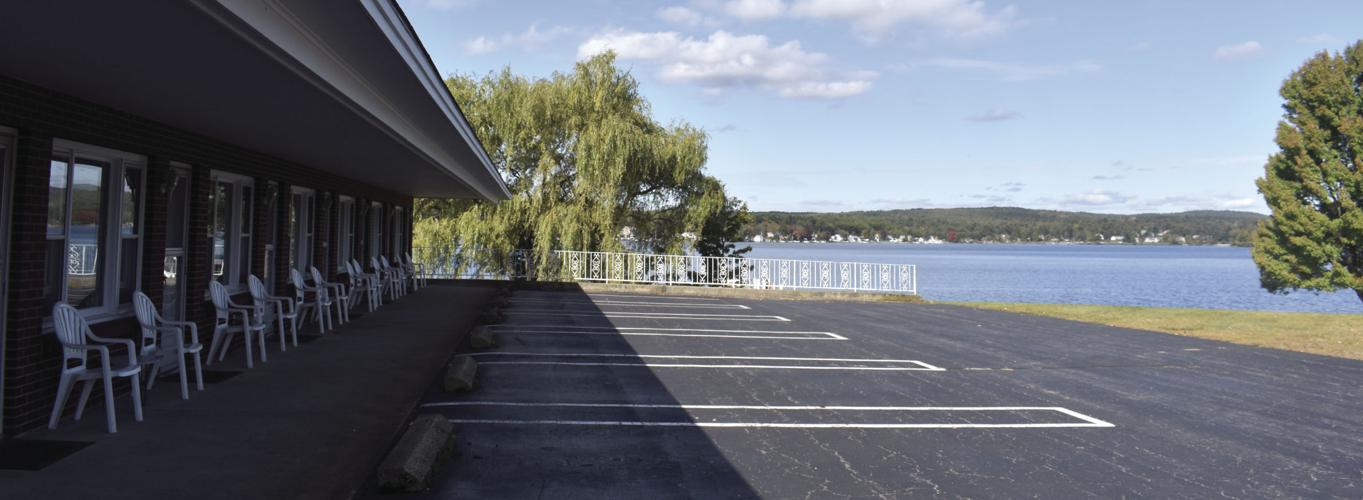
LACONIA — Barton’s Motel, which has been a fixture on the shore of Paugus Bay for decades, would be demolished in favor of new condominiums under a concept to be reviewed by the Planning Board on Tuesday.
Such conceptual reviews are part of a new performance zoning system under which projects that meet certain city goals can be more easily approved.
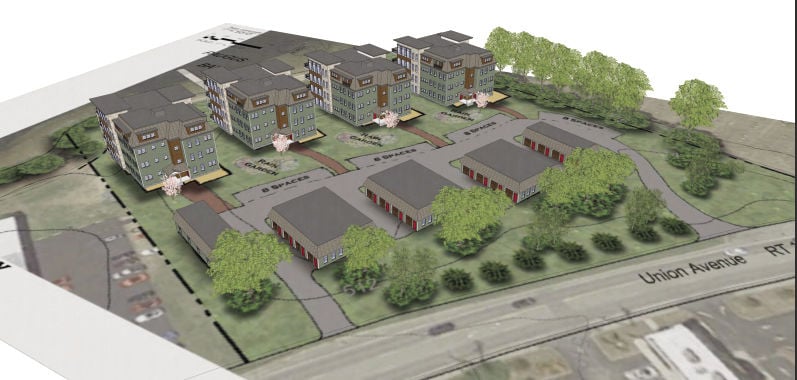
Documents filed for the meeting discuss building 32 condominium units in four buildings along the bay. Each building would be four stories tall and contain eight units. Patios would have direct sight lines to the water.
Renderings of the structures from various angles and a map of the project are part of the submittal.
In a brief interview, motel owner Chris Barton said the proposal is just in the planning stage.
“People have been interested in the property from time to time,” he said. “Nothing has been finalized. It’s basically an idea.”
DHB Homes of Londonderry is the applicant and Rokeh Consulting of Epsom is acting as the agent for the presentation to the board.
City property tax records show the motel at 1330 Union Ave., is appraised at $1.2 million. The motel includes eight buildings and a pool set on a lakeside property of 4.25 acres. The first building was constructed in 1937.
Planning Director Dean Trefethen said zoning requirements in the motel area set density at six units per acre, or 24 or 25 units for this property.
Through performance zoning, the developer would seek to have this density requirement waived. The benefit for the city is that new housing could boost the economy and the tax base, Trefethen said.
"They would be converting an underutilized property to a higher benefit," he said. "Barton's in its day was a very busy motel. Unfortunately that's not the business to be in these days."
On Tuesday night, the Planning Board is to vote on the concept of the proposal. No public hearing will be held until a later phase of consideration.
Regulations being considered by the City Council would prohibit short-term rentals outside of The Weirs unless the property is owner occupied. Trefethen said developers do not envision short-term rentals at this project and a homeowners' association rule would be written to that effect.
Since the motel is more than 50 years old, a permit to demolish the existing buildings must be considered by the Heritage Commission.
"I'm not sure how they're going to react to it," Trefethen said. "It's traditional cement block, nothing from my standpoint that is unique or unusual about the property."
Jane Whitehead, chairwoman of the commission, said the panel will discuss the historical value of the motel and ask a number of questions.
"Does it have architectural interest?" she asked. "Does it affect the fabric of the area and the general public's enjoyment of the area?"
In recent years, many motels and cottage communities along the lake have been converted to condos as the price of lakefront land has become so expensive that there is not sufficient return on investment for a buyer to continue to operate it as a lodging business.
There seems to be good demand for lakeside properties.
In July, the 1950s-era Proctor’s Lakehouse Cottages on Weirs Boulevard, each about 400 square feet, were converted into condominiums marketed at up to $250,000 each.
Developers bought the 1950s-era Christmas Island motel on Weirs Boulevard in 2013 for $1.2 million and built 16 duplex townhomes that sold for about $600,000 each.
Even a parking lot for what used to be a Burger King on Union Avenue has been turned into four waterfront condominiums.


(0) comments
Welcome to the discussion.
Log In
Keep it Clean. Please avoid obscene, vulgar, lewd, racist or sexually-oriented language.
PLEASE TURN OFF YOUR CAPS LOCK.
Don't Threaten. Threats of harming another person will not be tolerated.
Be Truthful. Don't knowingly lie about anyone or anything.
Be Nice. No racism, sexism or any sort of -ism that is degrading to another person.
Be Proactive. Use the 'Report' link on each comment to let us know of abusive posts.
Share with Us. We'd love to hear eyewitness accounts, the history behind an article.