


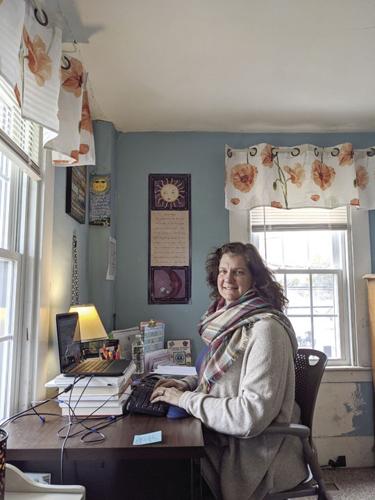

LACONIA — Social worker Jayme Sullivan treats people with borderline personality disorder – a mental illness that leaves them teetering between neurosis and psychosis, and battered by virulent emotions.
During the coronavirus, her one-on-one therapy sessions with patients – who are in a year of training to learn coping skills – takes place via telehealth: Video and voice conferencing by computer or phone. There is no soft lighting, soothing music or comfortable sofa, other than what they have at home.
For the most part, her clients not only respond – they like it. Telemedicine eliminates travel time, having to dress for appointments, and seems direct and personal and helps to establish trust, even though it eliminates some of the banter and body language reading that occurs during in-person office visits.
It's now poised to repaint the health care landscape in New Hampshire and other rural states, and not just for mental health.
“People are responding really well,” said Sullivan, a counselor at Lakes Region Mental Health Center. “People are grateful to be able to see my face and have somebody to talk to. They’re understanding this is how it needs to be. One person said, ‘It’s kind of neat that you come into my home.’ For another with many physical limitations, it takes a lot of time to get ready to come to my office. This gives her more time to do what she wants to do.”
Maggie Pritchard, the agency's executive director, said televisits allow counselors to see patients and understand what they’re going through. Since coronavirus distancing requirements went into effect three weeks ago and telemedicine has taken off, office appointments at LRMHC have dropped from 155 a week to fewer than 100. “Most people find it easier to engage by phone,” and many clients with iPhones choose FaceTime for voice and video, Pritchard said.
At HealthFirst Family Care Center, with primary and mental health care clinics in Laconia and Franklin, roughly 70 percent of patients like telehealth, 30 percent much prefer the social interaction of face-to-face appointments, and “100 percent like the service and knowing it’s there,” said Dave Ferrulo, a therapist and head of mental health services at HealthFirst, which has offered counseling via computer video conference for three or four years.
“There’s an element of human contact that’s nice and you miss it," said Dr. Nora Janeway, medical director at HealthFirst. "But most people are grateful that you’ve taken their safety seriously” during the coronavirus.
Like it or not, telehealth is here to stay. And providers are finding more ways to use it that streamline operations and cut wait times.
HealthFirst’s two clinics transferred most services to telehealth over the course of four days in March. The practices still see patients in-person, but gather basic information and descriptions of symptoms by telehealth, then request the Franklin Visiting Nurses Association to check on vulnerable seniors and others at risk at home. “Then we televisit to see how they’re doing and talk about how their medicine in working,” Janeway said.
At a time when many in-person visits to doctors and mental health counselors have been suspended to slow the spread of the flu-like, highly contagious coronavirus, telehealth is emerging as a life raft. It may not take the place of office visits. Face-to-face interaction is more satisfying emotionally and socially, including in doctor-patient relationships, and it provides more information about well-being, according to medical experts. But telehealth will become a more widely-used cost-effective alternative, used when sensible, expedient and necessary.
Now, with near-universal coverage of telemedicine by health insurance providers sparked by the coronavirus emergency, medical practices in New Hampshire are looking at using telehealth to triage patients, expedite first-time appointments, and provide followup care when office visits aren’t possible, practical or even ideal. With telehealth, people who can't carve out time for personal appointments and travel can retreat to their car or a nook at their office to consult with providers by laptop or smartphone, which will be treated the same as going to the doctor. Appointments that might not otherwise happen become easy to schedule and keep. And the benefits extend in both directions: providers and patients can do telehealth sessions from home or while on vacation, when and wherever they have cell or internet service.
Telehealth is "here to stay – the pandemic has created an opportunity for physicians, health systems and insurance carriers to see how telehealth services can be more robustly used,” said James Potter, executive vice president of the New Hampshire Medical Society.
“I don’t have to physically be in the room to help,” said Dr. Raymond Suarez, chief of psychiatry at Lakes Region General Hospital. Some subtleties in patient expression, appearance and carriage are lost, he said, but overall, and especially when diagnosis and care is based on conversation, teleconferencing is surprisingly effective, even for older patients who are uncomfortable at first. “For 90 percent of psychiatry patients it works, as long as the patients are OK with that.” While on furlough from LRGH, and for the duration of the coronavirus, Suarez is expanding outpatient counseling and medication monitoring through telehealth at his private practice, Lakes Region Wellness.
“Telemedicine has largely been underutilized up until this point,” Potter said. “One of the silver linings" of COVID-19 is it has increased and diversified telemedicine. For patients and providers, parity of insurance coverage between telehealth and face-to-face office visits has helped to spark the boom. Following orders last month by Gov. Chris Sununu, telehealth visits by phone and computer are reimbursed at the same rates as office visits, and based on time spent.
Medicaid, Medicare and private insurance will likely continue to cover telemedicine and office visits similarly when the coronavirus subsides, Potter said. Unknown is what will happen to telehealth coverage under employer-sponsored health plans, which are not governed to the same degree by state and federal mandates, and depend on partial payments by employees.
The forced telemedicine leap has sparked a plethora of uses and new techonologies, including more remote monitoring systems for patients who have tools to check their blood pressure, insulin levels and other health markers at home.
In New Hampshire, substance abuse recovery programs have already reported advantages, including greater participation by patients in group telehealth sessions. “It depends on how good the visuals are,” said Potter. “But it has increased interaction.” Many patients with substance misuse disorders are “much more comfortable in their home environments, provided they have a private place they can go,” and younger patients automatically seem to gravitate toward the technology, Potter said.
•••
The Sunshine Project is underwritten by grants from the Endowment for Health, New Hampshire’s largest health foundation, and the New Hampshire Charitable Foundation. Roberta Baker can be reached by email at Roberta@laconiadailysun.com


(0) comments
Welcome to the discussion.
Log In
Keep it Clean. Please avoid obscene, vulgar, lewd, racist or sexually-oriented language.
PLEASE TURN OFF YOUR CAPS LOCK.
Don't Threaten. Threats of harming another person will not be tolerated.
Be Truthful. Don't knowingly lie about anyone or anything.
Be Nice. No racism, sexism or any sort of -ism that is degrading to another person.
Be Proactive. Use the 'Report' link on each comment to let us know of abusive posts.
Share with Us. We'd love to hear eyewitness accounts, the history behind an article.