



Two weeks ago, Trisha Eisner’s 56-year-old husband started experiencing alarming symptoms: fluid retention and shortness of breath that could mean a serious heart problem. After 10 days, the medication prescribed by his provider at Belmont Family Health wasn’t working, and the outpatient practice, part of Lakes Region Hospital, was closed – at the very time he needed to be seen in person.
Eisner called the number indicated for telehealth, which led to a link to a patient portal, which her husband hadn’t registered for. She received no call back after leaving a message in voicemail. “The situation was very frustrating. Then you have the stress of COVID-19 on top of it,” Eisner said. “We haven’t gotten any response.”
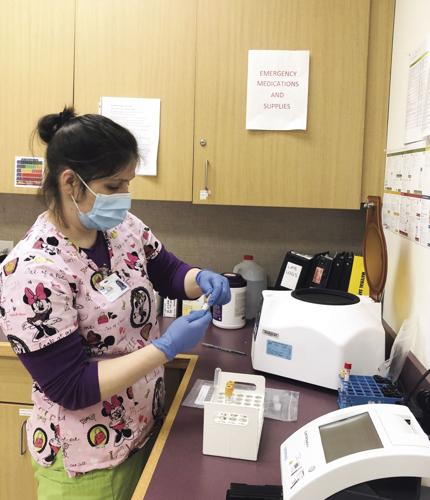
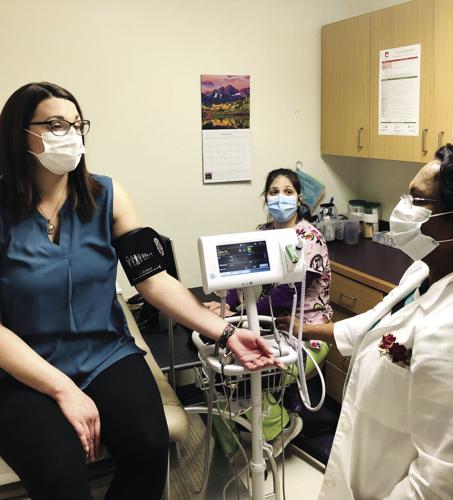
Eisner, who lives in Belmont, called Health First Family Care Center, which has primary care clinics in Laconia and Franklin. She filled out new patient paperwork online, and took her husband to see a provider in Franklin the next morning. There he had a series of medical tests and received authorization for a chest x-ray.
“I was relieved he was able to have a face-to-face appointment” despite precautions against social distancing and pressures to use telehealth, Eisner said.
“My doctor looks into everything I say. You usually get taken right away,” said Paula Merrigan, 81, who transferred from an LRGH primary care to Health First two years ago for management of her diabetes and COPD. This week, “I wanted to talk to (my doctor) because of oxygen. I’m getting a little out of breath. Do I have COVID-19? Or do I have a cold or allergies?”
At a time when the coronavirus and financial dire straits are shrinking or shuttering Lakes Region General Hospital’s outpatient services, it’s a relief to patients – especially those with life- threatening or undiagnosed health issues, that there are local alternatives for quick and continuing treatment.
Health First has been in business for 25 years and is accepting new patients, but few residents realize its Laconia and Franklin locations include internal and family medicine, addiction recovery and mental health care, said CEO Russ Keene. LRGH didn’t refer displaced patients there when the hospital furloughed staff.
Cancer care and general and elective surgery at LRGH are suspended until August. The hospital has re-opened primary care clinics with a skeleton staff at the Laconia Clinic and Westside Healthcare in Franklin. Roughly 700 of LRGH’s 1300 doctors, nurses, technicians, support staff and administrators are operating the emergency room, inpatient care and COVID-19 treatment, according to estimates based on the number of employees furloughed. Area hospitals are picking up the slack.
Concord Hospital, Huggins Hospital in Wolfeboro and Speare Memorial Hospital in Plymouth are fielding requests from patients seeking to transfer their primary care, and use the hospitals’ laboratory, chemotherapy, blood transfusion and wound care services. So far the influx has been small, but it’s slowly increasing, according to administrators at those area hospitals.
LRGH’s sudden upheaval left many patients feeling cut loose at a critical time, without referrals or clear directions on what to do.
Cass Walker, LRGH’s chief human resources officer and vice president of administrative and support services, said part of the problem was messaging. “The important information needed to put at the front” of recorded messages, without requiring patients to hopscotch through a list of options.
“I’m not going to promise that it’s perfect, but as we hear of problems, we’re mitigating them to come to solutions,” Walker said. Support staff is being added as patient volume increases, she said. “Despite all of them being impacted, our providers are still doing a lot of triaging by phone” and monitoring requests through patient portals.
Although LRGH’s transitional, COVID-focused and scaled-back clinics have become more functional and accessible over the past week, the meltdown left many patients feeling marooned, and disenchanted with what they see as a lack of organization or follow through.
Many have lost scheduled appointments, still lack information on the doctors they’ve seen for ongoing conditions, and are without a nearby hospital laboratory for routine bloodwork.
For many, the transition has been unsettling. Some say they are making do.
Malcom Murray, 82, of Laconia, said he misses his primary care doctor, Mark Aronson, now on furlough, who he’s seen for 14 years, including for managing his diabetes. When he called Aronson a month ago for a sinus condition, the doctor told him, “I’ve had that, this is what you do.” Now he calls a number for the Laconia Clinic to leave a message with an office receptionist, for a physician on call. The pharmacists at CVS in Gilford ensure his six prescriptions for diabetes are available and on auto-refill, mostly in 90-day supplies. One of the prescriptions requires a doctor’s authorization monthly, and CVS is proactive about getting that, Murray says. “I’m affected because my doctor’s on furlough. But I’m on a regimen that has kept me healthy,” including walking a mile daily to keep his blood sugar levels down – a lifestyle change recommended by his furloughed PCP.
For others, the transition has been bumpier.
Ed Engler, a cancer patient who lives in Laconia, travels to Dartmouth Hitchcock Medical Center in Lebanon for chemotherapy, but most of his oncology appointments there are now conducted by telehealth. When LRGH closed its outpatient clinics, he wasn’t told what had happened to his primary care doctor at Laconia Clinic – or the clinic’s laboratory where he gets oncology labs.
There was no announcement of where to go for bloodwork critical for managing chronic conditions, how to contact your provider, or referrals to area alternatives or providers on all. Engler, the former Laconia mayor and founder of The Laconia Daily Sun, asked Dartmouth-Hitchcock to send his lab request to Speare Hospital in Plymouth, where he got his blood drawn without wait.
“I just get the sense from talking to people that there’s a great deal of anxiety and frustration because of a lack of information from LRGH.” Early this week, Engler still hadn’t received a call back from his primary care provider’s office. He doesn’t know if his physician is still working, or seeing patients through telehealth. “There was no message or email from the office saying what to do. It seems that this was done quickly without a lot of thought or communicating with patients.”
On Monday, Steve Johnson, 65, was worried about getting pain medication that previously required an office visit and authorizations from the Drug Enforcement Agency. Johnson, a retired construction worker who lives in Laconia, became disabled in 1999 when a steel beam fell while he was operating heavy equipment on Boston’s Big Dig. His injuries led to multiple surgeries and plates and pins in his throat, and left him with constant pain, including while walking.
Refills of his hydrocodone medication have always required in-person visits and approval before he picked them up at the clinic’s pharmacy, which is now closed. An LRGH recording referred him to CVS in Laconia for all prescriptions – with no mention of an authorizing physician.
“They’re dumping thousands of patients,” Johnson said. “How do you squeeze that number through CVS?” Johnson said he and his wife tried to call the pharmacy for more than 30 minutes and couldn’t get through because the line was busy.
“Do we go to Concord or Dartmouth because that hospital’s failing? The doctors and nurses are wonderful people,” said Johnson. “It’s always the management that screws up.”
His wife Cynthia, 65, got a phone call saying all appointments at the clinic were canceled, including the followup to check her progress after beginning hydrocodone medication for osteoarthritis. “There’s too much contradicting information,” she said. “We’re older, and trying to limit going out. We’re scared like everybody else.”
Chip Broadhurst, a cancer patient who lives in Moultonborough, said he was lucky because his specialist is affiliated with a large oncology practice based in Hooksett, which has physicians at hospitals around the state. He didn’t receive any follow-up calls from LRGH, but was contacted by NH Oncology- Hematology’s group in Concord. He now travels to Concord Hospital for chemotherapy injections each week. “The seamless transition only occurred because I was contacted by NH Oncology- Hematology,” Broadhurst said.
It may not be as easy for older, local cancer patients who depended on taking taxis to LRGH’s Anderson Ganong Cancer Center, Broadhurst said. Now, they’ll need to find some way to get to infusion and other therapy appointments up to an hour from where they live.
Following Centers for Medicaid and Medicare recommendations for hospitals nationwide, LRGH’s routine screenings have been postponed indefinitely, and general and elective surgeries are also on hold. According to the website, laboratory services at LRGH are available three days a week, but the criteria for patient use isn’t clear. Quest Diagnostics in Gilford is the nearest local lab, open from 7 to 11 a.m. during the week.
“If I wanted my colonoscopy done, I’d have to wait,” Broadhurst said. “If I showed up with broken bones, I don’t know what would happen. From a trauma standpoint, I really don’t know what’s happening. Concord doesn’t really have the capacity to handle everyone.”
•••
The Sunshine Project is underwritten by grants from the Endowment for Health, New Hampshire’s largest health foundation, and the New Hampshire Charitable Foundation.
Roberta Baker can be reached by email at Roberta@laconiadailysun.com


(0) comments
Welcome to the discussion.
Log In
Keep it Clean. Please avoid obscene, vulgar, lewd, racist or sexually-oriented language.
PLEASE TURN OFF YOUR CAPS LOCK.
Don't Threaten. Threats of harming another person will not be tolerated.
Be Truthful. Don't knowingly lie about anyone or anything.
Be Nice. No racism, sexism or any sort of -ism that is degrading to another person.
Be Proactive. Use the 'Report' link on each comment to let us know of abusive posts.
Share with Us. We'd love to hear eyewitness accounts, the history behind an article.