


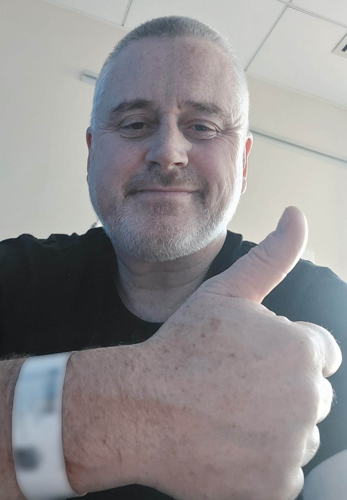
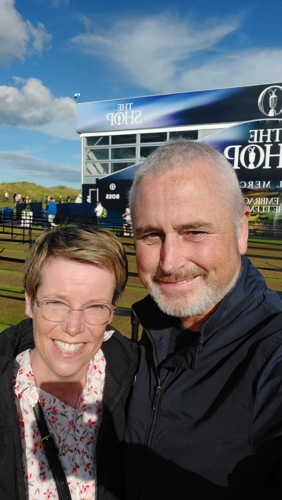
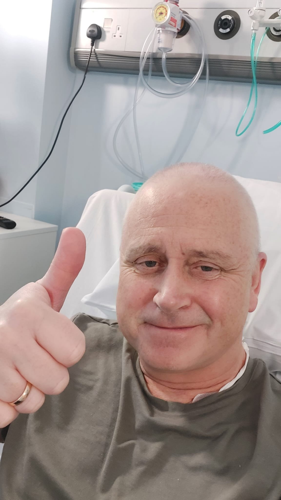

Robert Neill was diagnosed with leukemia. (Spot Leukemia via SWNS)
By Amy Reast
A dad who put his exhaustion down to work stress from running his own business later discovered it was actually leukemia.
Robert Neill, 55, began feeling drained in January 2024 but put it down to a busy December running his own business as a wine importer.
As a reward to himself, he took the month off work to catch up on rest.
Over the following months he developed a nasty chest infection twice - and began needing naps daily, putting the tiredness down to general aging.
But by June his exhaustion was worse than ever - and his turning point came when he closed his eyes for a moment in the car, and fell asleep for three hours, missing the meeting.
Around this time, a 70-year-old friend rang to share his own diagnosis of multiple myeloma, a type of cancer that affects the blood and bone marrow.
When Robert asked about his symptoms, he found he had seven of the eight his friend described - raising alarm bells.
He was diagnosed with acute myeloid leukaemia (AML) following a bone marrow biopsy and started intensive chemotherapy, before needing a stem cell transplant from a donor.
Despite some setbacks in recovery, including developing a liver disease which left him hospitalised for five weeks, Robert is now cancer-free and back at work running his wine business.

(Spot Leukemia via SWNS)
Dad-of-three Robert said: "I'd burnt myself out over the years running my own business.
"If there's one blessing in disguise, it's that I've learned to rest. Rest is half the battle.
"I went through what felt like a near-death experience, and it didn't frighten me.
"You appreciate what's really important, and the best things in life are free."
Robert noticed his exhaustion shortly after the busy Christmas period - and despite it being out of character, took the month off.
He said: "I thought, well, it's January, we've had a very successful December, and I'm no spring chicken anymore."
What followed was months of symptoms that all seemed to have ordinary explanations.
A bad chest infection in January cleared up after a week of rest. A few weeks later it came back "with a vengeance."
By February, Robert had developed an overwhelming need for an afternoon nap every single day.
He said: "It became a serious, almost addictive habit."


But there was no bleeding or bruising - nothing that obviously pointed to cancer, so Robert felt he had little reason to be alarmed.
That was, until Robert arrived early for a work meeting and decided to close his eyes in the car for a few minutes.
He woke up three hours later, having slept through the entire appointment.
He said: "I thought, right, no, something's definitely wrong here."
A GP appointment led to blood tests, which showed his counts were low - explained, initially, by the chest infection he was fighting.
But when the infection returned even worse than before, and his counts still hadn't recovered as expected, his GP began monitoring his bloods every two to three weeks.
But things escalated when his friend's symptoms mirrored his own.
He said: "That obviously raised the alarm bell with me as well."
Robert was referred to haematology and had a bone marrow biopsy at the end of September 2024. Weeks later, he was called back in to discuss the results - and told to bring his wife, Allison.
The couple were devastated to learn he had AML.

(Spot Leukemia via SWNS)
Robert began intensive chemotherapy, spending five weeks as an inpatient over Christmas 2024 before returning home on New Year's Eve.
Scans showed the cancer had gone into remission, but doctors were clear: that without a stem cell transplant, it was likely to return.
In March 2025, after a further round of intensive conditioning chemotherapy, Robert received his transplant - fresh stem cells, harvested from his donor and given to him the very next day.
The weeks that followed brought mild side effects and roughly four weeks in isolation, which Robert found harder than the treatment itself.
Following a stem cell "top-up" in August 2025, he developed graft versus host disease (GvHD) in his liver and was hospitalised for nearly five weeks while doctors brought it under control, eventually with a targeted medication he remains on today.
By October and November 2025, his strength had returned and he began to feel like himself again.
Now Robert has returned to work, and has taken the journey as an opportunity to grow and change his mindset.
His advice to anyone newly diagnosed is simple: "Embrace it. Of course you'll be fearful and nervous - you're being thrown into a world you never thought you'd be in.
"But stay positive, and befriend as many patients and staff as you can. One day at a time."
Colin Dyer, chief executive of Leukaemia Care, says: "Robert's journey shows just how easily the early signs of leukaemia can be mistaken for the ordinary wear and tear of a busy life - tiredness, a stubborn chest infection, needing a bit more sleep. It's precisely that which makes leukaemia so hard to catch early.
"That's why our Spot Leukaemia campaign exists, to help people recognise when persistent, unexplained symptoms are worth a simple blood test. We're enormously grateful to Robert for sharing his story so openly, and we wish him continued good health."


(0) comments
Welcome to the discussion.
Log In
Keep it Clean. Please avoid obscene, vulgar, lewd, racist or sexually-oriented language.
PLEASE TURN OFF YOUR CAPS LOCK.
Don't Threaten. Threats of harming another person will not be tolerated.
Be Truthful. Don't knowingly lie about anyone or anything.
Be Nice. No racism, sexism or any sort of -ism that is degrading to another person.
Be Proactive. Use the 'Report' link on each comment to let us know of abusive posts.
Share with Us. We'd love to hear eyewitness accounts, the history behind an article.