


March always brings back memories of our sugar house in Sanbornton, which provided maple syrup for our family's hotel kitchens and for sale to the guests. Most of our trees were grand old trees with a mound of roots that rose above the snow which made it easier to collect the sap. I quickly learned that navigating back with a full and heavy pail of sap meant I immediately sank deep into the snow and got wet with spilled sap. In the sugarhouse, hardwood was used to fire the evaporator and the combination of burning wood and sweet maple smells is still a clear and wonderful memory. Years later when I was given a tour of the C&H Sugar refinery just outside of San Francisco, I was amazed how similar the smells were to our little sugar house, even more surprising was that the captain of the ship that transported the sugar cane from Hawaii lived in Gilford!
The lighter hues of Grade A maple syrups are delicate with complex flavors, most professional pastry chefs use "Dark" or "Very Dark" grades, formerly known as "Grade B" syrup, because it has a deeper, intense flavor.
The most common mistakes people make when making bread is not activating dry active yeast properly. This is partly because the directions on the envelopes are so vague, they don’t tell you to wait until the yeast rises to the top and forms a raft. This is never an issue when using fresh yeast which doesn’t need to be activated. It is important that you don’t heat the water or milk to over 120˚F because you will kill the yeast.
In baking, sugar is considered not a dry ingredient, but a liquid. This because when sugar has contact with liquid or heat, it liquifies. This is why the sugar is added to the liquid to form a softer dough that is easier to mix and less likely to develop a tough dough. As with other soft, high liquid doughs, it’s better to use a paddle and not the dough hook. You mix at a higher speed, which is necessary to develop the gluten. This recipe can be made in a food processor, but only if you the plastic dough attachment. Food processors work very fast, so the total mixing time will only be about 4 minutes.
Use caution with the maple caramel; wear a long sleeve shirt and use heavy pot holders.
Yields: 12 buns
Dough
1/2 cup whole milk
2 tablespoons unsalted butter, cut into quarters
1/4 cup water
1 teaspoon, Plus 1/2 cup sugar
1 envelope active dry yeast
1 large egg, beaten
2 1/2 cups unbleached bread flour
1/2 teaspoon salt
In a small saucepan, warm the milk and butter. Combine the milk and butter in a small pot and warm over medium heat only until the butter is 50% melted and set aside, letting the butter melt completely. The warmth of the milk will continue to melt all the butter. Measure 1/2 cup warm (100˚F) tap water into a bowl, stir in 1 teaspoon sugar and yeast. Let stand until a good thick froth rises to the top, about 5 minutes.
Pour yeast, milk and egg into the mixing bowl of a stand mixer. Add the egg and 1/2 cup sugar. Using the paddle attachment, mix until the egg is incorporated and sugar is dissolved.
Add the bread flour, salt and mix on low speed to incorporate the flour. Once blended increase the speed to medium high and mix for 5 minutes. Then stop the mixer and scrap dough from the sides of the bowl and paddle. Continue mixing for another 5 minutes, then repeat scraping down the dough, but this time turn the ball upside down in the bowl. Continue mixing for another 5 minutes or until all the dough has clung to the paddle and the sides of the bowl are clean of dough.
Turn dough out onto a very lightly flour-dusted work surface. Lightly dust the top of the dough with flour and gently shape into a ball. Place in a lightly oiled bowl, cover with a damp cloth and let stand in a warm spot without drafts until risen to double in volume, about 1 hour depending on the temperature and humidity of your kitchen.
Filling
1 cup granular maple sugar
1/4 cup sugar
4 ounces unsalted butter (soft)
2 tablespoons dark maple syrup
2 tablespoons unbleached all purpose flour
1 1/2 cups pecans or walnut pieces
1 large egg, beaten
Beat together sugars and butter until smooth. Add the maple syrup and flour, mix on medium speed until blended, light in color and spreadable, about 5 minutes.
With extra butter, lightly grease each well of a 12 portion large muffin pan, then add about 1 teaspoon of the filling to each, add 1 rounded teaspoon of chopped pecans and press nuts into the filling. Place 2 large sheet pans nearby. One is to catch the filling overflow and the other for turning out the baked buns.
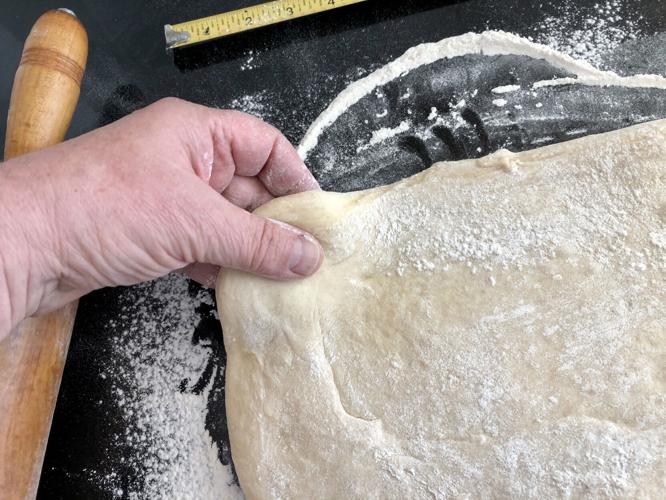
Once the dough has risen dust a smooth counter with flour about 15 inches wide and 10 inches tall. Lightly dust with flour the top of the dough, then scrape down the sides to loosen from the bowl. Turn out with the top side down onto the flour dusted counter. Lightly dust the top. Roll dough into a rectangle 12 inches left to right and 8 inches top to bottom. As you roll, keep the top and bottom of the dough lightly dusted with flour, this makes it easier to roll and prevents the dough from sticking to the rolling pin and counter. Glide your fingertips under the corners of the dough with your thumb on top about 1 1/2 inches deep, gently stretch the dough to form a right angle corner at all four edges. Use a wide soft brush to remove all flour from the top, bottom of dough and the counter.
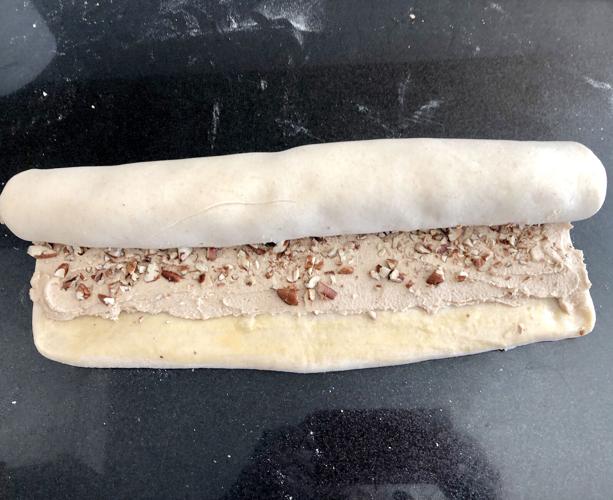
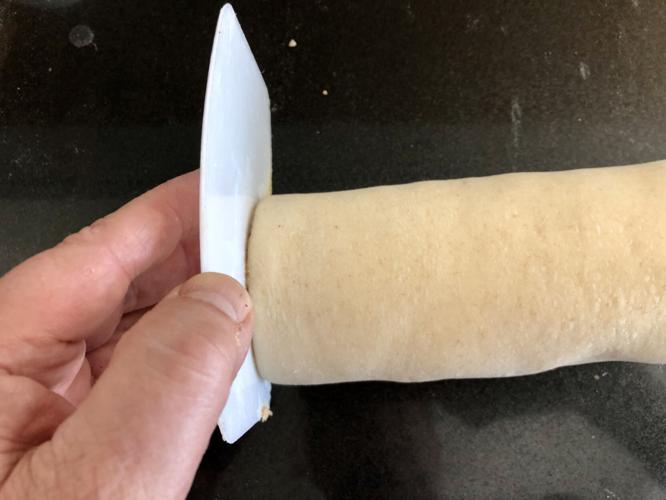
Brush a 3/4 inch wide ban of the beaten egg across the bottom edge of dough. Spread filling over top of dough above the 1 inch egg ban, do not cover the egg ban with the filling. Cover the top of the filling layer with remaining pecans and press gently into the filling. Start at the top and roll towards the bottom into a log. Then roll gently back and forth to help seal the edge. Using a smooth edge thin knife cut into 12 equal slices. Use a plastic scraper to push the ends back so you are maintaining the same thickness after rolling and cutting.
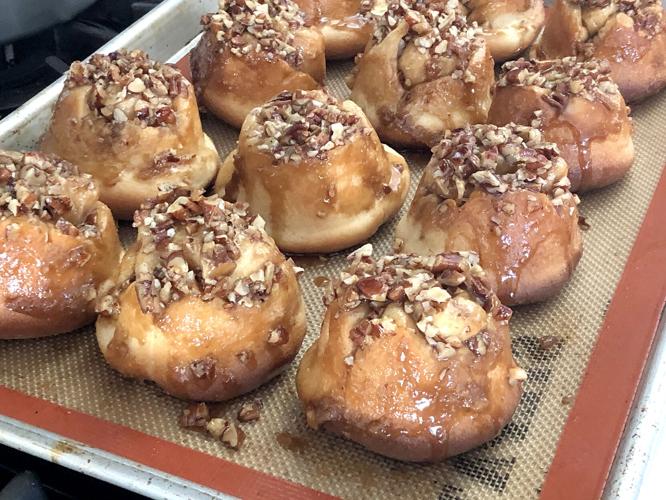
Place cut side down in each prepared muffin tin. Set aside in a warm spot without drafts to rise 30% in volume, about 30 - 60 minutes. Adjust oven rack to lowest level and preheat oven to 350˚F. Bake for 10 minutes, then place a sheet pan under the muffin pan to catch any fill overflow. Continue baking for about another 10 minutes or until the tops are golden brown and the filling is a caramel color.
Remove from the oven and place on the stove top. Use a spoon to scrape the hot caramel that has spread on the top of the pan back against the buns. Do not touch the caramel! Place the second on the counter with the longer edge facing you. Position the long edge of the muffin pan at the end of the sheet pan and quickly turn out onto the pan. Using a spoon, scrape caramel left in the pan onto the buns. Wait until completely cooled before handling, about 30 minutes. Store in an airtight container. For easy cleaning, soak maple caramel-covered pans in warm water to dissolve the caramel.


(0) comments
Welcome to the discussion.
Log In
Keep it Clean. Please avoid obscene, vulgar, lewd, racist or sexually-oriented language.
PLEASE TURN OFF YOUR CAPS LOCK.
Don't Threaten. Threats of harming another person will not be tolerated.
Be Truthful. Don't knowingly lie about anyone or anything.
Be Nice. No racism, sexism or any sort of -ism that is degrading to another person.
Be Proactive. Use the 'Report' link on each comment to let us know of abusive posts.
Share with Us. We'd love to hear eyewitness accounts, the history behind an article.