



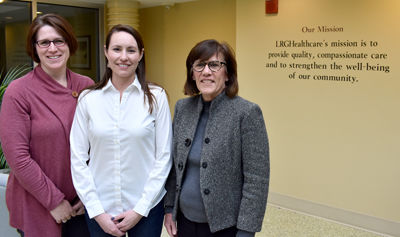
Corey Gately, program coordinator for the LRGHealthcare Recovery Clinic; Daisy Pierce, director of Navigating Recovery; and Marge Kerns, director of clinical services for LRGHealthcare, say that a grant provided by Foundation for Healthy Communities has allowed them to instill a culture of recovery at Lakes Region and Franklin hospitals. (Adam Drapcho/Laconia Daily Sun)
Two-year grant given to Lakes Region General Hospital and Franklin Hospital to establish a new culture, practices
By ADAM DRAPCHO, LACONIA DAILY SUN
LACONIA — A person is at their absolute lowest when they are brought to the hospital’s emergency department due to an opioid overdose. But, that also presents what might be the best moment to offer them a route out of substance abuse.
That’s the opportunity that LRGHealthcare and Navigating Recovery are aiming to capitalize on. The two nonprofit organizations are halfway through a two-year grant that they’re using to establish new practices and a new culture that will integrate local hospital staff and the recovery community.
The grant is from Foundation for Healthy Communities, which is providing $124,400 each to Franklin Hospital and Lakes Region General Hospital, which are both operated by LRGHealthcare, over a two-year period that ends next summer.
Corey Gately, program coordinator at the LRGHealthcare Recovery Clinic; Daisy Pierce, director of Navigating Recovery; and Marge Kerns, vice president of clinical services at LRGHealthcare, said the grant is being applied to twin efforts aimed at improving access to recovery services.
Treat the patient, train the providers
“We’re supposed to link people to recovery, but the number one barrier is stigma. People are embarrassed and ashamed to reach out,” Pierce said.
So, instead of waiting for people to reach out, Navigating Recovery and LRGHealthcare is making the first move. Part of the grant funding is being used to develop a program whereby anyone who is diagnosed with substance abuse disorder will be contacted by a trained recovery coach. That coach will describe how recovery is possible, thanks to a network of support services and groups in the area, and with medication-assisted treatment available at the LRGHealthcare Recovery Clinic, as well as through private providers.
At LRGH, recovery coaches will be available to respond around the clock. For example, if a person is brought in to the emergency department for an overdose, the recovery coach would be able to meet with that patient before discharge. That’s what has been happening in Laconia since June of last year. Since then, Navigating Recovery coaches have met with 107 people at the hospital, including some people who were seen for issues related to alcohol or meth.
For reasons that they don’t quite understand, the 24/7 access to recovery coaches wasn’t utilized at Franklin Hospital, so a different practice is being pursued at that site. In Franklin, a recovery coach will follow up with each patient diagnosed with substance use disorder. Additionally, a few staff members are being trained by Navigating Recovery, so that hospital will have its own in-house coaches.
“Now we can look at two different models to see which is successful,” said Kerns.
That’s the first of the two ways the grant is being used. The second is to train hospital staff, including nurses and doctors, about the science of addiction and the hope that exists for people who enter recovery.
“We’re trying to get across that it’s a medical illness, this is not a moral failing or a choice,” Pierce said.
That distinction is pivotal, said Gateley.
“The way that we deal with that person in that moment can make a huge difference when they decide whether or not they decide to enter recovery,” she said.
“We’re trying to instill a culture of recovery,” Pierce said.
When the grant money runs out next June, the programs should be able to sustain themselves. By that time, all hospital staff will be trained by Gateley and Pierce. In the meantime, recovery coaches will be pursuing the necessary licensing which will enable them to bill Medicaid for their services.
These types of programs are considered progressive for big city hospitals. For a hospital in a rural area, they’re cutting-edge. And they will soon be joined by a trial program in which emergency room providers will be able to prescribe a one-day dose of suboxone, which is used to both block the effects of opioids and to relieve the symptoms of withdrawals. The patient would also be given information as to how they could connect with available recovery resources.
Thanks to these developments, there will soon be day when a patient is brought in to the hospital while overdosing, and will walk out of the hospital on the path to recovery.
“The grant has provided us the room to be innovative,” said Gateley.


(0) comments
Welcome to the discussion.
Log In
Keep it Clean. Please avoid obscene, vulgar, lewd, racist or sexually-oriented language.
PLEASE TURN OFF YOUR CAPS LOCK.
Don't Threaten. Threats of harming another person will not be tolerated.
Be Truthful. Don't knowingly lie about anyone or anything.
Be Nice. No racism, sexism or any sort of -ism that is degrading to another person.
Be Proactive. Use the 'Report' link on each comment to let us know of abusive posts.
Share with Us. We'd love to hear eyewitness accounts, the history behind an article.