


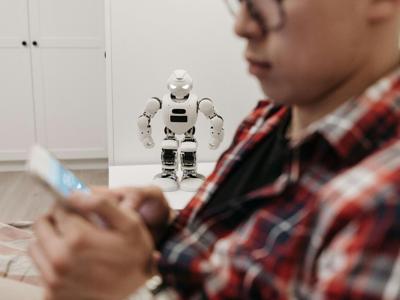

(Photo by Zulfugar Karimov via Unsplash)
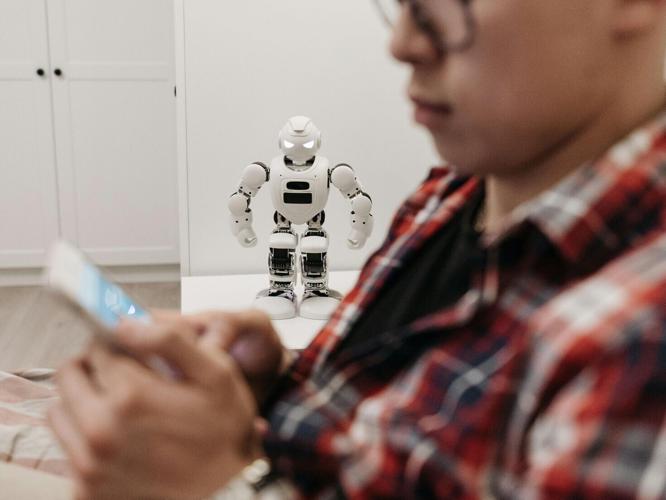
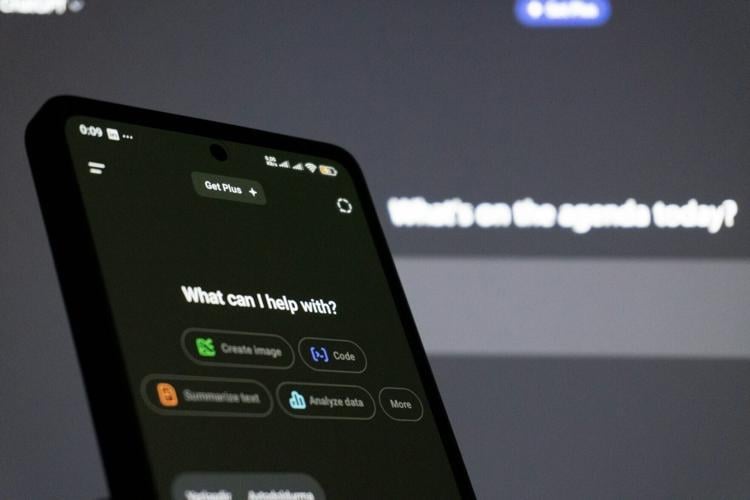
According to a new survey, 86% of office workers are using "please" and "thank you" with AI — and you may need to, too.
The poll of 2,000 U.S. AI-wielding office workers found two-thirds (64%) believe it's important to show AI common courtesy, and (27%) say "please" and "thank you" every single time they use it.
Commissioned by TripleTen and conducted by Talker Research, the study found one respondent believes courtesy is key because, "AI is more likely to respond in the correct way when you use words such as 'please.' Even if your prompt is not that great."
Others believe it’s to maintain character: "I don't want to train myself to be rude even to a robot — it might carry over." Multiple like-minded respondents believe courtesy literally improves AI output quality. "AI learns from me — I want it to model my manners," explained one.
And some simply say it’s due to survival humor: "Because I want to be polite now so I'll be remembered positively when our robot overlords take over.”
The study revealed 41% find it easier to address AI like a tool, while 23% find it easier to address it like they would any other human being.
Most of those who treat AI as a tool (91%) believe it's important they remain objective and direct with the technology.
Meanwhile, 87% of those who treat AI like any other human being believe it can function as an actual personal assistant to them.
It was also found that three in four of those who treat AI like humans also like to keep their chatbots gender-neutral, and only a quarter give their AI a gender — 14% prefer female, 11% prefer male.
Interestingly, it was revealed founders are most likely to assign AI a feminine gender (23%), compared to other job positions.

(Talker Research)
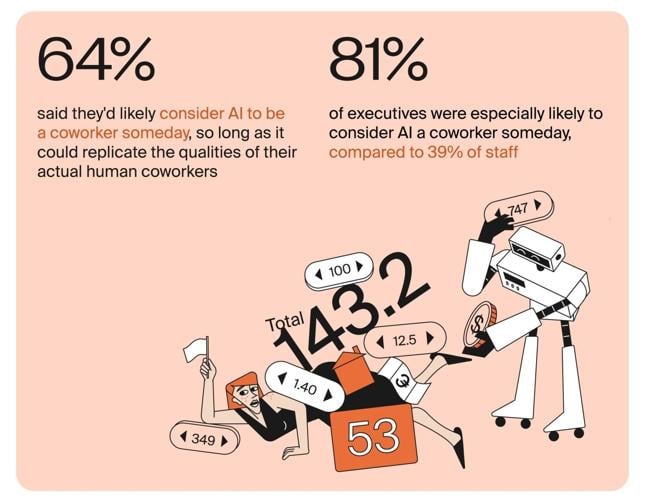
Nearly two-thirds (64%) would likely consider AI to be a coworker someday, if it could ever replicate the qualities of their actual human coworkers. Executives polled were twice as likely to consider AI a coworker (81%), compared to their staff (39%).


"AI isn't really a tool — it's a system with what you could call functional emotions, internal patterns that genuinely shape what it produces," said Ana Riabova, AI Growth Expert at TripleTen. "The most effective users have figured this out: tone, context, and specificity actually change what comes back. The 'please' and 'thank you' aren't superstitions — they're what it looks like when someone has noticed the model is responding to them, not just executing."
The survey found 83% of office workers have been encouraged to use AI at work by their leadership. Staff-level workers are the least likely to have been fully encouraged by employers (27%), which may explain their lower AI adoption: a support gap created from the top down.
Sixty percent of respondents identified as being in upper leadership positions, including founders, executives, C-suites and management. And according to them, 73% see a correlation between employees using AI and their productivity levels, with 92% of them seeing employees increase their productivity when using AI.
Likewise, 54% of leadership sees a correlation between employees using AI and staff morale, with 83% seeing an increase in morale the more AI is being used.
But despite the perceived productivity and morale increase, the results found a stark reality between C-Suite and staff levels when actually using AI.

(Photo by Pavel Danilyuk via Pexels)
C-Suites are more willing to embrace AI (93%) than staff level employees (70%), and find AI “very enjoyable” to use more frequently than staff (71%, compared to 33%).
C-Suite also shows a more positive view of how they use AI, compared to staff. Consistently, C-Suite feels “much further ahead” than their co-workers when using AI (42%, compared to 12% of staff) and believe showing courtesy to AI is important (78%) more than their staff does (46%).
But instead of replacing staff with AI, business see it working alongside their staff: on average, leaders believe their employees will start treating AI like human co-workers within six years.
“There’s a misconception that employees are hesitant to use AI, when in reality most just haven’t been given the tools or direction," says Nsaku Toya, AI & Automation Career Coach. "Saying ‘use AI’ isn’t the same as showing people how it fits into their actual work. Without that structure, adoption becomes inconsistent and frustrating. Organizations need to close that gap if they want meaningful results.”
WHAT TASKS IS AI BEST AT IN WORKPLACES?
- Summarizing documents 53%
- Brainstorming ideas 37%
- Writing emails 31%
- Parsing data 22%
- Coding/building applications for use 20%
- Scheduling agendas 19%
- Improving communication skills with colleagues 16%
- Building to-do lists 15%
- Advising on different interactions 12%
- Taking notations during calls 12%
- Sending reminders 11%
- Simulating client-facing interactions for training 8%
- Have human-like conversations 6%
- Reminders to take breaks 4%
- Taking entire calls on a person's behalf 4%
- Gossiping 2%
Research methodology:
Talker Research surveyed 2,000 American office workers who have used AI in the last 2 years who have access to the internet; the survey was commissioned by TripleTen and administered and conducted online by Talker Research between Mar. 16 and Mar. 30, 2026. A link to the questionnaire can be found here.
To view the complete methodology as part of AAPOR’s Transparency Initiative, please visit the Talker Research Process and Methodology page.


(0) comments
Welcome to the discussion.
Log In
Keep it Clean. Please avoid obscene, vulgar, lewd, racist or sexually-oriented language.
PLEASE TURN OFF YOUR CAPS LOCK.
Don't Threaten. Threats of harming another person will not be tolerated.
Be Truthful. Don't knowingly lie about anyone or anything.
Be Nice. No racism, sexism or any sort of -ism that is degrading to another person.
Be Proactive. Use the 'Report' link on each comment to let us know of abusive posts.
Share with Us. We'd love to hear eyewitness accounts, the history behind an article.