


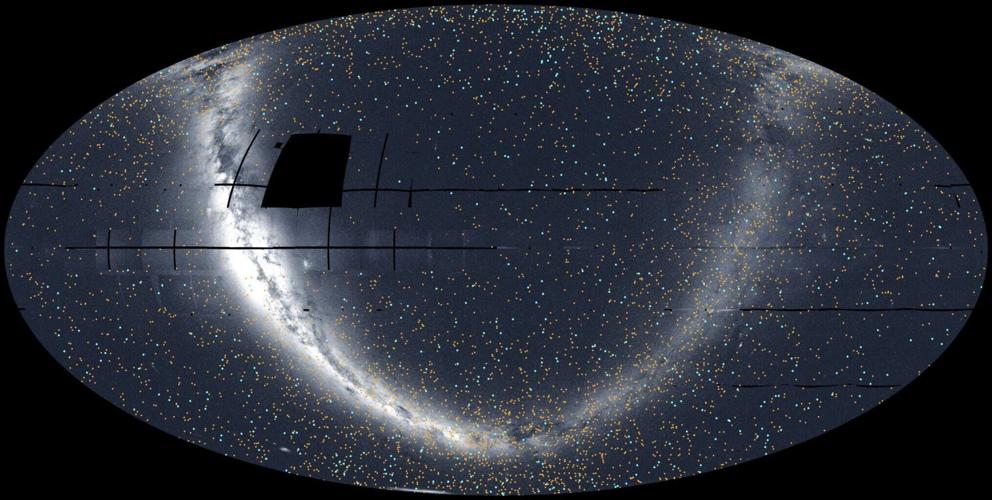

This view of the whole sky was constructed from 96 TESS sectors. (NASA / MIT / TESS / Kostov / University of Maryland via SWNS)
By Dean Murray
A NASA planet-hunting mission has unveiled its most detailed map of the sky yet, revealing thousands of potential alien worlds beyond our solar system.
The space agency's Transiting Exoplanet Survey Satellite (TESS) has released its most complete all-sky mosaic to date, combining years of observations into a jaw-dropping sweeping single view.

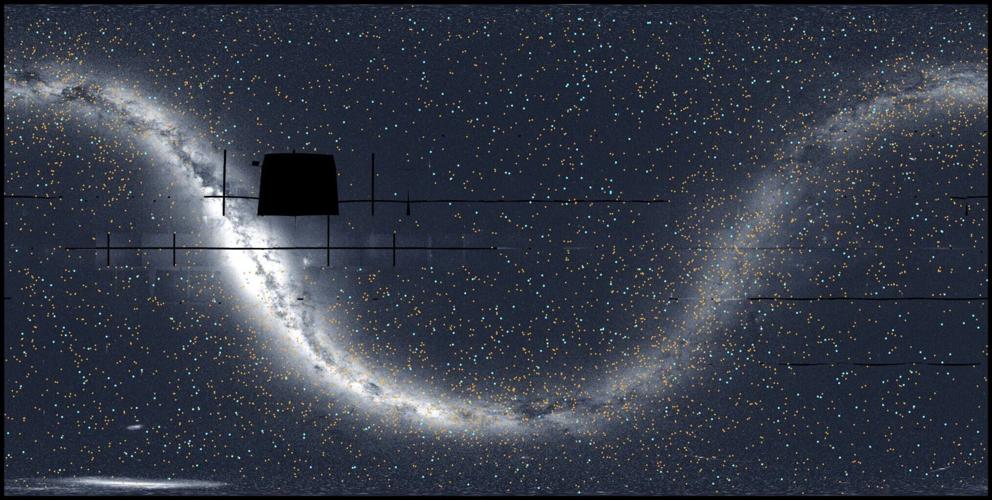
This all-sky view shows the TESS sky map in a rectangular projection and marks the locations of confirmed (blue) and candidate (orange) exoplanets. The band of the Milky Way, the central plane of our galaxy, takes on a U shape, and the Large Magellanic Cloud, a nearby galaxy, appears as the elongated glow at bottom left. Black areas within the map indicate regions TESS has not yet imaged. (NASA / MIT / TESS / Kostov / University of Maryland via SWNS)
Blue markers in the mosaic show the locations of nearly 700 confirmed exoplanets as of Sept. 9, 2025, while more than 5,000 additional candidates are shown in orange, awaiting further verification. Among them are extreme worlds, including planets that may be volcanic, those being torn apart by their stars, and others orbiting binary systems with two suns.


The image also captures the dense central plane of the Milky Way, visible as a bright band running through the middle, underscoring the vast scale of the survey.
The picture fills gaps left by earlier scans and highlights nearly 6,000 confirmed and candidate exoplanets identified by the mission as of September 2025, at the end of its second extended operation.

This view of the whole sky was constructed from 96 TESS sectors. By the end of September 2025, when the last image of this mosaic was captured, TESS had discovered 679 exoplanets (blue dots) and 5,165 candidates (orange dots). The glowing arc running through the center is the plane of the Milky Way. (NASA / MIT / TESS / Kostov / University of Maryland via SWNS)
NASA Universe said: "Our TESS telescope has released its most complete view of the starry sky yet! All those dots? They're confirmed and candidate planets! Since launching in April 2018, TESS has been scanning wide swaths of the sky to build up this mosaic."
The map is the result of 96 sectors observed between April 2018 and September 2025. TESS surveys one section of the sky at a time, spending around a month on each, using four cameras to monitor the brightness of tens of thousands of stars. Subtle dips in light can indicate planets passing in front of their host stars.


(0) comments
Welcome to the discussion.
Log In
Keep it Clean. Please avoid obscene, vulgar, lewd, racist or sexually-oriented language.
PLEASE TURN OFF YOUR CAPS LOCK.
Don't Threaten. Threats of harming another person will not be tolerated.
Be Truthful. Don't knowingly lie about anyone or anything.
Be Nice. No racism, sexism or any sort of -ism that is degrading to another person.
Be Proactive. Use the 'Report' link on each comment to let us know of abusive posts.
Share with Us. We'd love to hear eyewitness accounts, the history behind an article.