


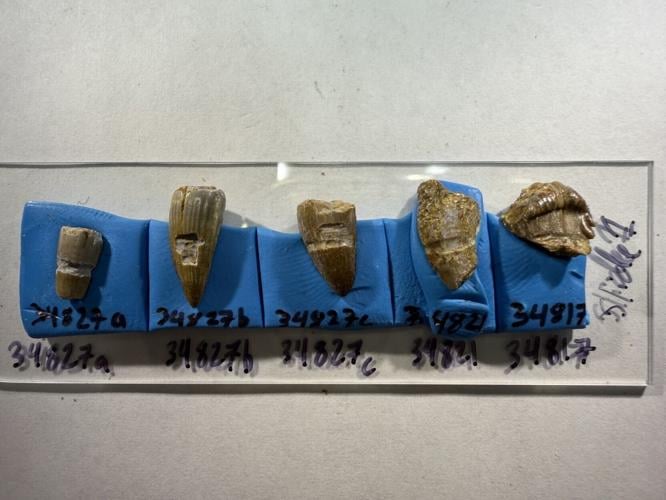

Five specimens from the Cloverly Formation assemblage after destructive sampling for isotopic composition and laser ablation analysis. (Idaho Museum of Natural History via SWNS)
By Stephen Beech
Dinosaurs loved to snack on seafood washed up on ancient beaches, reveals new research.
They also munched on seaweed — which offers an explanation to mysteriously high carbon isotope signatures in their teeth, according to the fossil study.
Storms routinely wash marine matter ashore, which even today land-living animals and other organisms exploit as food sources.
American scientists say the process, known as marine subsidization or MS, is common in coastal areas among animals, particularly when land ecosystems yield less food than usual, for example during droughts.
The new study suggests that dinosaurs and their prey were doing the same thing tens of millions years ago.
Study first author Clayton Forster said: "We show that coastal terrestrial organisms in the greenhouse climates of the Cretaceous relied on marine resources to supplement their diets in a similar way that modern organisms do.
"We can identify that marine resources are passed along the food chain and incorporated in the minerals of bones and teeth of dinosaurs, crocodiles, turtles, and fish."
He explained that plants contain "light" (C-12) and "heavy" (C-13) carbon isotopes.

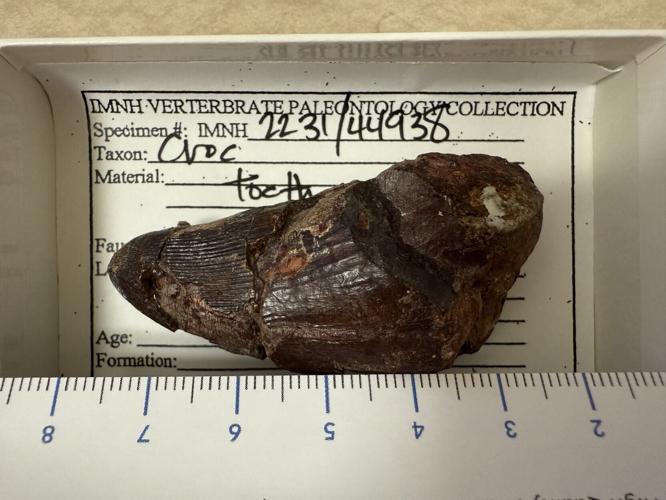
A large crocodilian tooth from the Wayan Formation. The specimen is shown next to a centimeter ruler in a specimen box on top of its specimen information card. (Idaho Museum of Natural History via SWNS)
The ratio of those isotopes, called delta 13C, is a chemical "fingerprint" that gets passed from food into the body of the consumer.
When an animal eats, the delta 13C value is incorporated into its tooth enamel with an upward shift in the value to one higher than that of its food.
Forster says the difference is between 11 and 13 parts per thousand in the tooth enamel of living animals.
But in dinosaur teeth he difference has been found to be consistently higher, creating a mystery around carbon signatures.
Their delta 13C values were also higher than expected for animals that solely eat land-growing plants, which have lower delta 13C values than most marine plants.
But if dinosaurs or their prey snacked on marine matter, it could explain the discrepancy.
Forster, a geologist at the University of Arkansas, said: "By determining the carbon isotope composition of dinosaur, fish, and crocodile tooth enamel, we can determine what their primary dietary source was and if they were different between regions."
The research team used fossils from former coastal sites along the Western Interior Seaway — a vast inland sea that split North America into two landmasses around 100 million years ago — and the ancient Gulf of Mexico coastline.
They also included fossils from landlocked sites.


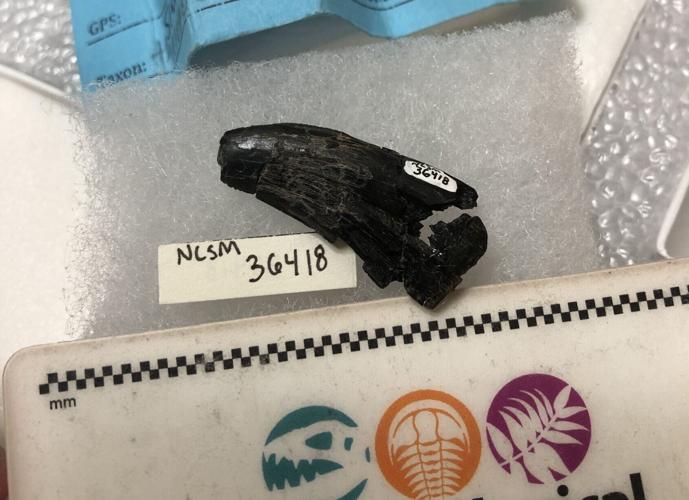
Theropod tooth from the Mussentuchit Member assemblage on a foam block next to a scale card. (Idaho Museum of Natural History via SWNS)
The sites formed during the early Albian period, around 113 to 107 million years ago, or early Cenomanian period, 100 to 96 million years ago.
The researchers used powder from the fossils to analyze isotopic composition during both ages and determined the latitudes on which the organisms lived.
The analysis showed that the delta 13C value in fossils from coastal sites was not only higher than that from the landlocked formation, but also was consistent between coastal sites — regardless of latitude or age.
The study, published in the journal Frontiers in Ecology and Evolution, is the first to identify MS in prehistoric ecosystems.
Forster said: "Coastal-dwelling organisms must have eaten some kind of organic matter from the ocean, or prey that had done so.
"This pattern is shared from fish to megaherbivores and indicates that the extra carbon source must have been low in the food-chain to affect both aquatic and terrestrial animals."
He says the source must also have been an organism living in coastal, but not inland, habitats and remained available over many millions of years.
Forster said: "Few organisms meet these criteria besides marine macroalgae or macrophytes — seaweeds.

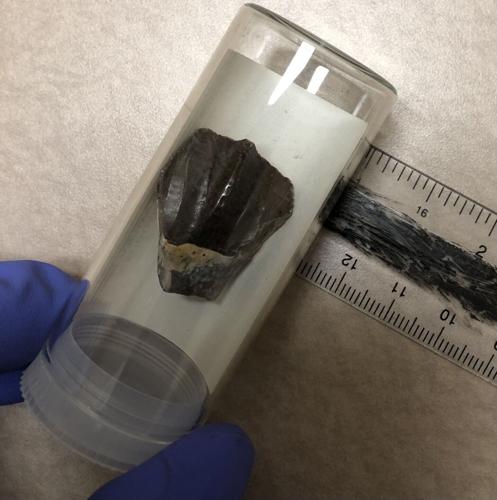
A Tenontosaurus tilletti tooth from the Cloverly Formation assemblage in a glass sample vial. (Idaho Museum of Natural History via SWNS)
"Given the almost ubiquitous behavior of large coastal herbivores today to supplement their diet with seaweeds, it's likely that most of the sampled herbivorous dinosaurs were no different."
But he says not all dinosaurs exploited marine resources.
For example, Tenontosaurus tilletti, a large herbivorous dinosaur found in many locations throughout the Cretaceous, didn't use marine sources for food.
Its delta 13C value was found to be similar to that of animals which are alive today and consume land-growing plants.
Forster says higher delta 13C values likely reflect dietary preferences rather than geological processes that changed chemical traces in tooth enamel after animals died.
He said further research is needed to determine whether MS was common in different latitudes and time periods.
Forster added: "Our study emphasizes the connections between terrestrial and marine ecosystems.
"They are deeply intertwined and have been for hundreds of millions of years.
"It highlights the importance of environmental linkages across time and space and protecting them where they exist today."


(0) comments
Welcome to the discussion.
Log In
Keep it Clean. Please avoid obscene, vulgar, lewd, racist or sexually-oriented language.
PLEASE TURN OFF YOUR CAPS LOCK.
Don't Threaten. Threats of harming another person will not be tolerated.
Be Truthful. Don't knowingly lie about anyone or anything.
Be Nice. No racism, sexism or any sort of -ism that is degrading to another person.
Be Proactive. Use the 'Report' link on each comment to let us know of abusive posts.
Share with Us. We'd love to hear eyewitness accounts, the history behind an article.