


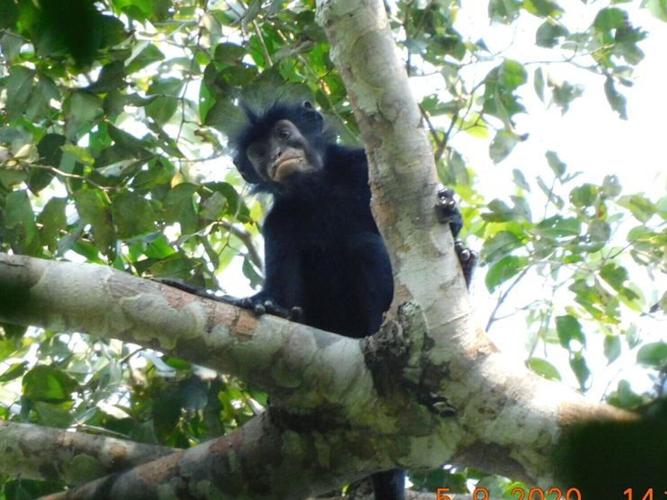
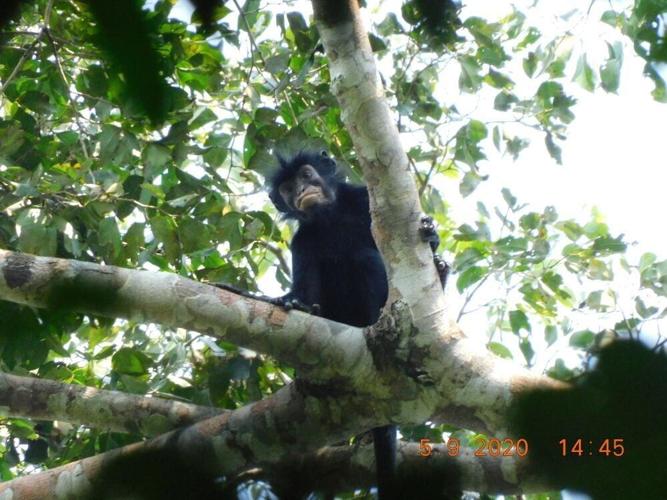
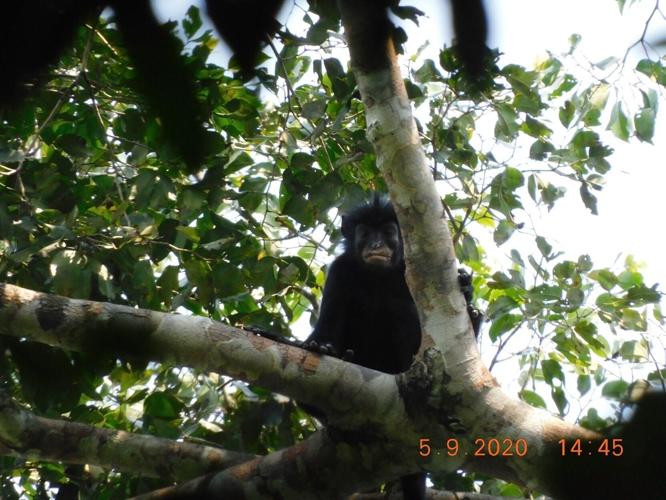
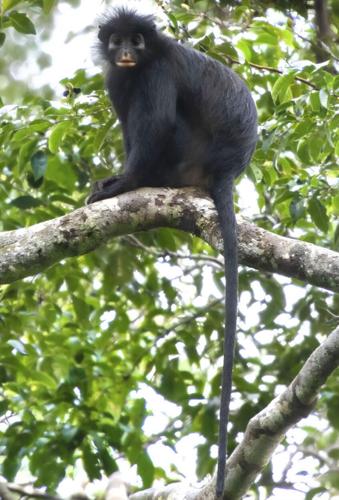

Colobus congensis, known locally as likweli, has a dramatic black face with pinkish-orange lips. (Junior Amboko, CC-BY 4.0 via SWNS)
By Stephen Beech
A new species of monkey with unusual orange lips has been discovered deep in the rain forests of Africa.
The species — already feared to be "endangered" — can be identified by its "striking" facial markings and unique call, say scientists.
It is known locally in the rain forests of the Democratic Republic of Congo (DRC) as "Likweli" and is only the fifth new monkey species identified in Africa the last 75 years.
The largely black species had remained undocumented despite decades of scientific exploration in the region.
It was first sighted in 2008 when researchers captured a partially obscured photograph of the monkey.

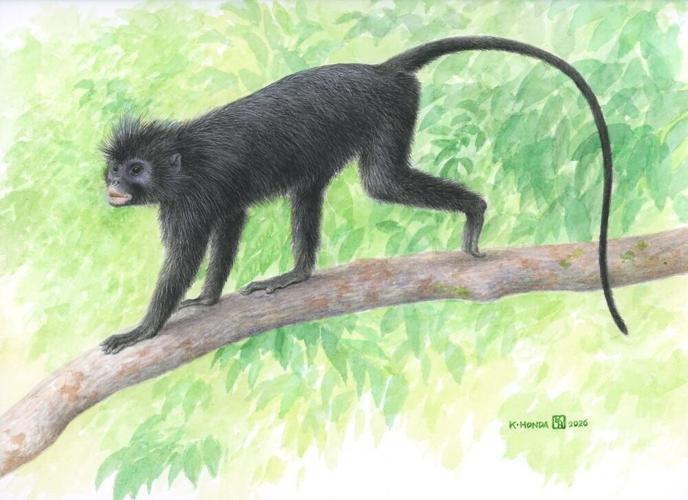
An illustration of Colobus congensis, whose common name is the local vernacular name, "likweli." (Kimio Honda, CC-BY 4.0 via SWNS)
A decade later, researchers encountered the animal again and obtained a much clearer image.
The discovery sparked further investigation into the elusive primate.
Now, new genetic, anatomical and acoustic analyses have confirmed that the monkey represents a "distinct" evolutionary lineage that diverged from its closest known relative four to five million years ago.
The findings, published in the journal PLOS One, also suggest the species — given the scientific name Colobus congoensis — may already be at risk because of its limited range, habitat loss and hunting pressure.
The discovery was made by an international team of scientists led by researchers from Florida Atlantic University (FAU) in the United States and the Lukuru Wildlife Research Foundation in DRC.
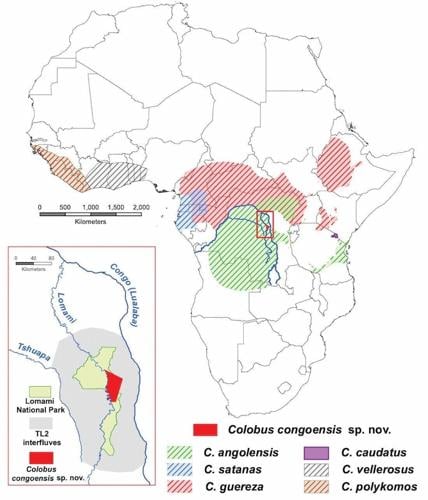
The mysterious monkey was found in the remote area between the Lomami and Congo rivers in east-central DRC.

(Junior Amboko / Florida Atlantic University via SWNS)
Its range size is believed to be a fraction of that of most other colobus monkeys, suggesting that Likweli may be very sensitive to habitat quality.
The species was usually observed in small groups, often alongside other monkey species.
Study co-author Junior Amboko, a FAU Ph.D. student, said: "This discovery is both exciting and deeply personal, highlighting the extraordinary biodiversity of my homeland and how much remains undocumented.
"I was fortunate to be part of this discovery from the very beginning – from recognizing in the first photographs that we were looking at something new in the forest, to training field teams to document its behavior, analyzing the data and helping write the scientific paper.
"Being involved through every stage, from fieldwork to the lab, made this an especially rewarding experience.
"It makes it even more meaningful that the name I proposed, Colobus congoensis, was chosen.
"The name honors the Democratic Republic of Congo, a country with extraordinary biodiversity, and reflects the incredible natural heritage that continues to reveal new discoveries.
"I hope it also draws greater attention to the importance of conserving these forests and the unique species that call them home."
Draped in glossy black fur with cape-like shoulders, a long sweeping tail and a vivid orange-cream patch around the mouth and nose, he said C. congoensis has a "striking, mask-like" appearance unlike other known Colobus monkey.


Study senior author Kate Detwiler, of FAU, said: "The discovery of Colobus congoensis is reshaping our understanding of African monkey evolution.
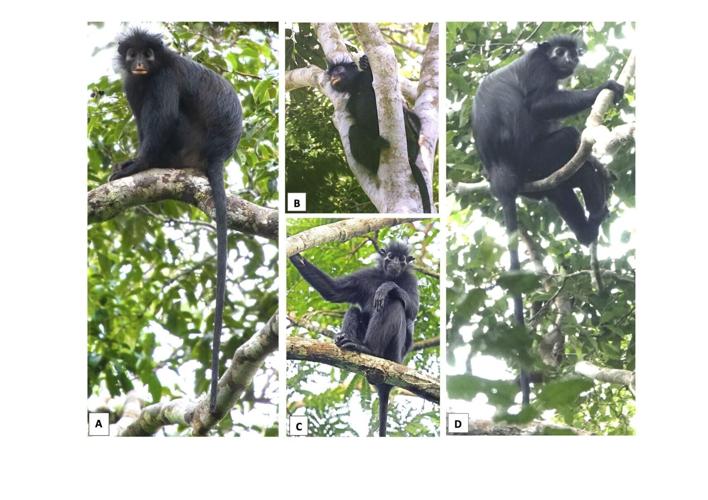
"Its closest known relative is Colobus satanas, found more than 1,200 kilometers away in west-central Africa.

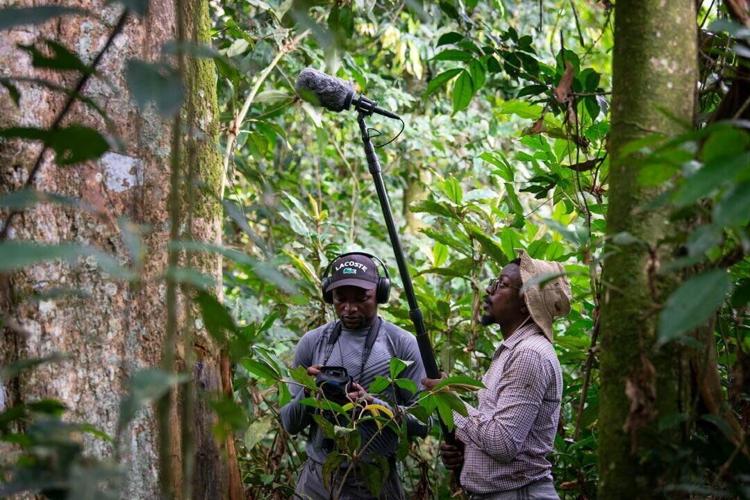
Junior Amboko (left) and Mardoché B. Koko working in the field in the Lomami National Park. (Junior Amboko / Florida Atlantic University via SWNS)
"Yet our genetic evidence shows the two species diverged roughly four to five million years ago, marking one of the oldest known evolutionary splits within the Colobus lineage."
Anatomical analysis played a key role in confirming C. congoensis as a distinct species and establishing the physical characteristics that set it apart from other African colobus monkeys.
Co-author Julia Arenson, from the Yale Institute for Biospheric Studies in the U.S., said: "We compared the skulls and pelts of C. congoensis with other species of African colobines, which underscored how unique this new species is.
"At the same time, despite being much smaller in body size, we also demonstrated it shares features of the teeth, skull and face with Colobus to the exclusion of other African colobines."
The cranial and dental findings corroborated the genetic evidence and helped the research team establish the formal anatomical diagnosis required to validate the species.
Co-author Christopher Gilbert, from City University of New York, said: "In order to name a new species, you have to be able to prove it.
"We used extensive museum collections including specimens housed at the Yale Peabody Museum and the American Museum of Natural History, and comparative datasets to compare the skulls and pelts with known African colobus monkeys.
"This robust pool of information allowed us to pretty quickly and conclusively confirm C. congoensis as a new species."

(Daniel Rosengren via SWNS)
Researchers also incorporated local ecological knowledge to better understand the species' distribution and behavior.
They spoke with residents and hunters across villages in the Lomami National Park's buffer zone.
Only eight villages recognized the species or could accurately describe it.
Local communities referred to the monkey as "Likweli" and "kasaba nkoni" — the latter meaning "the branch shaker" — and described it as elusive and rarely seen.
Between 2018 and 2022, researchers recorded 114 sightings across an estimated range of 1,700 square kilometers.
But even as the species enters the scientific record, researchers warn it may already be at risk.
Due to its extremely limited range, small population size, growing hunting pressure and ongoing habitat loss, scientists are proposing C. congoensis be classified as "endangered" on the IUCN Red List.
Detwiler said: "The discovery of Colobus congoensis is both a scientific triumph and a sobering reminder that some of Earth's rarest creatures may vanish before the world even knows they exist."

Colobus congoensis and C. satanas in life. (A & B) C. congoensis, Lomami National Park, Democratic Republic of Congo. ((A) Daniel Rosengren, (B) Bravo Bofenda. (C & D) C. satanas, Lop via SWNS)
Study first author John Hart, of the Lukuru Wildlife Research Foundation, added: "We continue to be reminded that the Congo Basin remains one of the world's last great frontiers for mammal discovery.
"Even in regions that have been scientifically explored, entirely new species are still coming to light.
"This discovery reinforces how much biodiversity remains undocumented in the Central Congo Basin and how this region continues to reshape our understanding of primate evolution and conservation."


(0) comments
Welcome to the discussion.
Log In
Keep it Clean. Please avoid obscene, vulgar, lewd, racist or sexually-oriented language.
PLEASE TURN OFF YOUR CAPS LOCK.
Don't Threaten. Threats of harming another person will not be tolerated.
Be Truthful. Don't knowingly lie about anyone or anything.
Be Nice. No racism, sexism or any sort of -ism that is degrading to another person.
Be Proactive. Use the 'Report' link on each comment to let us know of abusive posts.
Share with Us. We'd love to hear eyewitness accounts, the history behind an article.