


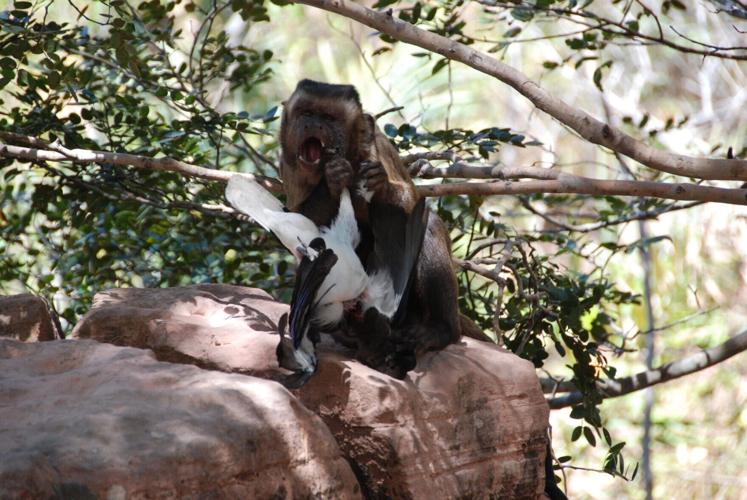

Adult male capuchin feeding on bird prey. (Luciano Candisani, CC-BY 4.0 via SWNS)
By Stephen Beech
Monkeys hunt for meat — including snakes and lizards — when fruit and vegetables are scarce, reveals new research.
The switch to carnivore behavior when their favored food is in short supply potentially mirrors the habits of early humans, say scientists.
They explained that humans are the only living primates who regularly hunt animals larger than themselves, a lifestyle thought to have emerged alongside large brains and complex social structures.
The predatory habit may have begun with the eating of smaller prey, as seen in other primates such as chimps and capuchins.
To determine what factors lead primates to hunt, an international research team investigated the hunting habits of capuchin monkeys living in rural Brazil.
The researchers followed two groups of bearded capuchins in Fazenda Boa Vista between 2006 and 2010.
They observed more than 5,000 hours of the capuchins' behavior and documented 446 instances of them eating small animals, mostly lizards (43%) and rodents (28%).
The observations included the first recorded cases of capuchins eating opossum, iguana and bird nestlings.
The findings, published in the journal PLOS One, showed that, compared with female monkeys, males hunted prey more often and went after more dangerous prey such as snakes.
Diets also varied based on environmental conditions, with an increase in hunting when plant foods were less accessible.

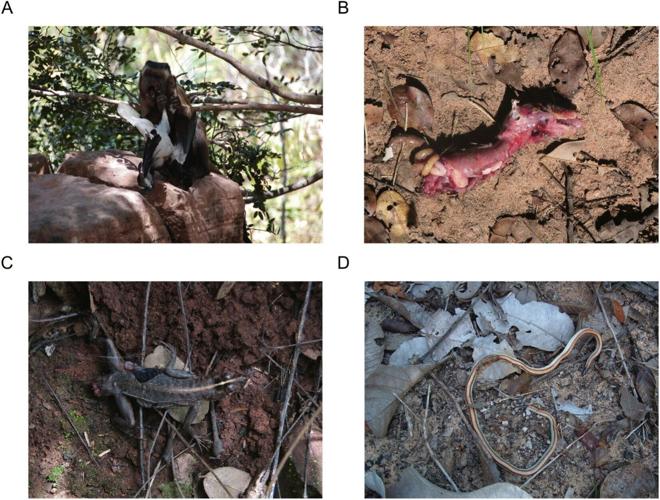
Evidence of vertebrate consumption at FBV. A (top left): Adult male feeding on avian prey (photo by Luciano Candisani); B (top right): Mammal prey (marsupial) preyed upon by an adult male. The skin was ripped off and the viscera exposed (photo by Noemi Spagnoletti); C (bottom left): Lizard preyed upon by an adult female. Viscera were exposed (photo by Eduardo D. R. Silva); D (bottom right): Snake preyed upon by an unidentified individual. The upper part of the snake containing the head was ripped off and the viscera exposed (photo by Noemi Spagnoletti). (Carvalho et al., 2026, PLOS One, via SWNS)
The monkeys also tended to prefer the brains and guts of prey — seemingly prioritizing fat-dense tissues, according to the findings.
Study co-author Noemi Spagnoletti said: "These results suggest that capuchins turn to vertebrate prey during times of plant food scarcity, a pattern that has been suggested for ancestral humans during climate fluctuations, but that the monkeys' hunting habits also vary based on sex and on which nutrients are lacking in their diet."
Co-author Susana Carvalho, director of science at Gorongosa National Park, Mozambique, said: "This study highlights the critical need of long-term observational field work to reliably understand the behavior of long-lived and highly flexible primate species.
"When we look at 45 months of data, we see small vertebrates like lizards, rodents and snakes as a key source of food when less fruit is available — and a preferential target for prey brains and viscera.
"Hunting small prey could have been an important source of nutrition for human ancestors, during periods of food scarcity, providing a steppingstone to the exploitation of larger prey — the fossil record now needs re-analyzing to look at evidence of small vertebrate predation."
Spagnoletti, from Sapienza University of Rome, Italy, said: "I began studying wild capuchin monkeys after completing a long-term study of the diet and activities of lowland gorillas in the rainforests of Central Africa.


"During that research, we discovered that, contrary to what was generally known at the time, lowland gorillas also preyed on termites.
"We made this observation because we followed the animals every day, working in rotation with teams of researchers and local guides.
"That experience taught me how much can still be discovered through patient, long-term observation in the field."
She said that during the field work in Brazil the team observed about 6.4 predation events per 100 hours of observation.
Spagnoletti said: "We observed this behavior in males and females, as well as in both adults and younger individuals, although it was more common among adult males.
"We recorded not only solitary hunting but also hunting events involving several individuals and cases in which prey or parts of prey were transferred between group members.
"Another particularly interesting finding was how the monkeys processed their prey.
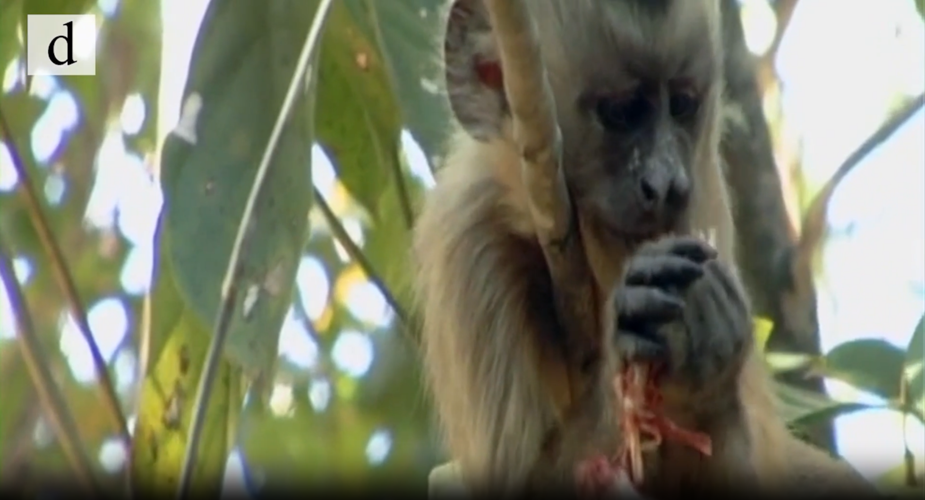
"They often consumed the brain and viscera before eating the rest of the body.
"This may allow them to obtain energy-rich fats and other nutrients quickly, which could be especially advantageous when prey is likely to be taken by another group member.

(Carvalho et al., 2026, PLOS One, via SWNS)
"Our observations also suggest that vertebrate prey may become an important source of energy when preferred fruits are scarce."
She added: "Overall, our findings show that vertebrate predation is a regular component of the feeding ecology of these capuchins and involves a surprisingly diverse range of prey and hunting strategies.
"Our study cannot tell us directly how the human diet evolved, and capuchins should certainly not be considered a direct model of our ancestors.
"However, they provide an interesting comparative perspective.
"Capuchins are highly adaptable primates that combine a predominantly plant-based diet with the active hunting and consumption of vertebrate prey.
"They also show sophisticated strategies for finding, capturing and processing food.
"These behaviors remind us that the incorporation of animal foods and the behavioral flexibility required to obtain them are not unique to humans or to the great apes.
"Looking at how similar feeding strategies have evolved independently in other primates can therefore help us better understand the evolutionary processes that may have shaped different components of the human diet."


(0) comments
Welcome to the discussion.
Log In
Keep it Clean. Please avoid obscene, vulgar, lewd, racist or sexually-oriented language.
PLEASE TURN OFF YOUR CAPS LOCK.
Don't Threaten. Threats of harming another person will not be tolerated.
Be Truthful. Don't knowingly lie about anyone or anything.
Be Nice. No racism, sexism or any sort of -ism that is degrading to another person.
Be Proactive. Use the 'Report' link on each comment to let us know of abusive posts.
Share with Us. We'd love to hear eyewitness accounts, the history behind an article.