


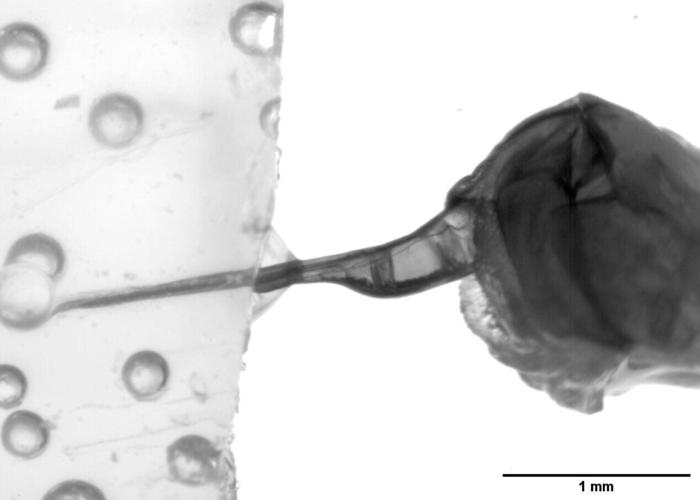
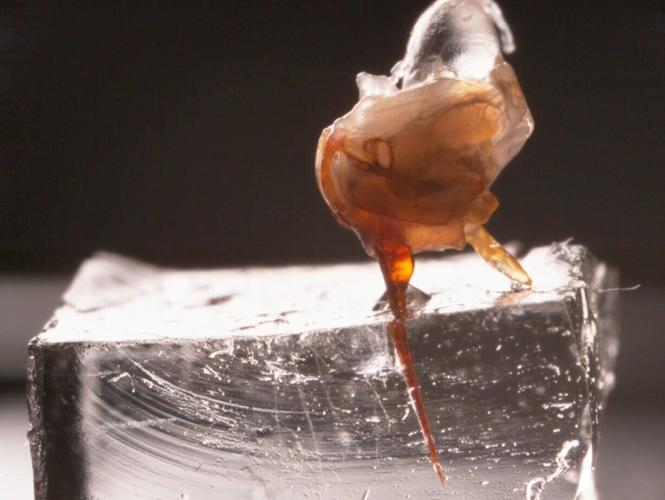

High-speed videography (100fps) of the stinger pumping venom into an artificial skin mimic. The bulb is seen in lateral aspect, transmitted illumination permits viewing of the pumping of the lancet valves. Lancet valve deformation is additionally visible, inflating on the downstroke and deflating on the upstroke. (Ramirez-Esquivel et al 2026 via SWNS)
By Stephen Beech
A honeybee’s “remarkable” stinger is a tiny double-piston venom pump, reveals new research.
High-speed video uncovered the “unique” mechanism that allows the 2-millimeter stinger to continue to pump poison into its target — even after it has separated from the bee’s body.
The groundbreaking study, published in the journal Proceedings of the National Academy of Sciences (PNAS), was conducted by scientists in Australia.
Lead author Fiorella Ramirez-Esquivel said: “We’ve known since as early as 1910 that the venom sac of a honeybee stinger empties into a chamber with little pumping elements called valves, but until now we didn’t know exactly how they work.

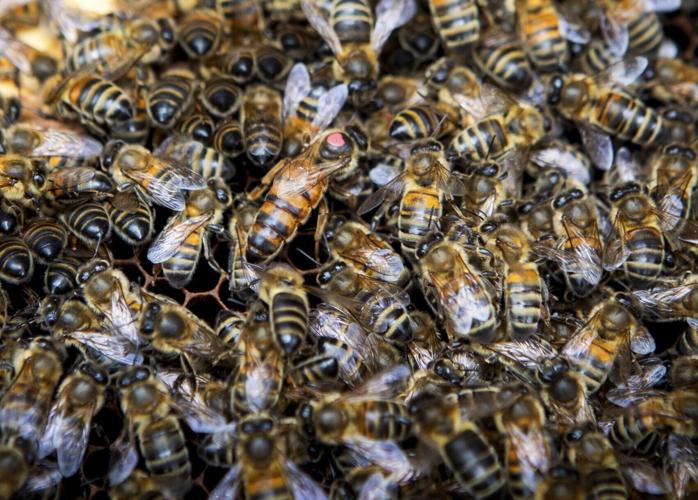
Bee's in a hive. (Katielee Arrowsmith via SWNS)
“If you’ve ever been stung by a bee, you’ll know it’s a very painful process, but now we’ve been able to identify all the working parts packed into the tiny stinger.”
She explained that after a worker bee lands and thrusts its stinger into the target, it flies away leaving the stinger behind in a process known as “autotomy.”
The stinger then continues to penetrate into the target tissue and inject venom under its own power.

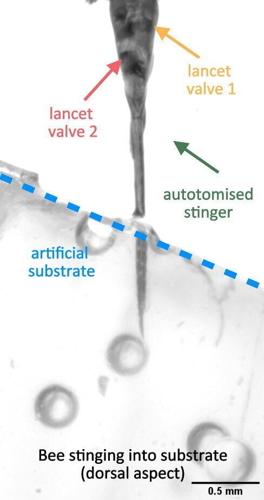
High-speed videography (100fps) of the stinger pumping venom into an artificial skin mimic. The bulb is seen in dorsal aspect, transmitted illumination permits viewing of the pumping valves and their deformations within the chamber. The stinger propagates deeper into the tissue as the lancets reciprocate, coloured illustrations indicate which lancet is in protraction (downstroke) and actively pumping venom. (Ramirez-Esquivel et al 2026 via SWNS)
By having bees sting a clear gel that mimics human skin, researchers from Macquarie University and the University of New South Wales, both in Sydney, were able to video the autonomous action of the stinger pumping venom for the first time.
Ramirez-Esquivel, of Macquarie University, said: “The stinger contains several different components, including a venom sac and pumping chamber, muscles and nerves.


“It also has two sharp, pointed lancets that slide backward and forward on a system of rails — called the olistheter — in a motion similar to that of a reciprocating saw; the lancets are responsible for working the stinger deeper into the skin and also pumping the venom.
“Each of the long lancets has a valve attached that sits inside the pumping chamber.”

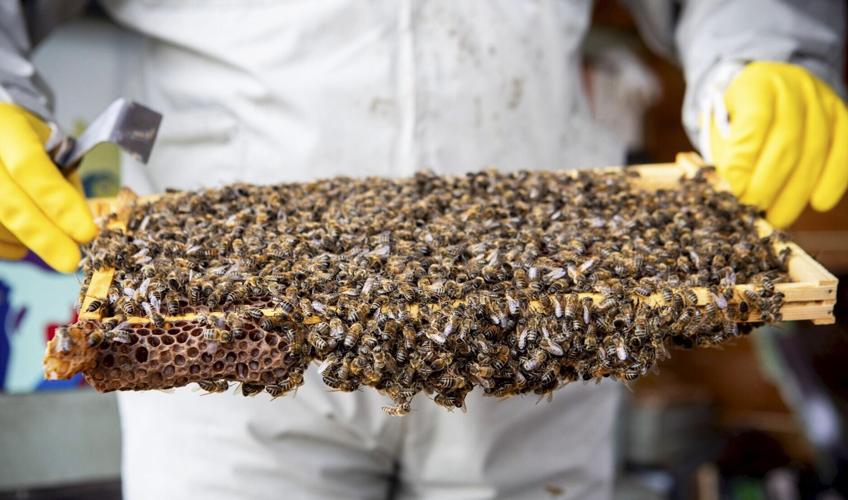
(Katielee Arrowsmith via SWNS)
The researchers found the valves dynamically change shape to form a seal during the downstroke and collapse during the upstroke, generating pressure for pumping while minimizing backflow during refilling.
High-speed video revealed that the valves inflate like a parachute on the downstroke, functioning as a piston to apply downward pumping pressure on the venom in the chamber, then deflating on the upstroke.
Ramirez-Esquivel said: “Finally, and perhaps most dramatically, as the valves meet in the middle of the stroke, they change shape again to push past each other.
“This is a remarkable strategy to pump fluid since maintaining a seal is vital to effectively transmit pressure.

High-speed videography (300fps) of the lateral aspect of the stinger pumping venom into an artificial skin mimic. The stinger is partially inserted into the substrate using fine forceps and the autotomised stinger works its way deeper into the phantom through the reciprocating action of the lancets. The lancet valves can be seen pumping within the bulb chamber thanks to the transmitted light illumination. As the substrate is not able to absorb the venom or wick it away, the venom is forced back up onto the surface. (Ramirez-Esquivel et al 2026 via SWNS)
“The unique geometry of the valves is the key; they act as collapsible pistons and — by pumping in opposite directions — they’re able to deliver a continuous flow of venom.”
The researchers also explored the mechanics and flow of the stinger by using microCT scans to 3D print an up-scaled working model, or small robot, of the bulb chamber and lancets, which confirmed key features of the pumping cycle.
Ramirez-Esquivel added: “The double-piston design adds complexity, but it’s the key to the stinger being able to deliver venom continuously in a compact, autonomous unit.”
The research team concluded that the design principles uncovered inside the stinger could inspire engineered micropumps with potential applications in minimally invasive medical and microfluidic technologies.


(0) comments
Welcome to the discussion.
Log In
Keep it Clean. Please avoid obscene, vulgar, lewd, racist or sexually-oriented language.
PLEASE TURN OFF YOUR CAPS LOCK.
Don't Threaten. Threats of harming another person will not be tolerated.
Be Truthful. Don't knowingly lie about anyone or anything.
Be Nice. No racism, sexism or any sort of -ism that is degrading to another person.
Be Proactive. Use the 'Report' link on each comment to let us know of abusive posts.
Share with Us. We'd love to hear eyewitness accounts, the history behind an article.