




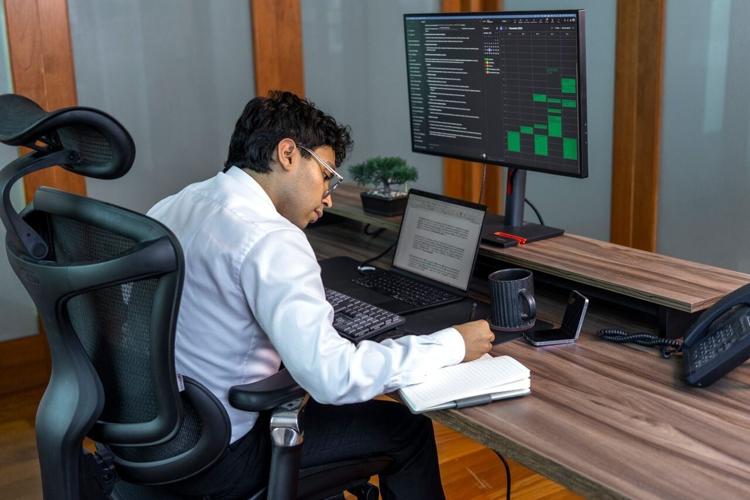
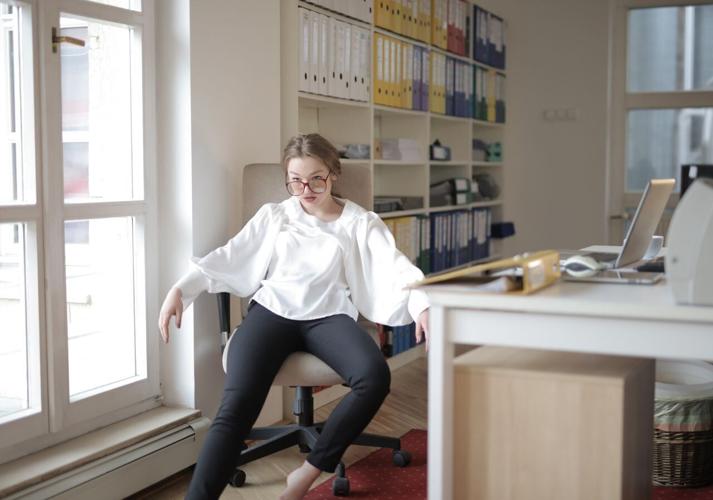

(Photo by Edmond Dantès via Pexels)
By Stephen Beech
Sitting upright makes people mentally sharper and happier, according to new research.
Posture really can have a positive influence on both mood and behavior, suggests the Canadian study.
The findings indicate that teachers who tell children that "slouching gets you nowhere" may be on to something.
Researchers from McGill University, Montreal, say their study shows that a person's posture appears to affect their emotions and decision-making ability more than they realize.
Participants sitting upright performed better in a risk-taking task and reported more positive feelings than their peers in slouching or control groups.

(Photo by Pavel Danilyuk via Pexels)
Study senior author Jorge Armony said that, although the effects were "modest" and only observed in a lab setting, the results highlight the body's influence on mood and behavior.
Armony and graduate student Soren Wainio-Theberge, who came up with the idea for the research and is a co-author of the study, recruited nearly 200 participants from the university.
After some initial testing on a computer monitor, the researchers asked the participants to complete a new task on a tablet, under the guise of testing a mobile app.
For some, the tablet was positioned on a stand on an adjustable table, to encourage an upright posture while sitting.
For others, it was placed flat on the desk, which was also positioned at a lower setting, prompting participants to hunch over.

(Photo by Alfredo Lau-Tam via Pexels)


Participants then completed a risk-taking test, in which players can earn rewards by inflating a virtual balloon, but risk losing everything if it bursts.
Over the course of the task, participants in the upright posture took greater risks and tended to earn greater rewards.
Armony said: "This suggests they were not acting more impulsively but rather were engaging in more effective risk-taking."
In an accompanying questionnaire, participants in the upright group also reported "significantly higher" feelings of pride, which is associated with a positive mood.
The findings, published in the British Journal of Psychology, shed light on the long-debated notion that the body's posture can influence the mind.
The McGill team tested the relationship while avoiding concerns associated with previous studies.
The researchers avoided telling subjects which posture to adopt, but, rather, influenced their choice without their knowledge.

(Photo by Andrea Piacquadio via Pexels)
They say that helped address a common criticism of earlier "power pose" research: that results may simply reflect that participants responded to researchers' expectations.
In post-experiment interviews, most participants indicated that they were unaware their posture had been manipulated.
The researchers also used video software to measure neck angle as a benchmark for posture conformity. In previous studies, that had not often been measured.
Armony added: "The findings do not mean that changing posture can dramatically transform a person's life.
"But it does raise interesting questions about whether everyday features of our environment — such as workplace ergonomics — can subtly influence mood and behavior."


(0) comments
Welcome to the discussion.
Log In
Keep it Clean. Please avoid obscene, vulgar, lewd, racist or sexually-oriented language.
PLEASE TURN OFF YOUR CAPS LOCK.
Don't Threaten. Threats of harming another person will not be tolerated.
Be Truthful. Don't knowingly lie about anyone or anything.
Be Nice. No racism, sexism or any sort of -ism that is degrading to another person.
Be Proactive. Use the 'Report' link on each comment to let us know of abusive posts.
Share with Us. We'd love to hear eyewitness accounts, the history behind an article.