





(Photo by Yaqui Zanni via Pexels)
By Stephen Beech
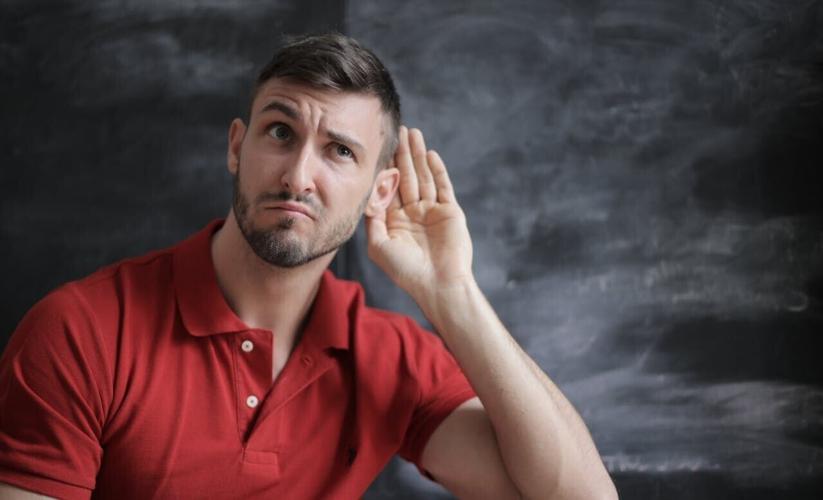
Closing your eyes might not help you hear better after all, according to new research.
People with their eyes shut struggled to hear faint sounds in noisy environments audible to open-eyed participants in a study.
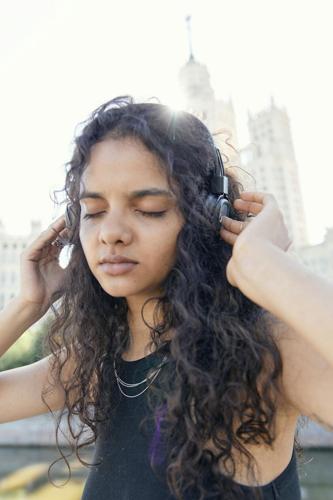
Most people close their eyes when trying to concentrate on a faint sound.
Many have been told that keeping our eyes closed helps us hear better, that it frees up our brains’ processing abilities and increases our auditory sensitivity.
Chinese researchers tested whether a person closing their eyes really can hear better in noisy environments.
They found the strategy may sometimes backfire, particularly in environments with a lot of loud background noise.

(Photo by Kindel Media via Pexels)
Volunteer participants listened to a collection of sounds through headphones amid background noise.
They then adjusted the volume of the sounds until they could barely make them out over the background noise.
The test was conducted first with eyes closed, then with eyes open but looking at only a blank screen, then looking at a still picture corresponding to the sound, and finally, looking at a video matching up with the sound they were trying to hear.
Study author Professor Yu Huang said: “We found that, contrary to popular belief, closing one’s eyes actually impairs the ability to detect these sounds.
“Conversely, seeing a dynamic video corresponding to the sound significantly improves hearing sensitivity.”


To find an explanation for the result, researchers attached electroencephalography (EEG) devices to the participants to monitor their brain activity.

(Photo by Darina Belonogova via Pexels)
The team determined that closing the eyes puts a participant’s brain in a state of "neural criticality" - which more aggressively filters noises and quiet sounds, including the target sounds those participants were trying to detect.
Huang, of Shanghai Jiao Tong University, said: “In a noisy soundscape, the brain needs to actively separate the signal from the background.
“We found that the internal focus promoted by eye closure actually works against you in this context, leading to over-filtering, whereas visual engagement helps anchor the auditory system to the external world.”
The research team pointed out that the findings, published in The Journal of the Acoustical Society of America (JASA), was unique to noisy environments.
With a calmer background, the conventional strategy of keeping eyes closed likely does help people detect faint sounds.

(Photo by Andrea Piacquadio via Pexels)
But because so much of our lives are spent surrounded by noise, it might be better to face the world with eyes wide open.
The research team plan to continue their work exploring the relationship between vision and hearing.
Huang said: “Specifically, we want to test incongruent pairings - for example, what happens if you hear a drum but see a bird?
“Does the visual boost come from simply having the eyes open and processing more visual information, or does the brain require the visual and audio information to match perfectly?
"Understanding this distinction will help us separate the general effects of attention from the specific benefits of multisensory integration.”


(0) comments
Welcome to the discussion.
Log In
Keep it Clean. Please avoid obscene, vulgar, lewd, racist or sexually-oriented language.
PLEASE TURN OFF YOUR CAPS LOCK.
Don't Threaten. Threats of harming another person will not be tolerated.
Be Truthful. Don't knowingly lie about anyone or anything.
Be Nice. No racism, sexism or any sort of -ism that is degrading to another person.
Be Proactive. Use the 'Report' link on each comment to let us know of abusive posts.
Share with Us. We'd love to hear eyewitness accounts, the history behind an article.