


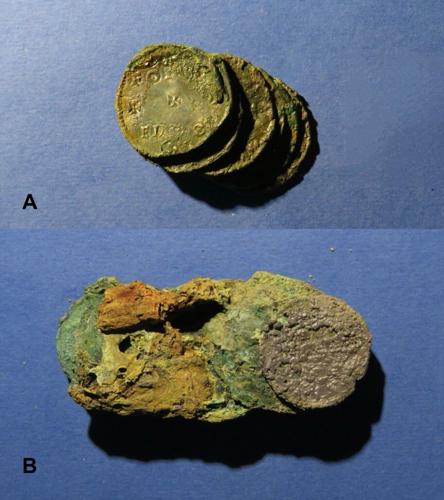


A fused group of Anglo-Saxon coins found in the excavations of the Palazzo della Rovere in Rome. (Cecilia de Leone via SWNS)
By Stephen Beech
An Anglo-Saxon expat community thrived in medieval Rome's "Little England" enclave, reveals new research.
They got special treatment from the pope and were even allowed to use their own currency, suggests the study.
The discovery of 20 coins alongside evidence of craftwork indicates English expats avoided "travel money" hassle the early Middle Ages, say scientists.
The find in Rome's English quarter is the first material evidence of Schola Saxonum — or the Saxon School — a charitable institution, founded by King Ine of Wessex about A.D. 727.
It served as a hostel and chapel for Saxon pilgrims traveling to the city.
In 2020, archaeologists started excavating deep under the walled garden of the Palazzo della Rovere near the Vatican.
The site made global news in 2023 following the discovery of the ruins of Emperor Nero's theater.
Now, it has led to a major medieval discovery which transforms understanding of the Anglo-Saxons in Rome.
The coins — 19 silver pennies and one halfpenny — have been identified as Anglo-Saxon.

Professor Francesca Tinti and Rory Naismith. (University of Cambridge via SWNS)
They were minted over a period of about 40 years in the names of Alfred the Great's son, Edward the Elder; and his grandsons Athelstan and Eadred.
Fourteen of the coins were found in rubbish pits in two clusters, which are now fused together after a millennium underground. The rest were scattered nearby.
Researchers also found 10 coins from the Roman period and from 10th-century Italy, as well as evidence of craftwork involving leather, bone and metal.
Francesca Tinti and Rory Naismith were invited to study the coins and interpret their significance.
Their findings have been published in a new Italian book called "Rome and the Others (300-1000): Foreigners in the city between conflicts and integration."
Naismith, a fellow of Corpus Christi College, Cambridge, said: "The coins aren't pretty but they have a lot to say.
"More Anglo-Saxon coins from this period have now been found in Rome than papal coins.
"This sounds bizarre, but it's telling us that a very large amount of money was flowing in from England at this time."
As well as dating the coins, the researchers were also able to identify that the coins came from East Anglia, Kent, London and the West Midlands.
They said the halfpenny was particularly rare and important because the denomination is associated with trading hubs in which lots of lower-value money was changing hands.
Tinti, from the University of the Basque Country and a visiting research fellow at Clare Hall, Cambridge, said: "Before this big discovery, we never had any material remains of the English quarter in Rome.
"We've been hoping this moment might come for most of our careers."
She said medieval texts refer to an Anglo-Saxon quarter in this area from the second half of the 8th century.

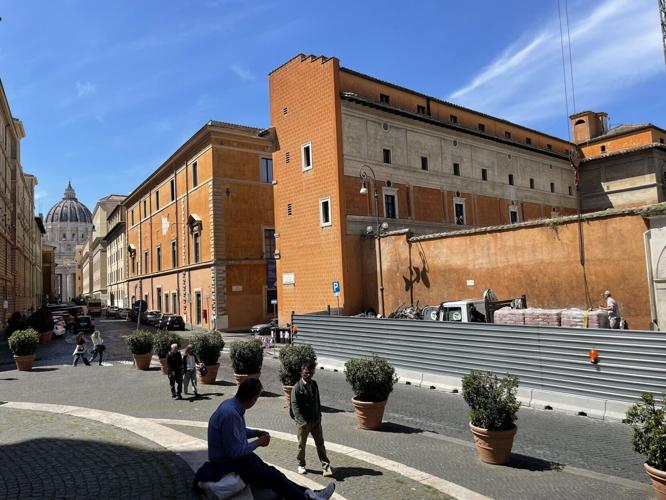
The Palazzo della Rovere in Rome, where the Anglo-Saxon coins were discovered. St Peter's Basilica appears in the background. (Rory Naismith via SWNS)
Two 9th-century fires were recorded, and it was known that the Saxon expats worshiped in a church, dedicated to the Virgin Mary.
It was even said that Burgred, king of Mercia from 852 to 874, was buried in the church having been exiled from England by the Vikings.


The English quarter lay within the Leonine City, an area between the Vatican and the River Tiber protected by walls following a raid by pirates in the 840s.
It's not known how big the entire Schola Saxonum was, but the area of craft activity covered at least 3,000 square meters — about half a soccer field.
The researchers say that because the coins were found individually or in small clusters, and scattered — rather than deliberately buried — they provide "clear evidence" of trade.
Together with the leather-, bone- and metal-working finds, they said the coins show that the Schola Saxonum was not just a place for pilgrims to rest and pray — it was also a "bustling" trade hub.
Naismith said: "The Anglo-Saxons are there to visit the Pope and tour churches in Rome, but they've still got to feed themselves.
"So they've got to make things and trade. That's what these finds tell us.
"This was a fairly big community, probably hundreds of people, living there on a permanent basis.
"So they're keeping a miniature Anglo-Saxon town going.
"You can easily imagine craftsmen arriving from Winchester, London or York and setting up shop by the Tiber."
He said evidence of English coins changing hands in Rome challenges the long-held assumption that the papacy banned the use of foreign currency in the city.

Two fused groups of Anglo-Saxon coins found in the excavations of the Palazzo della Rovere in Rome. (Cecilia de Leone via SWNS)
Naismith added: "You don't find other foreign coins in Rome from this period.
"It seems to be very much an English thing.
"There are not many coins from the Frankish world or even northern Italy.
"It seems to be a very specific connection they've got with the English at this stage."
One of the newly identified coins is papal, suggesting that the two currencies were used side by side.
The researchers point out that while other foreigners — including Franks, Lombards and Frisians — were also cared for by dedicated institutions close to St Peter's, the Anglo-Saxons left the most traces behind, and appear to have enjoyed special privileges.
Tinti said: "The English in Rome were quite unique.
"They made the greatest effort to get there.
"Their journey was really dangerous and many people died on the way.
"But once in Rome, they were special.
"We knew they had the privilege of being able to bury their dead in this area and now, it seems, they were permitted to use their own currency."
Naismith added: "The Anglo-Saxons were very firmly a part of the European community.
"They kept these bonds with Rome going strong for hundreds of years, through thick and thin.
"These coins show us how deep that relationship went.
"It's not just kings sending money and forgetting about it.
"It's people going to Rome in large numbers and setting up a home away from home on the banks of the Tiber."


(0) comments
Welcome to the discussion.
Log In
Keep it Clean. Please avoid obscene, vulgar, lewd, racist or sexually-oriented language.
PLEASE TURN OFF YOUR CAPS LOCK.
Don't Threaten. Threats of harming another person will not be tolerated.
Be Truthful. Don't knowingly lie about anyone or anything.
Be Nice. No racism, sexism or any sort of -ism that is degrading to another person.
Be Proactive. Use the 'Report' link on each comment to let us know of abusive posts.
Share with Us. We'd love to hear eyewitness accounts, the history behind an article.