



Ads have arrived in ChatGPT: What the future of AI search could mean for brands
At the start of 2026, OpenAI began testing advertising inside ChatGPT, bringing paid messages into conversations people already use to compare products and solve everyday problems.
The rollout arrived after a change many internet users had already begun to recognize. Rather than typing a few chopped-up keywords into a search box, people now ask artificial intelligence assistants complete questions and expect a written answer in return.
Today, hundreds of millions of people have made that habit part of daily life, from students checking homework to shoppers weighing their options before they buy. Placing advertising beside those conversations creates a new challenge, since paid messages have to earn attention without weakening trust in the answer.
But teams such as elk Marketing studying how brands are responding to AI search have observed that businesses are already rethinking how customers discover information as conversations begin replacing traditional search habits.
So as ChatGPT expands its advertising beta, its role will depend on how platforms balance commercial messages with the trust people place in the answer they receive.
Why AI Platforms Are Turning to Advertising
Running an AI assistant for hundreds of millions of users takes enormous computing power, and OpenAI has said continued access depends on heavy, ongoing investment in the systems behind it.
And covering those costs gets tougher when only a small share of ChatGPT users pay for subscriptions, leaving monthly plans to fund only part of the service. That pressure follows a pattern digital platforms have faced for decades, with advertising supporting free search engines and social networks without charging every user directly.
Now, OpenAI is following that same path, running ads alongside subscriptions while promising paid placements stay clearly separate from ChatGPT’s answers. By keeping that separation, the company gains another source of revenue without charging every user. It also sets limits on how far ads enter the conversation, giving brands a clearer idea of where paid messages will appear without becoming part of ChatGPT’s answer.
How AI-Native Ads Differ from Traditional Search Ads
Since OpenAI has built advertising into ChatGPT, the biggest difference appears in how those ads are selected. Traditional paid search already relies on several factors to judge relevance, while ChatGPT can also consider the context and intent of the conversation happening around the ad.
Google, for example, already looks beyond keywords to inferred intent and information from the advertiser’s landing page, with audience data adding more context to the decision. But ChatGPT receives a fuller account of what the person wants as the conversation develops through follow-up questions.
OpenAI says its ad system weighs the context and intent of the current conversation before it selects a paid message. But even with that added context, the company says ads remain clearly labeled and separate from ChatGPT’s response, so advertising does not become part of the answer.
David Dugan, OpenAI’s head of global ads solutions, told reporters at Cannes Lions that the format “is not a keyword-based buy, so it’s different from traditional search.”
Paid media teams therefore have to judge relevance differently, building campaigns through context hints and landing pages while OpenAI’s ad system determines whether the message fits a conversation the advertiser never sees.
What AI Search Means for Brand Visibility
Brand visibility has moved well beyond simply “Googling it.” McKinsey reports that half of surveyed shoppers now seek out AI-powered search on purpose, where one written response can replace a full page of links. So, with fewer sources appearing, a brand that AI cannot identify clearly may never enter the customer’s consideration.
Accurate product information answers that risk directly by telling the system what the company actually sells, while outside reporting helps confirm those details.
Customer reviews then show how buyers describe the company after purchase, adding evidence the brand cannot produce on its own. With those sources pointing to the same business, well-organized product details help the system connect each item with the correct company.


Marketers call this AI search optimization or generative engine optimization (GEO), a growing practice focused on helping answer engines find companies and describe them accurately. But none of that visibility is bought, and running an ad does not change whether a brand appears organically in the answer itself.
However, when a brand does appear organically, the conversation may carry on from research toward a buying decision.
Commerce Is Moving Into AI Conversations
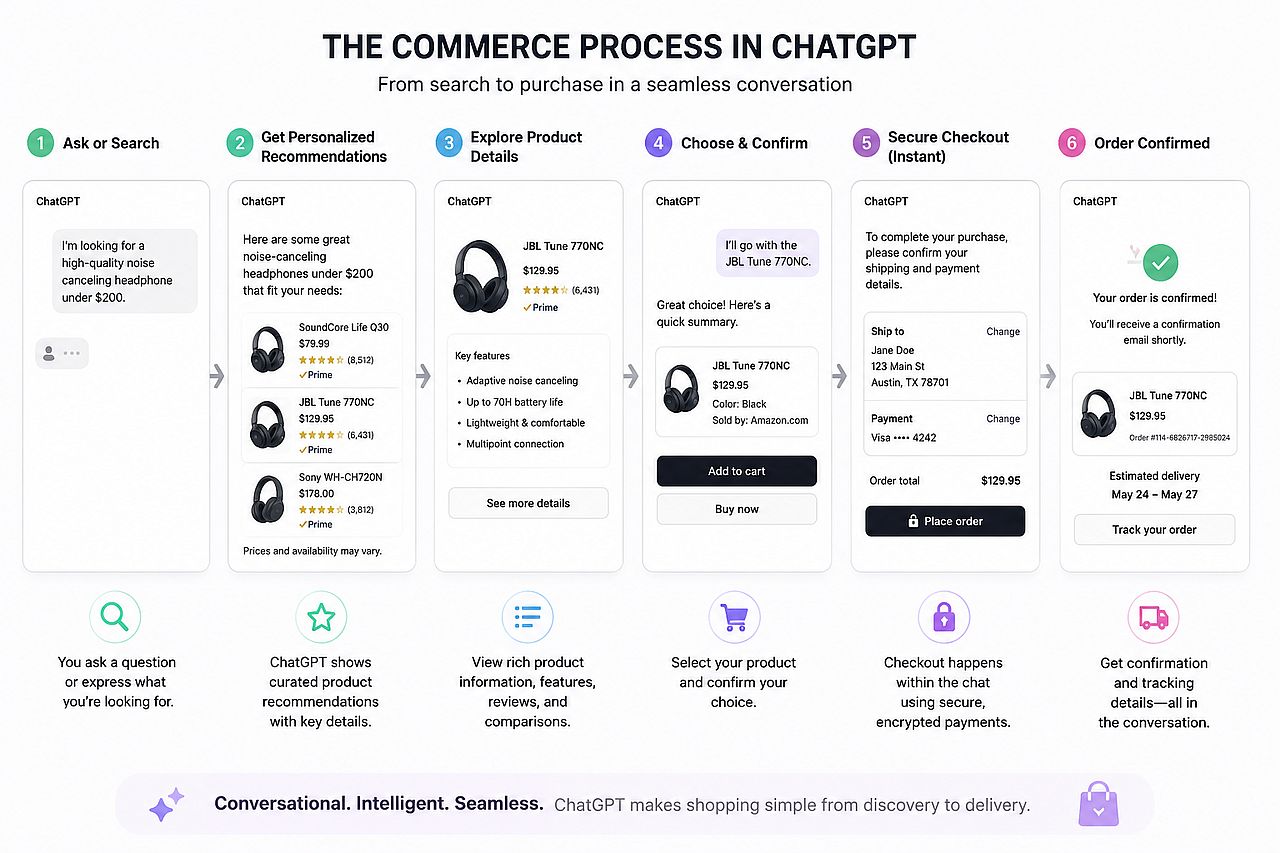
Now more than ever, shoppers are moving from a product question toward a purchase without leaving the same AI conversation. Viant CEO Tim Vanderhook told search engine experts that AI commerce “collapses the ‘search → click → checkout’ funnel into a single, intelligent conversation,” capturing how quickly a product question may develop into a buying decision.
A shopper may begin by describing a need, then narrow the choices through follow-up details about price or preferred features. OpenAI says ChatGPT can then line up suitable products with current prices and key specs, letting the shopper weigh a few serious options without hopping between retailer websites.
Some eligible products also support checkout inside ChatGPT, bringing purchase assistance into the same exchange. By the time a retailer enters the process, the assistant may have already reduced a crowded category to the brands most likely to receive the sale.
What Marketers Can Do Today
Marketers do not need every detail of AI advertising settled before they begin preparing for it. Google Ads executive Dan Taylor has warned that “search behavior has become more conversational and complex,” giving teams a reason to examine how assistants describe their company before more customer decisions move through them.
Forbes contributor TerDawn DeBoe argues that AI performance cannot be judged by last-click sales alone, since brand mentions and lead quality may reveal influence earlier.
A brand following that thinking can approach ChatGPT as a fresh paid channel rather than another version of Google Search, starting with small, measured campaigns even when the conversation suggests strong buying interest. But before spending grows, marketers need enough reporting and attribution to determine whether those campaigns are producing real conversions.
Beyond the campaigns themselves, brands need a reliable way to connect early ad interactions with later sales. McKinsey points to accurate customer data and regular tracking as part of that process, giving marketing teams a clearer record of whether ChatGPT ads are actually leading to business.
And having a clear record of those results also helps marketers decide how much of their customer acquisition should come from ChatGPT and how much should remain spread across other channels.
The Future of Advertising in AI: Preparing for the Next Era of Digital Marketing
OpenAI’s decision to place advertising inside ChatGPT has given the technology industry a difficult test of whether commercial growth can coexist with a trusted assistant.
E-marketer analyst Jeremy Goldman warned Reuters that users could move to rival chatbots if advertisements feel “clumsy or opportunistic,” leaving little room for placements that distract from the help people came to receive.
But OpenAI has responded by keeping sponsored messages separate from its answers, while its expanding pilot continues to test whether relevance can protect the user experience. Several competing AI companies remain cautious about advertising as they focus on trust and accuracy, suggesting no single model has won industry support.
But looking beyond that hesitation, McKinsey expects AI search to move deeper into buying decisions as these systems begin acting on a customer’s behalf, placing greater pressure on brands to provide accurate information before any paid placement appears.
Still, as ChatGPT Ads expands, brands will need to treat paid placement and organic AI visibility as two separate paths.
Paid campaigns give marketers a channel they can test and measure, while answer engine optimization (AEO) and GEO support the unpaid visibility that develops outside those campaigns. Running both gives brands a stronger way to stay visible as more search activity moves through AI.
This story was produced by elk Marketing and reviewed and distributed by Stacker.


(0) comments
Welcome to the discussion.
Log In
Keep it Clean. Please avoid obscene, vulgar, lewd, racist or sexually-oriented language.
PLEASE TURN OFF YOUR CAPS LOCK.
Don't Threaten. Threats of harming another person will not be tolerated.
Be Truthful. Don't knowingly lie about anyone or anything.
Be Nice. No racism, sexism or any sort of -ism that is degrading to another person.
Be Proactive. Use the 'Report' link on each comment to let us know of abusive posts.
Share with Us. We'd love to hear eyewitness accounts, the history behind an article.