


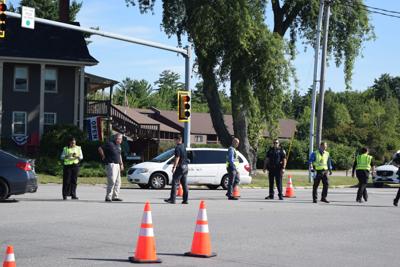
GILFORD — Town leaders are concerned about the yellow blinking left-turn light at the intersection of Weirs and Lake Shore roads after a number of accidents, including one in which a driver died. They've contacted the New Hampshire Department of Transportation with a request to have the traffic light changed.
During the first selectboard meeting led by Town Administrator Kristian Kelley, on Aug. 26, the majority of the brief meeting was a discussion about the intersection.
Mark Mason, 79, of Gilford, died after a collision with another vehicle at the intersection on Aug. 21. The accident is under investigation.
Kelley, the former police chief, had no doubt the intersection is dangerous, and the light is causing confusion.
“I’ve had a couple people tell me, ‘I don’t know what their problem is, it’s just you got to pay attention,’” Kelley told the selectboard. “Well, I personally sit at that intersection, and you have cross traffic both going left and oncoming traffic. You just can’t see. So, I’ve had a hard time sometimes crossing that intersection.”
Chief Dustin Parent reached out to NH DOT staff, and had yet to receive a response.
“I am not hearing back from the Department of Transportation on the concern that I presented to them,” Parent told the selectboard. “I think we’re all in agreement, or I know the TA and I are, that we would like to see the blinking lights go back to red, and function the way they did.”
It has been three years since the light changed and Parent said it was “unbeknownst” to them.
“It was just like that one day,” Parent said.
Vice Chair Gus Benavides recognized the urgency, and said with the data the town has, with “at least one death,” he thought it important the board instruct Kelley to write to NH DOT, as well. He also requested including Gov. Kelly Ayotte (R-NH) in the email, and other elected leaders, like members of Senate and Congress.
“Tag them all in this,” Benavides said.
Benavides said he has not found a single person who loves the blinking light at the intersection. He also said there is plenty of data from police and fire departments they can refer to, including reported accidents and incidents. Those only tell part of the story, due to the number of close calls, including some he's witnessed.
“I’ve seen it personally.”
Chair Chan Eddy agreed, and recalled a time when a now-planning board member was driving through the intersection shortly after the change to the blinking light. He said the person was “T-boned,” and while there were no injuries, the vehicles were damaged. He has also witnessed near misses.
“I’ve seen a lot of close calls,” Eddy said.
Clerk Richard Grenier agreed this is an issue.
Kelley said the caution lights aren’t unique to Gilford, and have been implemented statewide, so there might be other supporting data. Eddy thinks the problem could be found everywhere.
Benavides called the scenario “dangerous.” He said he likes to deal with things in person, but said it’s time to put pressure on state and government leaders to make a change.
“If they’re not responding, then it’s time to take it to the next level,” Benavides said.
Lee Baronas, traffic engineer with the NH DOT Bureau of Traffic, said Thursday he'd spoken with Kelley since the meeting.
Flashing yellow lights are being used nationwide, and feedback has generally been positive, he said. The state implemented a change at 11 intersections in 2023, as part of the same project, and many others exist around the state.
The state is reviewing the crash data to better understand the circumstances at the site, and whether or not the lights are a contributing factor. However, that doesn’t mean they’ll be changing them.
“We are hesitant to eliminate it completely, but we want to make sure that if adjustments are appropriate,” Baronas said.
There are two instances when the flashing yellow arrow indication light is called for. It's installed in spots with a dedicated left turn lane. Some have a permissive green, which means the light allows a left turn but it is generally a “green ball” indication to yield to oncoming traffic.
National research has shown people weren’t yielding with the solid green light, and the flashing arrow improved instances of drivers yielding.
The other instance is when there is a protected green arrow for a left turn, where drivers need to wait until it is their turn. All other movements have red lights except for opposing left turns, resulting in delays.
After hearing safety concerns, NH DOT staff are looking into whether the flashing yellow light is right for the intersection.
“It is on our radar again,” Baronas said.
The intersection is expected to be discussed at the next selectboard meeting at 6 p.m. on Wednesday, Sept. 9.


(0) comments
Welcome to the discussion.
Log In
Keep it Clean. Please avoid obscene, vulgar, lewd, racist or sexually-oriented language.
PLEASE TURN OFF YOUR CAPS LOCK.
Don't Threaten. Threats of harming another person will not be tolerated.
Be Truthful. Don't knowingly lie about anyone or anything.
Be Nice. No racism, sexism or any sort of -ism that is degrading to another person.
Be Proactive. Use the 'Report' link on each comment to let us know of abusive posts.
Share with Us. We'd love to hear eyewitness accounts, the history behind an article.