


LACONIA — It’s a classic snapshot of summer. A giggling girl in a tie-dyed shirt points a hose up like a fountain, while children scamper underneath.
Steps away, in an octagonal pen called a gaga ball pit, children punch a colored ball so it skids between them without touching their shins — cheering for a girl who blocks each incoming pass, and a boy who pummels them back.
It's a panorama of fun — a spontaneous and unstructured scene that couldn’t take place during COVID, when learning and social life went hybrid and remote, and even summer camp was divided into small groups that did not blend or interact.
“For a lot of these kids, this is their first experience with our summer program,” said Erin Costello, director of the Boys & Girls Club at Pleasant Street School, a day camp that serves roughly 45 children ages five to 10, plus a few older ones who come because they still enjoy it.
At a time when schools are charged with bolstering social and emotional health — which nosedived during COVID — camps are taking on the mission during summer, sometimes in novel ways.
Costello stands inside the school gym that she and camp staff transformed into a carnival-like arena with five colorful stations for art, reading, building, science exploration and dramatic play. “There was a lot of shock and awe coming in here. When it clicks with the kids and they start to use the things, it always catches me up a little bit,” she said, surveying a smorgasbord of options intended to foster interest, teamwork, creativity and getting along with peers. There’s a purpose to every item in the room, including for the puppets and kitchen sets.
“Even 10-year-olds should be encouraged to engage in pretend play,” Costello said. “It’s one of the best ways for them to learn to process their emotions. They will act out scenarios they’ve encountered in their real lives and observe how teachers and other kids respond.”
Summer camp has been an American tradition and vacation-time staple for over 100 years — a place where children can learn how to play, share, wait their turn, win or lose a game, try new things without expectations or judgement, and acquire new skills without grades. But in the wake of the pandemic, even after a year of in-person interaction in school, day camp’s goal is broader and deeper: How to catch kids up on emotionally readiness and social skills that were delayed or simply not acquired during COVID.
“It gives them that social experience around children their own age,” said Chris Emond, chief executive officer of Boys & Girls Clubs of Central New Hampshire, which operates two summer programs in Laconia. “Even without COVID, kids are still latched to their cell phones and iPads” — a habit that became more entrenched during the pandemic, including in the youngest children. “When they go to the club those things get locked away. We have some old-fashioned fun. We still need people,” Emond said.
The most recent surveys of youth mental health paint a sobering picture of social and emotional wellbeing in kids, and worrisome trends that began before COVID. In a Centers for Disease Control survey of high school students in 2021, 37% reported poor mental health during the pandemic and 44% said they persistently felt sad or hopeless during the past year. In September 2021, when in-person education returned full time across New Hampshire, many schools — including in the Lakes Region — reported record numbers of young children with behavioral and mental health challenges, including anger, inattention, anxiety, apathy, hopelessness and thoughts of self-harm.
“There is no question that the mental health crisis for kids is real,” said Susan Stearns, director of NAMI-NH, the state’s chapter of the National Alliance on Mental Illness. “The American Academy of Pediatrics and the surgeon general have all called out the fact that we have a mental health emergency for children.” The pandemic was a global trauma, including for kids. Stearns said summer camps across the state have contacted NAMI-NH for guidance and training to support camper mental health.
For kids in the youngest grades, COVID’s drought of in-person interaction translated to lower levels of tolerance, less self-control, more frustration and compromised ways of dealing with other kids.
At a time when anxiety, loneliness and depression have surged among all age groups, particularly seniors, youth and young adults, summer camp provides an incubator for social and emotional growth that prepares children for school and life.
“One of our key elements is providing that sense of belonging,” said Julie Rothemund, program director for after-school and summer day camps for the Boys & Girls Clubs of Central NH. “We provide a place where kids feel safe and connected and have a trusted adult” and can form friendships that continue throughout the year. “To have that time to be together and sit around a table making string bracelets and talking and dreaming — that time is so different from the school year,” she said. “These relationships and the time to develop them is really important.”
When camp is a good fit, it becomes a refuge, Stearns said. In these times, more children need safe places just to be kids.
According to the CDC’s interviews of high school students from in 2021, 55% of those surveyed reported experiencing emotional abuse by a parent or another adult at home, including swearing, insulting or putting down the student. More than 11% reported hitting, kicking, beating or physical harm from a significant adult. Younger children were not polled, but they exist in the same environments, with the same grownups and disproportionate levels of threats — constant or unpredictable — which underscores the need for safe havens, trusted adults and positive role models for kids. A source of fun and relaxation, camps become both therapeutic and educational.
A place to learn, grow and thrive
At Pleasant Street School, after the school year ended on June 21, the gymnasium was stocked with games, puzzles, puppets, books, cardboard and wooden blocks, marble works, art supplies, and costumes and tools for make-believe, and ingredients for every day, tactile science. “Here, through manipulating materials and watching what happens," Costello said, “they experience science in a free-form way.”
There are opportunities to squeeze flowing sand into weird, gooey shapes and crunch corn chips into dust under stomping toy dinosaur feet. Children can switch between activities at will or choose one they relish and want to stick with, bringing an independent or group project to fruition. Last week, a group of children constructed a 3D garage out of magnetic tiles on the back of one of the metal doors, to house the program’s fleet of Matchbox cars.
It’s a place to acquire patience and perseverance, to navigate friendships, and learn how to steer through interpersonal twists and turns in effective ways.
“If they’re going to build Godzilla out of papier mache, they have to work together to design it then build it,” said Costello. The game area, with a giant Connect 4 floor set and cubbies filled with board games, is “basically our socialization center.” Games nurture team building, problem solving, collaboration and cooperation. Children learn to compete without becoming emotionally frazzled. “When they don’t know how to gracefully lose a game,” she said, “it’s our job to help them do that.”
After one week, Costello said, the children seem comfortable with the new routine, and grow comfortable with each other. Gaga ball has emerged as a favorite pastime — and remains a valuable teaching tool. Children are eliminated when a ball strikes below their knees, but they still consider themselves part of the game — in the cheering section, where they celebrate others’ wins.
“It was hard for some to step out when they’re eliminated,” she said. “As far as social skills go, they’re learning to follow the rules.” Physically, they’re learning hand-eye coordination — and how to dodge the ball and impress each other. When they leave the ring they become referees, and learn to advocate for one other and to speak with respect. “Kindness matters, friends. Kindness is key,” Costello reminds them when tempers flare.
“I think this is one of the better group games to play,” said Costello. “They learn to play autonomously, and they can do it independently and don’t need a teacher to guide them.” Staff can observe the interaction and spot when a child needs support or intervention.
Last week, when a 10-year-old boy reached his personal boiling point after too much noise and stimulation, he walked to a quiet spot to sit away from the game. Then, after several minutes, he decided to do the Snake Walk — a course kids can choose for fun, or for an emotional reset: a hopscotch-like lineup of tip toes, zig zags, swirls, hand crawls and a tightrope painted on the blacktop. Seeing him leap and crawl, a much younger girl joined in, jumping between colorful spots.
“One of the things I love most about this job is to be able to watch these kids grow,” Costello said, as a game of gaga ball wound to a close. “A year ago, one of these kids would not have lasted in this game, because his social skills were underdeveloped, and he had problems with anger. A couple of kids struggled with verbal skills when they came to us,” she said, usually because of physical challenges, socialization deficits or emotional trauma.
A spot for problem-solving
After the game, campers dispersed to areas of interest inside the gym. Some found a quiet space with soft bean bag chairs and fidget toys and headphones to cancel the noise in the room.
Costello reached for a collection of eight books, “A Little Spot of Emotion” by Diane Alber, a parent and early childhood educator, whose titles include “A Little Spot of Anger,” “A Little Spot of Sadness,” “A Little Spot of Anxiety” and others about confidence, happiness and finding peace. The books, which also guide parents, can be found at dianealber.com.
When a child is having a hard time or says they’re angry, Costello suggests “A Little Spot of Anger,” a primer on how to shrink angry by growing your love spot, which can increase by giving compliments to others. The collection, used in the Boys & Girls Club’s preschool program, also resonates with older kids, and can provide continuity in emotional learning.
Some Pleasant Street School camp staff recently took a course through ACROSS NH on how to coach kids to recognize and manage troubling emotions and boost their resilience. They learn to help kids achieve self-awareness — how to take stock of their thoughts, feelings and actions, and to notice when they’re stressed or distressed. The program builds competency in self-regulation, thoughtful decision-making and relationships skills, such as how to hold a back-and-forth conversation. An app and videos on YouTube train youngsters in mindfulness, and how to sit with their emotions instead of letting them control their behavior.
Last week, a staff member asked a boy who just turned six if it was time for an “alone space.” He sat inside a large three-sided open box, a soft space with pillows and pictures of a sun and stars. "They go to be in a quiet, safe space, where they don’t feel like people are watching them,” Costello explained.
A staff member passed him rocks from a bag she brought from home, letting the boy examine each one. He held a clear stone up to his eye like a monocle. “This is a bag where I keep them safe,” she said. “Is there one you want to keep with you? Are you ready to go back to the hallway? Do you want to bring your headphones? I’m going to bring mine because it’s a little loud in there for me.”
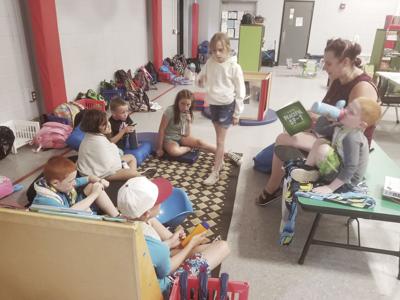
More kids filtered in from outdoors. A group collected around Costello. A little boy volunteered to help her read. “Today I’m going to show you how to get to your peaceful spot,” she said, pointing to a character that resembled a smiling, green M&M on stilt legs. “When you’re overwhelmed, it can be hard to find your peaceful spot... Are you feeling frustrated or annoyed because something didn’t turn out as you expected? Are you worried about trying something new? Anxiety feels like nervous and worried. Sad feels like disappointed, lonely and lost... Are you sad and mad? We call that ‘smad.’ Sometimes saying a fun word can make your anger disappear,” she said. And drawing or writing what you are feeling can help you identify which emotion you’re having.
So far, Costello and other camp staff said they are seeing the difference this year in how kids are acting — compared to last year when they met in small, contained groups. The children are having a better time. They’re more relaxed and staff is not experiencing as many behavioral issues.
“Every day I get feedback, ‘That was fun',” Costello said. “When they’re with us we want them to feel comfortable to explore and experience things. We like to see where these things take them. They let us know what they’re interested in and want to be learning, and we can facilitate that.”


(0) comments
Welcome to the discussion.
Log In
Keep it Clean. Please avoid obscene, vulgar, lewd, racist or sexually-oriented language.
PLEASE TURN OFF YOUR CAPS LOCK.
Don't Threaten. Threats of harming another person will not be tolerated.
Be Truthful. Don't knowingly lie about anyone or anything.
Be Nice. No racism, sexism or any sort of -ism that is degrading to another person.
Be Proactive. Use the 'Report' link on each comment to let us know of abusive posts.
Share with Us. We'd love to hear eyewitness accounts, the history behind an article.