


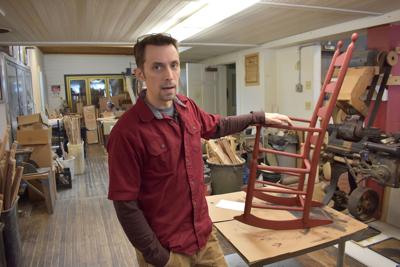
SANDWICH — On paper, Adam Nudd-Homeyer is the CEO and majority owner of Tappan Chairs, but he prefers a different title: “Steward.”
Nudd-Homeyer likes that descriptor because he feels it better represents his relationship with the company that he bought in 2013. He’s the seventh owner in the brand’s 201-year history, which began in 1819.
Each one of those owners remade the brand in their own image. Nudd-Homeyer just sees himself as one of the many Sandwich crafters to sell chairs in the Tappan style. Modesty aside, Nudd-Homeyer’s contribution to the brand is perhaps the most significant since Abraham Tappan first hung out a shingle.
Always seen as a sturdy, utilitarian piece of furniture, Nudd-Homeyer’s first move was to rebrand Tappan Chairs as fine furniture. “We couldn’t compete with Ikea, WalMart,” he explained.
In May of 2018, Tappan Chairs moved its production facility from what Nudd-Homeyer described as an “unheated, uninsulated, un-air-conditioned barn” to an historic building in the village of Sandwich, which had sat vacant for 10 years. The move allowed him to hire his first employees, and to bring the brand name into the public realm.
“We said, we should really find a place where we could welcome visitors, tell the story, have an open shop,” he said. He was right, as the shop’s door rarely stayed shut during their first two summers at their 6 Skinner St. location. He estimated that between 1,500 and 2,000 people visited each summer.
Late last year, Nudd-Homeyer purchased a competitor and a supplier. Tappan Chairs now owns the Shaker Workshops brand, which makes historic reproduction furniture using modern equipment, and which slots in neatly right below Tappan’s products in price points. The company also purchased Cohasset Colonials, which supplies the tape that is woven to make the seats for Tappan Chairs.
With the acquisitions, Nudd-Homeyer figures that the company is poised to triple or quadruple its volume.
The most recent of Nudd-Homeyer’s changes, though, might be the most significant. Since the beginning of 2020, Tappan Chairs has been organized as a benefit corporation – a term for a for-profit business that has public benefit codified in its bylaws.
Where a traditional corporation seeks to maximize its benefit to its shareholders, a benefit corporation seeks to return value to all of its stakeholders – including its employees, business partners and the community and environment in which it operates.
As Nudd-Homeyer said, his goal with Tappan Chairs is to create, “not only a draw for tourists, not only an employer, but a place that benefits its community.”
As a benefit corporation, he said the business will return a portion of its profits to its investors – there will be a public stock offering this summer, Nudd-Homeyer said – and will use the balance to strengthen the community of Sandwich. As an indicator of what he had in mind, Nudd-Homeyer donated about $5,000 to local causes at the end of the year, divided between the Sandwich Historical Society, Sandwich Children’s Center, and Sandwich Home Industries, collectively representing the past, present and future craftspeople of the town which has supported Tappan Chairs for more than two centuries.
Halo effect
Businesses in the Granite State have had the option of organizing as a benefit corporation for about five years, said Michelle Veasey, executive director of New Hampshire Businesses for Social Responsibility.
Veasey said she has seen strong interest from businesses that want to be seen as a benefit to their communities. Her organization works with the University of New Hampshire to pair groups of business students with companies in order to perform impact evaluations. “We constantly have businesses looking to be connected with that group of students, so I know there is a lot of interest in that program,” she said.
For existing corporations, it takes some work to switch to becoming a benefit corporation, she said. “If you don’t start from the very beginning, it takes a lot of changes to policy and written documentation.” Yet, she added, “it’s an important way to communicate with consumers” that the company considers its role in the community.
Jill Robbins, president and founder of HomeFree, a Windham-based company that makes allergy-friendly cookies, decided to go one step further and is a certified “B Corp” by the nonprofit organization B Lab. There are currently 10 businesses in New Hampshire that are B Lab certified, including Pete and Gerry’s Eggs and Stonyfield Farm.
Bcorporation.net describes a B Corporation as "businesses that meet the highest standards of verified social and environmental performance, public transparency, and legal accountability to balance profit and purpose."
Robbins said she learned about B Lab certification several years ago while searching for funding sources for her growing business. “One of them said I had to have a B Lab assessment. I had never heard of it before. "As I was looking at it I said, this is wonderful that this exists. I decided to become a B Corporation because I believed in the idea of it.”
B Labs’ certification, which must be renewed every two years, is rigorous, Robbins said, though she said she learns more about her business, and its impact, each time. And, she is proud of what being a B Corp says about her business.
“I know that, frequently, and increasingly, shoppers want to shop with their conscience. I like that the B Corporation makes it easier for them to identify products that they feel good about supporting,” Robbins said.
Nudd-Homeyer called that the halo effect. “We’re not only going to do the right thing, we’re publicly saying that we’re going to do it.”
Yet, he said he isn’t doing it to give Tappan Chairs a marketing angle. He said it’s his way of balancing a ledger, paying for what he said he was given.
“At the end of the day, it’s just trying to do the right thing… I personally am indebted to this community, this business is indebted to the community.” Six times before he came into the business, a Sandwich craftsman has operated the Tappan Chairs brand, then passed it on to the next generation.
Nudd-Homeyer was born in Laconia and said he moved 14 times before he graduated from high school. Sandwich also gave him a place to call home.
“None of what I have here, I would have without the community support,” he said.


(0) comments
Welcome to the discussion.
Log In
Keep it Clean. Please avoid obscene, vulgar, lewd, racist or sexually-oriented language.
PLEASE TURN OFF YOUR CAPS LOCK.
Don't Threaten. Threats of harming another person will not be tolerated.
Be Truthful. Don't knowingly lie about anyone or anything.
Be Nice. No racism, sexism or any sort of -ism that is degrading to another person.
Be Proactive. Use the 'Report' link on each comment to let us know of abusive posts.
Share with Us. We'd love to hear eyewitness accounts, the history behind an article.