


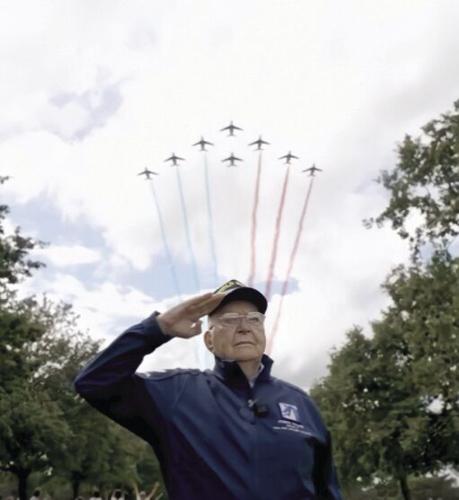
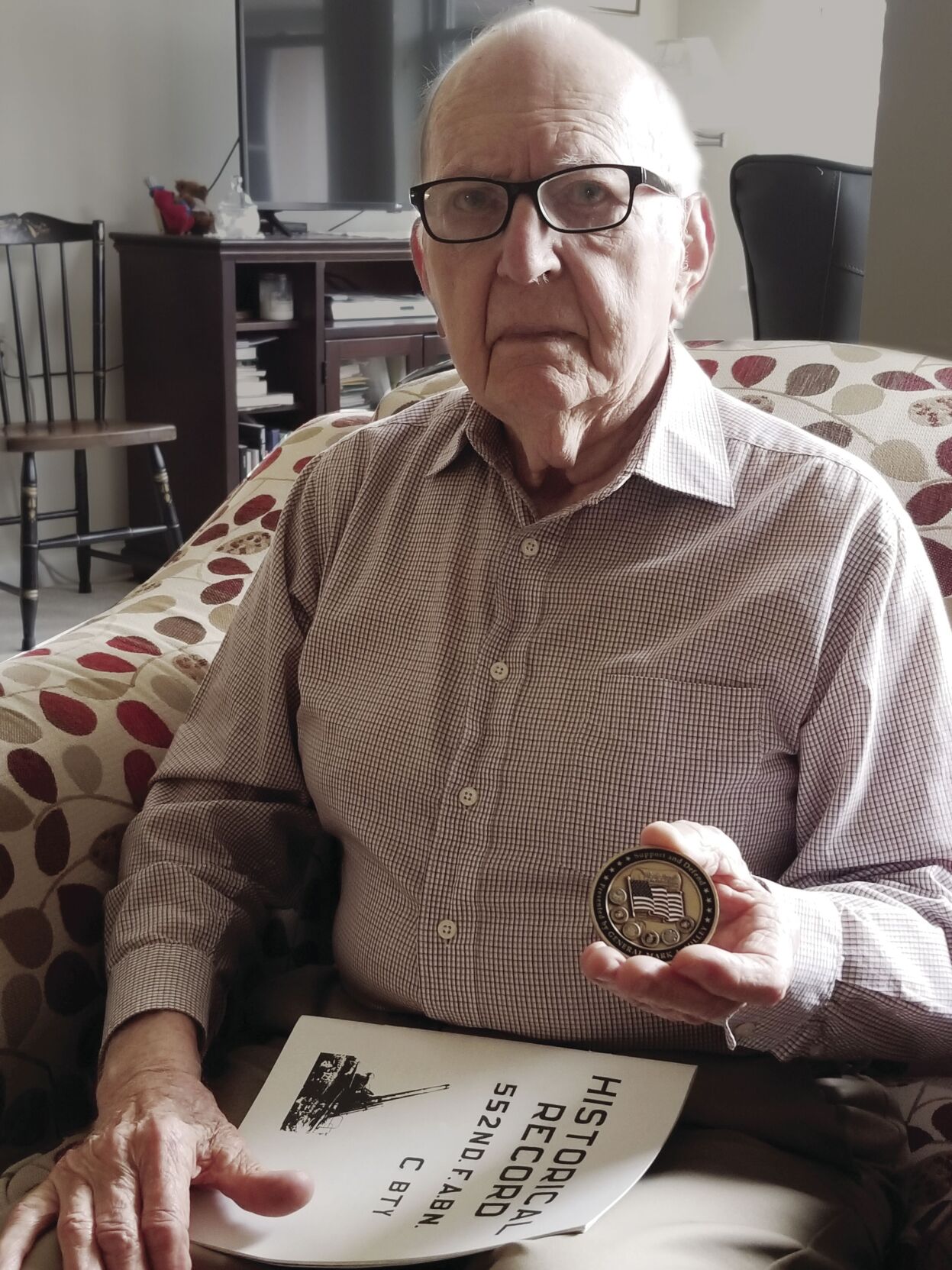
LACONIA — The 22 homemade thank-you cards from middle school students in France were beyond Joe Picard’s wildest expectations. Now that the 97-year-old World War II veteran has returned from visiting Normandy on the 78th anniversary of D-Day, they are a prize that makes his eyes glisten.
Operation Neptune, or D-Day, the largest seaborne invasion in history, occurred on June 6, 1944, and it turned the tide of the war that has been labeled the most destructive conflict in human history.
“My name is Mascence, I’m 14 years old. I live in Etreham. I like history and will join the French army. Thanks to you, I’m here today.” His words are written in English next to a photo of a smiling sweatshirt-clad teen, with the French translation on back.
“Hello, my name is Josephine – ‘Joe.’ I’m 11 years old. I love swimming and horse-riding. My grand-grandfather was in the war, too. He was English. He met my grand-grandmother when she made a cross after the war. THANK YOU VERY MUCH.” The i’s are dotted with red and blue hearts.
“I was one of those who went in right after high school,” said Picard wistfully. He holds a booklet made by the kids, with drawings and poetry. “The French are very appreciative of U.S. efforts. They hold a big celebration with parades and speeches by dignitaries every D-Day.”
For decades this critical day and the efforts that followed have lived on mostly in hearts and minds of the soldiers who went there to fight, and the French who welcomed them.
Picard, who now lives at the Taylor Community, visited France a couple of times with his wife, who has since passed away. But his trip from May 31 to June 8, courtesy of the Best Defense Foundation in California, to battle sites in Normandy, villages that American, Canadian and British forces liberated, and the beaches — Omaha and Utah — where American troops landed, brought everything back as if it occurred yesterday.
“It’s so impressive and heartwarming to see how these people commemorate this every year,” said Picard, who served as a corporal in Battery C of the 552nd Field Artillery Battallion from August 1943 to January 1946. “What we’re dealing with is descendants. They respect and adopt cemeteries and put flowers on the graves. When they have a ceremony, everyone turns out. It’s amazing that they still do that 78 years later.”
Across the U.S., there are efforts to record and compile the stories of veterans, whose accounts provide valuable windows on the travails of war, and on a singular period in history. Justin Gamache, curator of the Wright Museum of World War II in Wolfeboro, believes there is no recent accurate survey of the remaining WWII survivors, or a count of how many live today in New Hampshire. “In 2021, it was estimated that about 240,000 WWII vets were still alive,” said Gamache, “but it is also estimated that approximately 230 pass each day.”
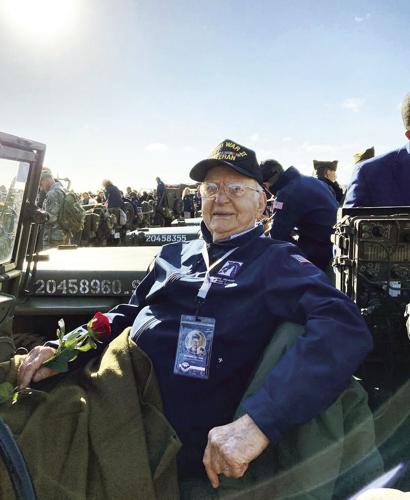
During his trip early this month to where his unit fought, Picard got to walk in parades through the streets of towns in Normandy with 28 other Americans who served in Europe during World War II. The youngest in the group was 93. It included two women, an Army nurse, and a Navy WAVE who marched in her WWII uniform. Both were both 101 years old.
“Realizing that we’re all moving along in age and it’s not very likely that we’ll get back there, it was very important to all of us, for the last time, to go there,” said Picard. “We were escorted by motorcycles and state troopers the whole week we were there. Everybody waved and said, ‘Thank you.’”
The celebrations and parades thanking American soldiers who helped to save France, Belgium and Holland and England from Nazi control made Picard proud to be part of a momentous and patriotic effort.
Joe’s granddaughter, who just graduated from Villanova University with a degree in engineering, was traveling in Europe and joined her grandfather in Normandy, where they rode in a Jeep together. Picard said his family was moved by the warm and grateful response of the French citizens.
“I almost felt like a politician shaking hands with all the people,” said Picard. Compared to France and the countries in Europe, “We were affected in a very different way in that we didn’t have the loss of life and devastation at home that these people had. Our contribution was not only military help, but producing in a short period of time all this military equipment and providing England with food.”
When the war started in 1941, the United States had “virtually no military and in a very short period of time, there were 16 million people” in military service. “They fought a war over the world and succeeded in beating the enemy and freeing these people. It was a different time,” Picard said. “People didn’t begrudge going in even if they were drafted. We were the only country that could beat Hitler. We had to help England because England was almost lost.”
Picard was born in Springfield, Massachusetts, on June 25, 1925 and was drafted at age 18. He trained as a cannoneer of a 240mm Howitzer, an enormous cannon with a 14-mile range. “We had the largest mobile gun in the military at that time,” he said. “The shell weighed 360 pounds,” and required four men to lift and slide it into position on a tray with the help of a battering ram. “It was a devastating sound. You got used to it. I can’t really describe how loud it was. All the weapons were loud. But this was very loud.” When the battalion relocated, the gun had to be moved in two pieces and reassembled with a crane.
Picard was appointed battery clerk, a recorder of the battalion’s efforts, and sent overseas first to England.
“In World War II, there was a joke that we had so many planes and people and equipment in England that it was going to sink,” he said.
On June 28th and 29th, 1944, on D+22 (22 days after D-Day), Picard’s unit landed on Utah Beach on the north coast of France, and started firing their guns on June 30, targeting points where reconnaissance teams said advance firepower was needed for infantry and tank corps operations to succeed. Later the battalion moved to Aachen, Germany and fought in the Battle of the Bulge, supporting the Army’s 18th Airborne Corps. On Nov. 5, Picard’s best friend, Raymond A. Bolduc of Laconia, was killed by an incoming shell. After the Bulge, the 552nd made its way further into Germany, fighting from the Roer River to the Rhine River, and supporting the Remagen bridgehead, according to a commemorative card about Picard’s service produced by the Best Defense Foundation.
“The nurses were out in tent hospitals in the field, doing their best to patch up people” with whatever was available. “War is hell, there’s no question about it,” he said. “Everybody had to do their part. You did what you were assigned to do, and there wasn’t much you could do about it. That kind of spirit and the motivation of that day, it’s the kind of thing I doubt we’ll ever see again. When they talk about the greatest generation, I think it is. I don’t recall people moaning and groaning about it. Someone with a couple of children at home called into the service, that was pretty tough. We had to win the war to free the people of Europe, including France, Belgium and Holland,” he said. Three-quarters of a century later, “You remember the people we lost.”
During the war, Picard and his father wrote as often as they could. After he was discharged in 1946, Picard went to college on the GI Bill, majored in accounting, then worked for Fleet Bank for 37 years – opportunities that he is still grateful for.
“Despite all the problems we have, this is the greatest country in the world, and we should respect it and do what we can to preserve it,” said Picard.
When asked about the war in Ukraine and what U.S involvement should be, Picard is pensive but clear. “It’s a tough situation and a different situation. I don’t think we should be there or send troops over there, but we should supply them with material to fight their own war.”


(0) comments
Welcome to the discussion.
Log In
Keep it Clean. Please avoid obscene, vulgar, lewd, racist or sexually-oriented language.
PLEASE TURN OFF YOUR CAPS LOCK.
Don't Threaten. Threats of harming another person will not be tolerated.
Be Truthful. Don't knowingly lie about anyone or anything.
Be Nice. No racism, sexism or any sort of -ism that is degrading to another person.
Be Proactive. Use the 'Report' link on each comment to let us know of abusive posts.
Share with Us. We'd love to hear eyewitness accounts, the history behind an article.