


LACONIA — While many may be singing that familiar Christmas lyric “Over the river and through the woods to grandmother’s house we go,” few — if any — will be doing that this year.
People will not be crowding around the dining table or living room with loved ones to share a meal, swap gifts, and have a merry time.
Even the religious observances that traditionally commemorate one of the most important events in the Christian faith will be different.
In normal times the holiday season — while typically hectic and potentially stressful — can also bring the comfort of annual traditions, time with family and friends, and a break from work. But holidays during a global pandemic? One more aspect of our lives that will be upended, disrupted.
This Christmas will be like few in generations. And it will most certainly be lonelier.
“Holidays are the most stressful time we see,” said Jennifer Schmidt, a clinical mental health counselor for Lakes Region Mental Health in Laconia. “There’s a perception that if you do not have this Hallmark life (at this time of year) there’s something wrong with you, and this pandemic is only exacerbating that notion.”
The Centers for Disease Control and Prevention's Household Pulse Survey shows the highest percentage of adults who report symptoms of anxiety or depression are 18- to 29-year-olds. Between Nov. 25 and Dec. 7, the most recent dates available in the survey, 40 percent of New Hampshire residents reported feelings of anxiety or depression. That is 6 percentage points higher than was found in the survey taken in early April.
With the medical experts emphasizing the importance of minimizing close contact with those outside one’s immediate family in order to minimize the spread of the virus, many people are feeling increasingly isolated.
“That brings on depression,” said Michael Tabory, chief operating officer and deputy director of the Community Action Program of Belknap and Merrimack Counties. “You tack on that they can’t have face-to-face contact, and that’s intense.”
CAP is responsible for operating the Meals on Wheels program in the Greater Laconia area.
Meals on Wheels was delivering meals to 1,054 people in the two-county area as of June 30, the date of the most recent count. All told, Belknap-Merrimack CAP provided 291,553 meals between July 1, 2019, and this past June 30, to people who were unable to purchase or prepare their own meals.
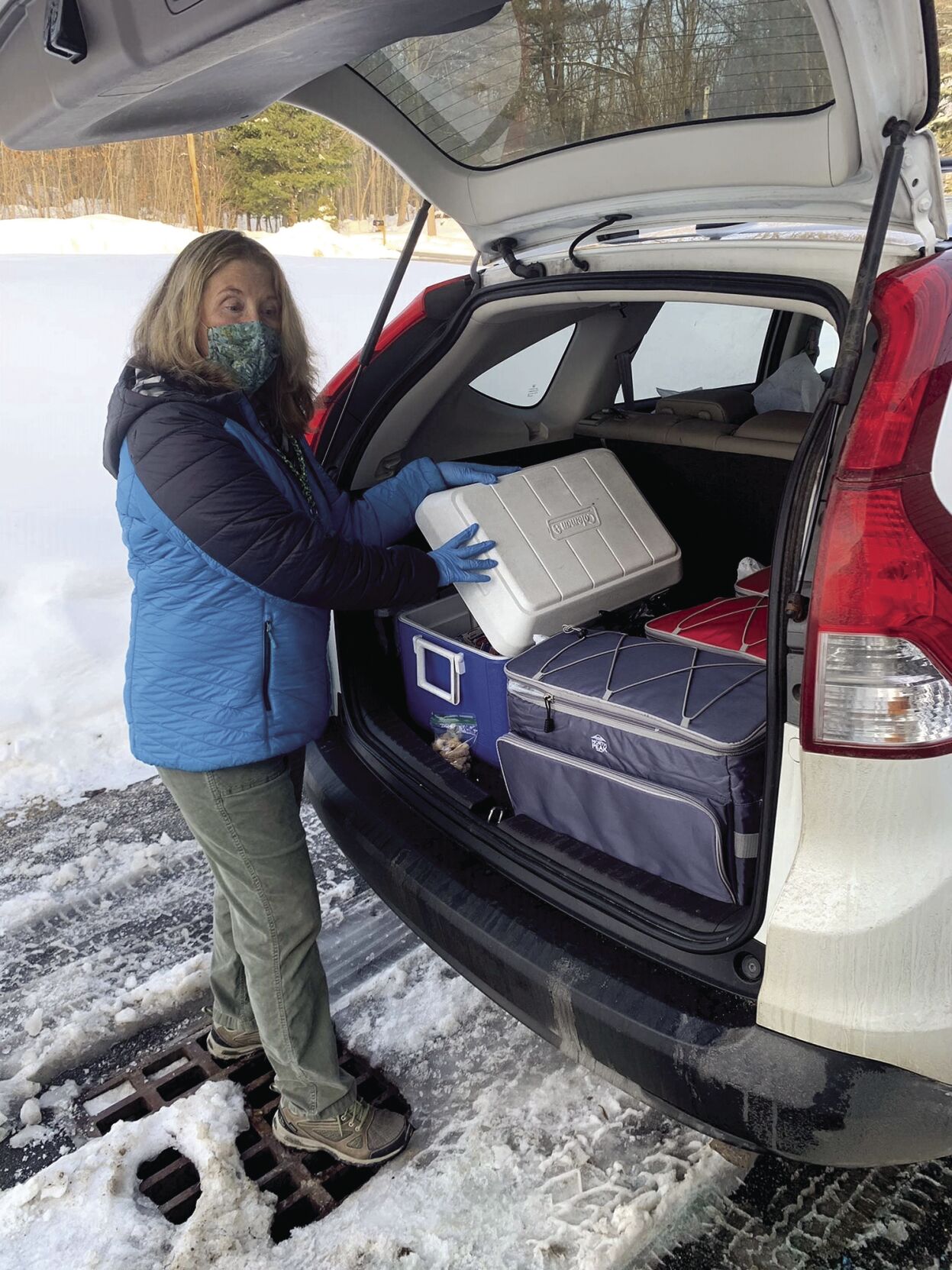
Prior to COVID, Meal on Wheels drivers, in addition to delivering the meals, made a brief personal visit with the recipients on their route. That one-on-one contact has stopped due to COVID. Now drivers drop meals outside the recipient’s door and move on, Tabory explained. The day after the delivery someone from CAP will make a wellness call to the recipient to check how they’re doing.
Tabory put out an appeal for more Meals and Wheels drivers as well as for donations to help support the nutrition program.
Schmidt said COVID is putting stress on people of all ages.
“Some people are struggling with relationship issues,” she said. “Others are turning to substance abuse, or are experiencing eating disorders. I’ve heard of some going on shopping binges on home shopping channels.”
“There’s a lot of anxiety,” agreed the Rev. Neil Wilson, pastor of the Laconia Congregational Church.
In addition to feeling down at a time when everyone is supposed to be merry, there’s the effect brought about from shorter days and longer nights and the prospect of a long winter, he said.
While no member of his church has died of COVID, Wilson said some have lost family members. Funeral rites have either been postponed indefinitely or severely altered because of the pandemic.
“We have not been able to say good-bye the way we are used to,” Wilson said.
Like so many other churches, the Congregational Church will be offering its traditional Christmas Eve services this Thursday, but they will be livestreamed from the church, with the faithful watching at home on their computers. The only ones in the church will be Wilson and church organist Robert Bengtson.
Wilson said while the internet has allowed his church to continue reaching out during the pandemic, he knows that the church building itself is a critical venue in the faith lives of his congregation.
On Sunday, the church held a special time of visitation when parishioners were allowed to come into the church for 20 minutes during which time they could pray silently, meditate, or just listen to the organ music.
Wilson said the idea of the visitation period arose early in the fall when some church members who had donated flowers that were displayed during one of the online services came to the church afterward to pick up the flowers to bring them to someone else. Some were stunned by the emotion they felt as they stepped into the church for the first time since March, he said.
“Tears filled my eyes,” Kathy Giovanni said of the moment she walked into the worship space. “I was overcome for a moment.”
Schmidt said that, for many people, traditional symbols help bring stability and reassurance during these uncertain and unprecedented times. One indication of that, she said, was many Christmas tree lots sold out much faster this year.
"People are doing what they can to bring a special spot of joy into their homes," she said.
“Nothing can take the place of relationships,” Schmidt said, whether it is through connections with others, or with a space, or a custom.
People who are finding these times especially challenging also need to know “it’s OK to ask for help,” she emphasized.
“The key is finding meaning in the midst of chaos,” Schmidt said. “This is where growth happens.”


(0) comments
Welcome to the discussion.
Log In
Keep it Clean. Please avoid obscene, vulgar, lewd, racist or sexually-oriented language.
PLEASE TURN OFF YOUR CAPS LOCK.
Don't Threaten. Threats of harming another person will not be tolerated.
Be Truthful. Don't knowingly lie about anyone or anything.
Be Nice. No racism, sexism or any sort of -ism that is degrading to another person.
Be Proactive. Use the 'Report' link on each comment to let us know of abusive posts.
Share with Us. We'd love to hear eyewitness accounts, the history behind an article.