


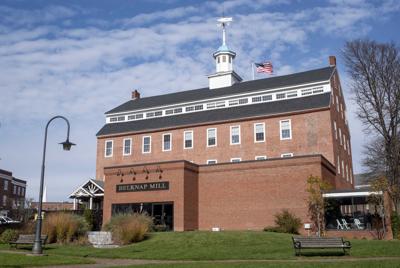
LACONIA — Following a public hearing which garnered mixed opinions, councilors approved a resolution providing $20,000 of health insurance rebate money to the Belknap Mill to assist in making critical structural repairs there.
But there’s a catch.
The funds being transferred to the Belknap Mill are contingent upon its governing nonprofit staff and volunteers fundraising the match to a state-funded Land and Community Heritage Investment Program grant totaling over $37,000. Otherwise, those who oversee the caretaking of the mill may need to wait until the city’s fast-approaching budget season begins.
“Today, we’re just here to ask the City of Laconia for some assistance while we do some structural repairs to the Mill,” board Chair Laura LeMien said. “We have received an L-CHIP grant, but we’re looking for some help with the matching part of that.”
The Belknap Mill is the oldest textile mill of its kind still standing in the country, and it’s also the official meeting house of the State of New Hampshire. It’s operated today as a museum and interpretive center, and event space. The Belknap Mill Society is the nonprofit charged with its care and operation.
Their relationship to the city is atypical. The Mill is located on city property, and frequently plays host to municipal events, such as inauguration of the city council and mayor every two years. They also foot the electric bill for much of the city’s lighting and water at Rotary Park downtown.
The mill building itself is located above the Winnipesaukee River which, in times past, powered machinery used in the manufacturing of products there. At the bottom of the mill sets a sluiceway, which is used to control the movement of water, and therein lies the problem. Water seepage, over decades, has degraded the structural integrity of parts of the mill building.
Mill representatives told councilors at their regular meeting on March 9 that they need immediate assistance in making the necessary repairs. They’ve got $38,000 in-hand, are asking for $20,000, and a representative said they’re “very confident” they’ll get the remaining amount for the $76,000 needed in total for plans, design, engineering and contracting.
“We have a structural stability issue in our sluiceway, it’s where the water runs underneath the building that used to power the turbines. Seven years ago, there was a structural assessment: there are two steel pillars in that area, after decades of being in place they are starting to corrode, they’re approaching end of life,” Kevin Switala, Belknap Mill Society treasurer, said.
The city, in January, received a rebate on an earlier over-assessment on their health insurance payment in the amount of $86,316. At their prior meeting, on Feb. 23, Ward 1 Councilor Jon Hildreth motioned to provide the mill $20,000 to assist in their repairs. The motion passed — the remainder would be deposited into a health insurance stabilization reserve fund.
Debate on March 9, regarded the appropriateness of expending those funds in that manner. Some members of the public wondered if the city should provide tax monies to nonprofit organizations. Some councilors wondered if waiting for the city’s budget process would be most prudent.
“This is taxpayer money. The Mill is a beautiful, beautiful building and it's a nonprofit and the city should not be funding the building,” Ward 6 Councilor Mike Conant said. “As I indicated, we were charged for using the building. I certainly can’t, as a councilman representing taxpayers in my ward, to give away their money to a nonprofit.”
Conant’s reference is to an invoice paid by the City of Laconia, to the tune of some $550, for holding the inauguration ceremony at the Mill in January.
“Whenever we use monies like this for a nonprofit, it’s coming out of taxpayers' dollars — this is not a unique situation,” Hildreth said. “I believe that the situation is dire over there, I also believe that if we don’t act on this, and they don’t get the structure fixed, this is just going to cost more and more as time goes on.”
Switala told councilors there is a defined timeline by which their organization must spend the funds received from L-CHIP, but he did not know what it is. In terms of structural repairs, Switala said, no engineer would provide a defined timeline in terms of the structural integrity of the components, and they’d require immediate attention.
“No structural engineer will give us a specific timeline, they don’t do that because of risk and liability,” he said. “We also have structural beams in the basement that have developed cracks, which may or may not be attributed to the same issue. We need the cracks repaired to stabilize those structural beams in the basement as well.”
The Mill team has apparently held off on hosting larger events due to concerns regarding the building’s structure, complicating matters further without earning that revenue. They can't host events like weddings because, representatives said, a population of the unhoused congregate in and around Rotary Park, making the location difficult to market to couples.
Jennifer Anderson, who was chair of the Mill board for nine years, said she supports the city providing the funds.
“This investment to the structure, I view as an investment to the structure of our community, as the oldest unaltered textile mill in the entire country, and as the official meetinghouse for the State of New Hampshire,” she said. “We have a legacy that I believe should be protected.”
“Seventy-six thousand for this project is a small amount for the annual amount we have to raise to keep the lights on. That total this year is $126,000 to keep the lights on and to do this project, so it’s a significant amount to raise in a community like this,” Switala said.
They arrived at the compromise, which will provide the mill with $20,000, as long as the nonprofit society raises enough to match the L-CHIP grant. Councilors voted 5-1 in favor, with Conant opposed.
“For two years, Rotary Park was taken off of the market, and that’s not included in the COVID situation where they had another two years of shutdowns,” Ward 5 Councilor Steven Bogert said. “For four years, they were not able to do what they needed to do in order to have income coming in. Some of it was caused by federal issues, and some of it was caused by city issues, and it's taken us now a year to get that cleaned up.”


(0) comments
Welcome to the discussion.
Log In
Keep it Clean. Please avoid obscene, vulgar, lewd, racist or sexually-oriented language.
PLEASE TURN OFF YOUR CAPS LOCK.
Don't Threaten. Threats of harming another person will not be tolerated.
Be Truthful. Don't knowingly lie about anyone or anything.
Be Nice. No racism, sexism or any sort of -ism that is degrading to another person.
Be Proactive. Use the 'Report' link on each comment to let us know of abusive posts.
Share with Us. We'd love to hear eyewitness accounts, the history behind an article.